ORGO- quiz 7
 Call Kai
 Learn
 Practice Test
 Spaced Repetition
 Match
 Flashcards
 Knowt Play
1/45

There's no tags or description
Looks like no tags are added yet.
46 Terms
when dealing with the bromium ion, we don’t ever observe what?
the carbocation rearrangement product
since we don’t examine the intermediate step, tell me how the arrows should be drawn in a bromium ion
one arrow breaking off one bromine
another arrow coming from the double bond to the first bromine
and then another arrow going from the lone pair on the first bromine to the carbon that is closest to the tertiary carbon
for the curve arrows on the bromium ion, no ___ shifts
hydrogens
bromine is large enough to …..
reach across the bond

what carbon does bromine share a charge with and why?
shares a charge with the more substituted carbon
shares because it doesn’t want to be positively charged
steps for a bromium ion
after your arrows are drawn, what should you do next?
draw the molecule with bromine sharing a charge with the carbon both in wedge and dash form (it should make something like a triangle)
bromine now has a (+) charge
steps for a bromium ion
what’s your next step?
nuc (leftover bromine/whatever is more nucleophillic) attacks electro (where the lone pairs were drawn to)
bromine that’s been attached now breaks off
steps for a bromium ion
next step?
where the nuc attacks, adjust stereochem
outside stereochem is to stay the same since nothing is happening to it
steps for a bromium ion
is this a chiral center?
make sure to tell if diastereomers, enantiomers, or the same
what is more nucleophillic/basic?
water or bromine
water
when it comes to neutralizing a reaction, what can you do this with?
water (because there is always leftover water in a reaction)
or can neutralize with whatever is leftover in the reaction (ie: HSO4-, Br-, etc)
you create the “triangle” where?
at the ends of the double bonds (which should be closest to the tertiary carbocation because no shifts are required)
the size and availability of electrons will help prevent?
a carbocation formation which is unstable its short an octet

true or false: it doesn’t really matter what X is, as long as it’s connected to a leaving group
true
adding the non-hydrogen thing to the more substituted side of the double bond (aka the more stable carbocation) is what?
markovnikov

adding the non-hydrogen thing to the less substituted side of the double bond (aka the less stable carbocation) is what?
anti-markonikov

these are examples of what?
mark
give me the reactions for anti-mark
1) BH3
2) NaOH, H2O2
give me the reaction for mark
1) Hg(OAc)2, H2O
2) NaBH4
adding halogens anti-mark instead of OH requires the use of?
radicals
we show the movement of radicals using
single headed arrows
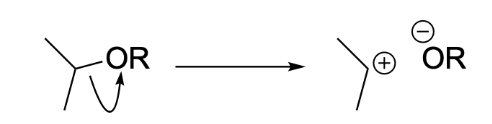
homolytic cleavage
double headed arrow, all electrons are moving the same way

heterolytic cleavage
single headed arrow, electrons are moving in different directions
radicals are not _____
happy to be alone
any molecule that has a radical attached to it that doesn’t want it is now looking to
give the radical away
radicals should be given away
to the atom that would be the most stable with it
stabilizing radicals is similar to
stabilizing electrons

which molecule would be most stable with a radical
Br
peroxides (also known as what?) will make the addition of what?
HOOH
make the addition of anti-mark
1) Hg(OAc) 2, NaOH
2) NaBH4
(OAc)2= leaving group
separate Na from OH, nuc
NaBH4= H-
know how to do radicals for a potential arrow pushing problem
^^

note that this is the intermediate step for mark
^^

intermediate step for mark in more detail
^^
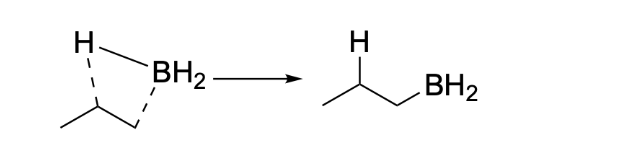
note that this is the intermediate step for anti-mark
^^
anti-mark consists of what two things
inversion of dipoles
radicals
Hg and BH3 are only the addition of ____
OH
if you see H2O2 that means
something is being added to less sub side, adds a radical on the more sub side
the point of a mark reaction is
to avoid rearrangement of a carbocation
OH is added to the more sub side
H is added to the less sub side
what happens in the reaction that allows Br to create the potato chip
Br (and Hg really) have enough electrons to share with the carbocation to fill its octet so no rearrangement is needed, which creates the potato chip
for anti mark… the ____ of polarity allows?
the inversion of polarity allows the H to get on the more sub side
where does the reaction get the addition of H in anti mark
BH3
if asked to give the products of the original mark and anti mark reagents, what should you remember?
to put it in both wedge and dash form
the most stable radical goes on….
the most sub carbon or the most EN thing
H2O2 creates a _____ on _____
radical on the more sub side
for bromium reactions, the nuc is going to add into the ____
most sub carbon
oxymercuration
an organic chemical reaction that adds water and a mercury group across the carbon-carbon double bond (C=C) of an alkene to form an alcohol on the moat sub carbon