TSI Math Cram Review
 Call Kai
 Learn
 Practice Test
 Spaced Repetition
 Match
 Flashcards
 Knowt Play
1/149

There's no tags or description
Looks like no tags are added yet.
150 Terms
Natural numbers
The number 1 or any number obtained by adding 1 to it one or more times. 1, 2, 3, 4, 5, ...
Whole Numbers
Whole numbers do not include fractions or decimal parts and is a positive integer or zero. 0, 1, 2, 3, 4, 5, ...
Integers
Any whole number or its opposite. ..., −5, −4, −3, −2, −1, 0, 1, 2, 3, 4, 5, ...
Rational numbers
A number can that be expressed as a ratio or fraction. • 2/10.6 • 3/10 • 2.957.
Real Numbers
A number that has no imaginary part. All real numbers can be located on a number line. • −92 • 5/9 • √2
Complex Numbers
a + bi where a and b are real numbers and i (imaginary number) is a formal square root of −1 (i= √-1, i 2 = -1). • -1 + 2i • 7 - 9i • -6i
Each number system_____________________.
is a subset of another
A rational number is also___________________.
a real number
A real numbers is also___________________.
a complex number
Standard Number Line
These may have a point for zero and may show negative numbers on the left side of the line. Any positive numbers are placed on the right side of the line.
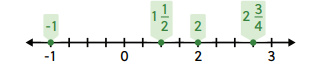
Absolute Value
The distance away from zero a number is on the number line. It is always positive and is written |x|. For example, the absolute value of 2 is written as |2|.

=
equal, is, was, will be, has, costs, gets to, is the same as, becomes
×
times, of, multiplied by, product of, twice, doubles, halves, triples
÷
divided by, per, ratio of/to, out of
+
plus, added to, sum, combined, and, more than, totals of
−
subtracted from, less than, decreased by, minus, difference between
𝑥, n, etc.
what, how much, original value, how many, a number, a variable
The Golden Ratio
φ
Infinity
∞
Euler’s Number
e
Universal Quantifier
∀
Membership Sign
∈
Percent Increase
(new value – original value/ original value) x 100
Percent Decrease
(original value – new value/ original value) x 100
Percent to Fraction/Decimal
Percentage/100
Fraction to Decimal
numerator/denominator
Fraction to Percent
(numerator/denominator) x 100
Decimal to Fraction
decimal/1 x 10n/10n
n
The number of places behind the decimal point.
Decimal to Percent
decimal x 100
Ratios of 6 oranges, 8 apples
Ratio- 6:8, Fraction- 6/8, Written- 6 oranges to 8 apples, Simplified- 3:4
Ratios of 8 trains, 14 cars
Ratio- 8:14, Fraction- 8/14, Written- 8 trains to 14 cars, Simplified- 4:7
Ratios of 4 feet, 3 feet
Ratio- 4:3, Fraction- 4/3, Written- 4 feet to 3 feet, Simplified- 4:3
To simplify a ratio,_________________________________________.
find the greatest common factor (GCF) that divides evenly into all numbers in the ratio. Then, divide every part of the ratio by that same number

Examples of ratios that are part to part

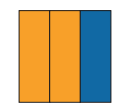
Examples of ratios that are part to whole

Proportions
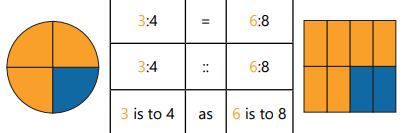
Calculating Proportions
Step #1: Cross-multiply: Multiply the top-left number by the bottom-right number. Then, multiply the bottom-left number by the top-right number.
Step #2: Set products equal: Write an equation with an equals sign between your two new cross-products.
Step #3: Isolate the variable: Use basic division or multiplication to get the unknown letter (like x) all by itself on one side of the equation.
Step #4: Find the answer: Simplify the final number to find the exact value of your variable.
Proper Fraction
The neumerator is less than the denominator. Ex. 1/8
Improper Fraction
The numerator is greater than the denominator. Ex. 8/3
Mixed Number
Whole number and proper fraction together. Ex. 3 1/8
Add or subtract fractions with different denominators
1. Change to equivalent fractions with common denominators using a scale factor.
2. Add or subtract following the rules for fractions with the same denominators.

Add or subtract fractions with the same denominators
1. Add or subtract the numerators.
2. Keep the denominator the same.
3. Simplify if possible.

Multiply fractions
1. Multiply the numerators.
2. Multiply the denominators.
3. Simplify.

Divide fractions
1. Keep the first fraction as is.
2. Change from division to multiplication.
3. Flip the second fraction to its reciprocal.
4. Follow multiplication of fractions rules.

Convert Mixed Number
Keep the original denominator when converting a mixed number to an improper fraction. Simplify if needed.

What is a factor
A whole number is a factor of another whole number if it divides it evenly.
Greatest common factor (GCF)
The greatest common factor of two or more whole numbers is the largest number that is a factor of them all.
Ex. 7: 1, 7
28: 1, 2, 7, 14
GCF: 7
Factor Tree
A tool used in math to break a whole number down into its basic building blocks called prime factors.

What is a multiple?
A whole number is a multiple if it is the result of multiplying another whole number by an integer.
Least Common Multiple (LCM)
The least common multiple of two or more whole numbers is the smallest number that is a multiple of them all.
Ex.
3: 3, 6, 9, 12, 15, 18, 21, 24
7: 7, 14, 21, 28, 35, 42, 49, 56
LCM: 21
Parts in an algebraic expression
terms, variable, constant, coefficients, and operator
Terms
Individual “pieces” in an algebraic expression. Ex. 4x+6y-17
Variable
A symbol, typically a letter, that refers to an unspecified mathematical object. Ex. 4x+6y-17
Constant
A fixed value that does not change throughout the problem or expression. Ex. 4x+6y-17
Coefficients
A constant factor of a term as distinguished from a variable. Ex. 4x+6y-17
Operator
A symbol or function that indicates an action to be performed on one or more values. Ex. 4x+6y-17
PEMDAS
Parentheses, Exponents, Multiplication/Division, Addition/Subtraction
a1 = a
Any number to the power of 1 is equal to itself
1n= 1
The number 1 raised to any power is equal to 1
a0 = 1
Any number raised to the power of 0 is equal to 1
a^n× a^m = a^n+m
Add exponents to multiply powers of the same base number
a^n ÷ a^m = a^n-m
Subtract exponents to divide powers of the same base number
(a^n )^m = a^n×m
When a power is raised to a power, the exponents are multiplied
(a × b)^n = a^n × b^n
Multiplication operations inside parentheses can be raised to a power
(a ÷ b)^n = a^n ÷ b^n
Division operations inside parentheses can be raised to a power
a^−n = 1/a^n
A negative exponent is the same as the reciprocal of a positive exponent
FOIL
Multiply the first terms of each binomial.
Multiply the outer terms.
Multiply the inner terms.
Multiply the last terms of each binomial.
Quadratic Equation
An equation where the variable x represents an unknown number, and a, b, and c represent known numbers, where a ≠ 0.
Quadratic Formula: Standard Form

Quadratic Formula: Equivalent Form

Polynomials
Mathematical expressions consisting of variables, coefficients, and constants combined using addition, subtraction, and multiplication.
Monomial Polynomial
One term. Ex. 5x³
Binomial Polynomial
Two terms. Ex. x + 2
Trinomial Polynomial
Three terms. Ex. x²+3x-4
Function
A relation between a set of inputs and a set of outputs where each input is related to exactly one output.

Constant Functions
f(x) = a
The Identity Function
f(x) = x
Linear Functions
f(x) = ax + b
The Squaring Function
f(x)= x²
Quadratic Functions
f(x) = ax2 + bx + c
Polynomial Functions
f(x) = an xn+ an−1xn−1 + ⋯ + a2 x2 + a1 x + a0
Rational Functions
f(x) = P(x)/Q(x)
The Square Root Function
f(x) = √x

Area of a square
A = l²

Area of a Rectangle
A = lw

Area of a parallelogram
A = bh

Area of a triangle
A = ½ bh

Area of a trapezoid
A = ½ (b1 + b2 )h

Area of a rhombus
A = ½ (d1 × d2 )

Area of a circle
A = πr²

Area of an ellipse
A = πab
Perimeter
The sum of all sides of a shape.
Circumference
The distance around a circle (C=2πr).

Volume and surface area of a cube
SA = 6s²
V= s³

Volume and surface area of a rectangular prism
V= l x w x h
SA= 2(lw+lh+hw)

Volume and surface area of a triangular prism
V= b x h x l/2
SA= lsa + 2 (area of base)

Volume and surface area of a cylinder
V=πr²h
SA= 2πr(r+h)

Volume and surface area of a cone
V= π²h/3
SA= πrs + πr²

Volume and surface area of a rectangular pyramid
V= l x w x h/3
SA= lsa +area of base