Early Human Embryonic Development
 Call Kai
 Learn
 Practice Test
 Spaced Repetition
 Match
 Flashcards
 Knowt Play
1/130

There's no tags or description
Looks like no tags are added yet.
131 Terms
Germinal stage: what happens?
Cells divide into more cells; no organs form
Embryonic stage: what happens?
Organs begin to form (organogenesis); after week 8 the embryo looks human
Fetal stage: what happens?
Organs mature, each on its own timeline
What is the all-or-none principle?
In the first 2 weeks, damage either kills only some cells (the rest develop normally) or causes miscarriage/failure to implant
Which weeks are the essential (most sensitive) time for teratogens?
Weeks 3-8
Red vs. yellow bars on the critical period chart
Red: more sensitive, a teratogen causes a severe defect; yellow: less sensitive, the organ develops but malfunctions
Examples of teratogens
Chemicals, medicines, pollution, tobacco, disease, obesity, untreated diabetes
When are teeth most vulnerable to severe damage?
About weeks 6-8
What happens if teeth are affected from week 9 to birth?
Functional anomalies (not severe structural defects)
Critical window for the palate, and the result of a hit
About week 6 to just past week 8; causes cleft palate with speech and breathing problems
What might a teratogen hit to the palate in weeks 9-12 cause?
Possibly no obvious symptoms (normal eating and breathing), but speech may be affected
Another name for the fallopian tube
Oviduct
How does the zygote divide?
Mitosis (2-cell, 4-cell, etc.)
Morula: cell number, timing, and potency
16-32 cells at about day 4; cells are totipotent
When does the blastocyst form, and what does it do next?
Day 5; it hatches from the zona pellucida and implants
Sperm vs. egg meiosis
Sperm: meiosis I and II from puberty, giving 4 sperm; egg: secondary oocyte arrests and finishes meiosis only when a sperm enters
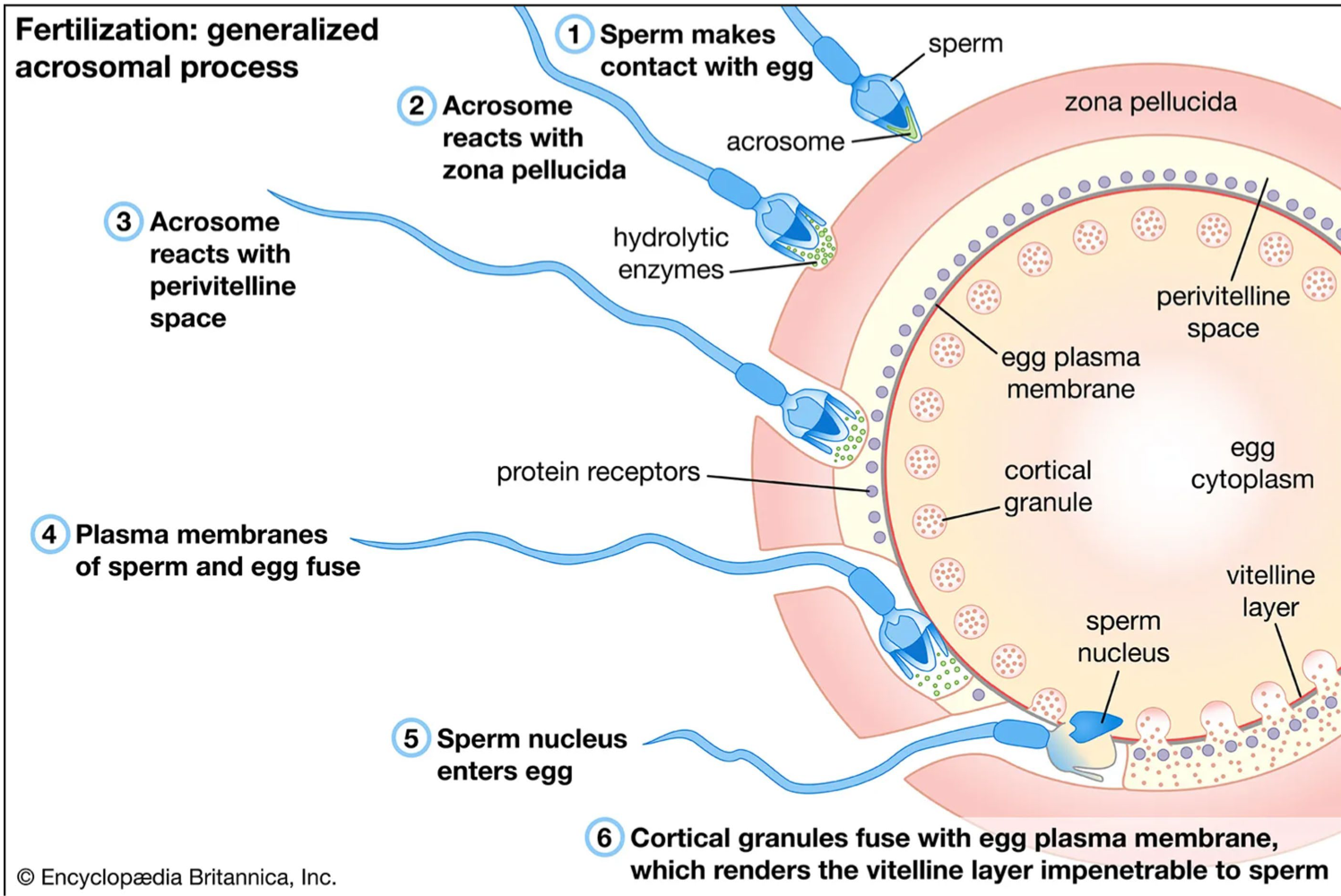
What breaks down the zona pellucida during fertilization?
Hydrolytic enzymes released in the acrosomal reaction

How does the cortical reaction prevent polyspermy?
Cortical granules merge with the egg plasma membrane after the first sperm enters, blocking other sperm
When does gastrulation occur?
Weeks 2-3
What is capacitation?
Final activation of sperm in the female reproductive tract that enables it to undergo the acrosomal reaction and fertilize the egg
What happens during the acrosomal reaction?
The acrosome releases hydrolytic enzymes that digest through the zona pellucida so the sperm can reach and fuse with the egg membrane
What is polyspermy?
Fertilization of an egg by more than one sperm (abnormal; prevented by the cortical reaction)
What is the goal of neurulation?
To form the neural tube, which becomes the brain and spinal cord (CNS), and to release neural crest cells
Where do the epiblast and hypoblast come from?
The inner cell mass (embryoblast)
Gastrulation: what does each germ layer come from?
Epiblast cells migrate and replace the hypoblast -> endoderm; remaining epiblast -> ectoderm; cells migrating in between -> mesoderm
How does the primitive streak form?
By invagination and proliferation on the epiblast
What polarity does the primitive streak set?
Cranial vs. caudal, dorsal vs. ventral, left vs. right
Membrane at the cephalic vs. caudal end of the disc
Cephalic: oropharyngeal membrane; caudal: cloacal membrane
Steps of neurulation
Flat neural plate -> neural groove -> closes into the neural tube
3 roles of the notochord
Supports the embryo
guides the neural tube
induces overlying ectoderm to undergo neurulation
Are neural crest cells derived from ectoderm or mesoderm?
Ectoderm
What forms the pharyngeal arches?
Neural crest cells mixing with mesoderm
What forms cranial to caudal as the neural tube closes?
Aortic arch vessels, pharyngeal arches, somites
How severe are neural tube defects?
Varies: some have no obvious symptoms until found; others are lethal
Examples of neural tube defects
Anencephaly, encephalocele, craniorachischisis, iniencephaly, spina bifida occulta, meningocele, myelomeningocele
How are neural tube defects prevented?
Folic acid supplementation
Which germ layer forms enamel?
Surface ectoderm
Which germ layer forms most of the tooth?
Neural crest: dentin (odontoblasts), cementum, pulp, PDL
Which germ layer forms most craniofacial bone and cartilage?
Neural crest
Dental one-liner for germ layers
Enamel = surface ectoderm; everything else in the tooth + most craniofacial bone = neural crest
Adenohypophysis vs. neurohypophysis origin
Adenohypophysis: surface ectoderm; neurohypophysis: neural tube ectoderm
Neural tube ectoderm derivatives
CNS, retina, pineal gland, neurohypophysis
Head mesoderm derivatives
Skull, cranial muscles, connective tissue of head muscles
Paraxial mesoderm derivatives
Some head muscles, trunk/limb muscles, axial skeleton, dermis
Endoderm derivatives
Lining of the gut and respiratory tract, thyroid, parathyroid, liver, pancreas, bladder lining
The 3 folds of embryonic folding
Head fold and tail fold (longitudinal) and lateral folds (transverse)
What do the lateral folds form?
The gut cavity (they wrap around)
What becomes visible after embryonic folding?
The pharyngeal arches
How many pharyngeal arches are there, and when do they appear?
Six pairs; weeks 4-5
3 components of each pharyngeal arch
Endodermal pouch (inside), mesenchymal core (neural crest + mesoderm), ectodermal cleft (outside)
What 4 structures does each arch's core contain?
Its own artery, nerve, muscle, and cartilage
How many pouches and clefts are there?
4 pouches (endoderm) and 4 clefts (ectoderm)
1st cleft derivative
External auditory meatus
Why do clefts 2-4 form the cervical sinus?
Arch 2 overgrows arches 3 and 4
Pouch derivatives 1-4
1: Eustachian tube and tympanic cavity
2: palatine tonsil
3: thymus and inferior parathyroids
4: superior parathyroids and ultimobranchial body (thyroid C cells)
What are placodes?
Surface epithelial thickenings (like the optic placode) that form ganglia
Placode -> ganglion for arches 1-4
1: trigeminal; 2: geniculate; 3: inferior sensory ganglion of CN IX; 4: inferior sensory ganglion of CN X
1st arch: nerve
CN V (V3)
1st arch: cartilage and bones
Meckel's cartilage; maxilla, mandible, zygomatic, squamous temporal; malleus, incus
1st arch: muscles
Muscles of mastication, mylohyoid, anterior digastric, tensor veli palatini, tensor tympani
1st arch: ligaments
Sphenomandibular; anterior ligament of malleus
2nd arch: nerve
CN VII
2nd arch: cartilage and bones
Reichert's cartilage; stapes, styloid process, upper hyoid body, lesser horn
2nd arch: muscles
Muscles of facial expression, stylohyoid, posterior digastric, stapedius
2nd arch: ligament
Stylohyoid ligament
3rd arch: nerve, skeleton, muscle
CN IX; lower hyoid body and greater horn; stylopharyngeus
Does Meckel's cartilage form the mandible?
No; it guides the mandible as a scaffold but does not form mandibular bone
Fates of Meckel's cartilage
Rostral: persists at the symphysis; main body: resorbs; proximal: malleus and incus; intermediate: jaw-ear ligaments
Do the maxilla, zygomatic, and temporal bones come from Meckel's cartilage?
No; they're related to the 1st arch but don't originate from Meckel's cartilage
Tongue development: week 4
Three swellings: two lateral lingual swellings and the median tuberculum impar
Tongue development: weeks 4-5
Lateral swellings overgrow the tuberculum impar and fuse -> anterior 2/3 (arch 1)
Tongue development: weeks 5-6
hypopharyngeal eminence adds arch 3 and 4 tissue → posterior tongue
arch 4 → epiglottic region
Tongue innervation by arch
Arch 1 (V3): anterior 2/3 sensation; arch 2 (VII): anterior 2/3 taste; arch 3 (IX): posterior 1/3 sensation + taste; arch 4 (X): base sensation, taste, palatoglossus motor
Which nerve gives most tongue motor?
CN XII (all except palatoglossus, which is CN X)
Why does the tongue have segmented innervation?
It develops from four separate pharyngeal arches
Treacher Collins: oral/craniofacial clues
Micrognathia
underdeveloped cheekbones
downslanting eyes
lower eyelid coloboma
small/absent ears → conductive hearing loss
airway restriction, possible cleft palate
Treacher Collins: gene and mechanism
TCOF1; impaired ribosome biogenesis -> apoptosis of neural crest precursors -> altered arch 1 and 2 structures
Treacher Collins: dental relevance
Micrognathia, malocclusion, airway planning, coordinated craniofacial/orthodontic care
Ectodermal dysplasia: oral clues
Hypodontia/anodontia, conical teeth, delayed eruption, reduced alveolar ridge
Ectodermal dysplasia: other clues
Sparse/brittle hair, little or no sweating, abnormal nails/skin, dry eyes, hearing loss
Ectodermal dysplasia: pathway and dental relevance
EDA -> EDAR -> NF-kB disruption; early diagnosis and growth-adapted management of missing/malformed teeth
Holoprosencephaly: oral/craniofacial clues
Single central maxillary incisor, cleft lip/palate, midface hypoplasia, hypotelorism; severe: cyclopia, proboscis
Holoprosencephaly: developmental basis
Failure of fusion/separation of forebrain midline, often SHH disruption
Gardner's syndrome: oral clues
Impacted and supernumerary teeth, odontomas, abnormal eruption, multiple jaw osteomas
Gardner's syndrome: systemic clues
Colon polyps, desmoid tumors, epidermoid cysts, dark retinal spots
Gardner's syndrome: gene and dental relevance
APC/Wnt; jaw and dental signs may precede intestinal symptoms, allowing early recognition of FAP
Syndrome gene/pathway associations
TCOF1: Treacher Collins; EDA/EDAR/NF-kB: ectodermal dysplasia; SHH: holoprosencephaly; APC/Wnt: Gardner
Germinal stage (proliferative)
0-2 weeks
Embryonic period (organogenesis)
3-8 weeks
Fetal period
9 weeks-birth
When do tooth buds appear?
Weeks 9-15
Week _ is a critical time for teeth and palate development to begin.
6
The order of embryogenesis
Fertilization
Cleavage & blastula stage
Gastrulation
Neurulation
What is the blastocyst?
Hollow ball of cells with a cluster of cells inside known as the inner cell mass
What comprises the blastocyst?
Embryoblast (forms embryo)
Trophoblast (forms placenta)
How is sperm cell formation different from egg cell formation?
Meiosis II is stimulated by sperm for egg cells
Sperm cell formation forms 4 sperm; egg cell formation forms 1 egg cell and 3 polar bodies
Fusion of male and female pronuclei = ...
Zygote
How many chromosomes does a zygote have?
46 (23 sperm + 23 egg)
What do the acrosome and zona pellucida allow for?
Capacitation and acrosomal reaction of sperm
What does the acrosomal reaction result in?
Cortical reaction