Psychology Lectures 5–8: Learning, Memory, Intelligence, Development Study Guide
 Call Kai
 Learn
 Practice Test
 Spaced Repetition
 Match
 Flashcards
 Knowt Play
1/235

There's no tags or description
Looks like no tags are added yet.
236 Terms
What is classical conditioning?
A learning process where two stimuli are paired together to elicit a response.
What does S1 represent in classical conditioning?
The first stimulus, which can signal the arrival of a second stimulus (S2).
What is the role of a neutral stimulus (NS)?
It is a stimulus that initially does not elicit a response until paired with an unconditioned stimulus.
What is a conditioned stimulus (CS)?
A previously neutral stimulus that, after being paired with an unconditioned stimulus, elicits a conditioned response.

What is an unconditioned stimulus (UCS)?
A stimulus that naturally and automatically triggers a response without prior training.
What is an unconditioned response (UCR)?
The natural response elicited by an unconditioned stimulus.
What is a conditioned response (CR)?
A learned response to a previously neutral stimulus that has become a conditioned stimulus.
What is higher-order conditioning?
A process where a conditioned stimulus is paired with a new neutral stimulus to create another conditioned stimulus.
How does aversive conditioning occur?
A neutral stimulus is paired with an aversive event, leading to a conditioned response of fear or anxiety.
What is fear conditioning?
A type of classical conditioning where an aversive stimulus (like shock) is paired with a specific environment or cue.
What happens when an animal is re-exposed to a conditioned stimulus?
The animal expects the unconditioned stimulus associated with that conditioned stimulus.
What is the significance of the metronome in classical conditioning?
It serves as an example of a conditioned stimulus that signals an unconditioned stimulus.
What is the typical outcome of repeated pairings in higher-order conditioning?
Each successive conditioned stimulus elicits a weaker conditioned response.
What is the relationship between NS and UCS in aversive learning?
The neutral stimulus becomes a signal for the unconditioned stimulus, leading to a conditioned response.
What is stimulus generalization?
The greater the similarity in physical characteristics, the greater the tendency for a response.

What was the case of Little Albert?
Little Albert learned to fear white, furry objects after they were paired with loud noises.
What is conditioned taste aversion (CTA)?
A learned avoidance of a particular food that has been associated with illness.
What is latent inhibition?
A familiar stimulus is less suitable for conditioning because it has been experienced many times in a neutral context.
What is blocking in classical conditioning?
Once a UCS has been paired with a CS, it becomes difficult to pair that UCS with other CS in the future.
What happens during extinction in classical conditioning?
If UCS-CS pairings stop, the conditioned response (CR) will decline, indicating a suppression of learned associations.

What is reinstatement in the context of extinction?
The return of the CR to full strength following a single US alone after extinction.
What is spontaneous recovery?
A rebound increase in the CR after a prolonged time following extinction.
What is renewal in classical conditioning?
The phenomenon where extinction is specific to context, allowing the CS to elicit a CR in new contexts.
What is positive reinforcement?
Adding something to reward a behavior, increasing its frequency.

What is negative reinforcement?
Removing something to reward a behavior, thereby increasing its frequency.
What is negative punishment?
Removing something to punish a behavior, decreasing its frequency.
What is a token economy?
A system where tokens are earned for good behavior and can be exchanged for rewards.
What is applied behavior analysis (ABA)?
An intensive study of behavioral patterns to encourage certain behaviors, often used for children with autism.
What is the difference between continuous and fixed interval reinforcement schedules?
Continuous reinforcement follows every response, while fixed interval reinforcement occurs after a specific time period.

What is a variable ratio reinforcement schedule?
A reinforcement schedule where a varying number of responses must occur before reinforcement is given.

What is observational learning?
Learning that occurs by witnessing the experiences of another, without direct experience.
What is latent learning?
Learning that is not immediately expressed and may require incentives to be revealed.
What are the benefits of longhand note-taking compared to laptop note-taking?
Longhand note-taking may enhance learning due to reduced distractions and increased engagement.
What is dual coding theory?
The idea that pairing note-taking with mental imagery can enhance learning.
What is spaced practice?
A learning technique that involves spreading out study sessions over time for better retention.
What are some potential advantages of using AI in learning?
Accessibility, cost-effectiveness, time efficiency, and personalized learning experiences.
What are some concerns regarding the use of AI in education?
Overreliance leading to reduced independence, cognitive off-loading, and issues with academic integrity.
What are different learning styles mentioned in the notes?
Visual, auditory, reading, kinesthetic (VARK), though the effectiveness of tailored methods is debated.
What is the process of memory?
The process by which information is stored, consolidated, and retrieved.
What are the three types of memory stores?
Sensory memory, short-term memory (STM), and long-term memory (LTM), each with different properties.

What is the duration of sensory memory?
Sensory memory varies by type and is limited by decay over time.
What is the capacity of short-term memory?
Short-term memory can hold a limited amount of information before it decays.
What is echoic memory?
A type of sensory memory with a very short duration, typically lasting seconds or less.
How does iconic memory compare to echoic memory?
Iconic memory has a much shorter duration than echoic memory.
What is the capacity of echoic memory?
Theoretically large but functionally small, as only a few stimuli can be attended to or reported.
What is short-term memory (STM)?
A mental sketchpad where information usually decays if not rehearsed, lasting about 15-30 seconds without rehearsal.
What is the digit span task?
A test measuring the longest string of digits a person can remember without error, with a population average of about 7.
What is chunking in memory?
Dividing a body of information into meaningful groups to enhance memory capacity.
What happens to STM capacity if chunking and rehearsal are prevented?
Capacity may drop to as little as 3 items.
What are the two forms of rehearsal?
Maintenance rehearsal (simple repetition) and elaborative rehearsal (relating information to other concepts).
What is working memory (WM)?
A system that manages and manipulates information, involving several processes working together.
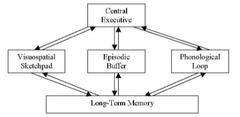
What is the OSPAN test?
A measure of working memory that involves tracking words while performing math tasks.
What is the primacy effect?
The tendency to better remember the first items in a list.

What is the recency effect?
The tendency to better remember the last items in a list.
What are the two types of long-term memory?
Declarative memory (episodic and semantic) and non-declarative memory.

What is episodic memory?
A person's unique memory of an event from their perspective, often described as 'remembering.'
What is semantic memory?
General knowledge that anyone could know, often referred to as 'knowing.'
What is non-declarative memory?
Memory that influences future behavior without requiring conscious recollection, such as skills learned through experience.
What is a retrieval failure?
A situation where a memory exists but cannot be accessed, often described as being on the 'tip of the tongue.'
What is the misinformation effect?
When a person's memory of an event is altered by misleading information after the event.
What is source monitoring?
The process of identifying the source of information, which can lead to errors in memory.
What is the role of schemas in memory?
Schemas are cognitive frameworks that help fill in memory gaps and influence how we recall events.
What is the significance of eyewitness testimony?
Eyewitness testimony is crucial in the legal system but can be unreliable, leading to wrongful convictions.
What is the relationship between emotional arousal and memory?
Memory for central, arousing details is often strong, while memory for peripheral details is comparatively poor.
What are false memories?
Memories that may be inadvertently created by interactions with law enforcement, media, or therapists.
What are repressed memories?
Aversive memories that are too traumatic to handle and may be hidden beneath consciousness.
What is mood-congruent memory?
The tendency to recall information that is consistent with one's current mood.
What is genetic variation?
The presence of different alleles within a population that can lead to differences in traits and behaviors.
What is heritability?
The proportion of phenotypic variation in a population that is attributable to genetic variation.
What are monozygotic twins?
Identical twins that arise from a single fertilized egg that splits into two.
What are dizygotic twins?
Non-identical twins that arise from two separate eggs fertilized by two different sperm.
What is heritability (H2)?
Heritability (H2) is expressed as H2 = VG / VP, where VG is genetic variance and VP is phenotypic variance.
Which psychological traits are considered heritable?
Traits such as personality, intelligence, ideology, religiosity, and psychological disorders are considered heritable.
What factors besides genes influence heritability?
Environment and randomness also play a role in heritability.
What is a key limitation of heritability estimates?
Heritability estimates can be inaccurate or misleading and are context-specific.
What does the nature vs. nurture debate imply?
It implies that both genetic and environmental factors are significant and interact with each other.
Why do certain traits become common in a population?
Traits that enhance reproductive fitness or disease resistance tend to become more common.
What is the significance of G x E interactions?
G x E interactions indicate that genes can affect how individuals respond to their environment.
What is the typical heritability estimate for psychological traits?
Earlier estimates were around 0.4-0.5, while later estimates using molecular methods are around 0.1-0.2.
What is intelligence defined as?
Intelligence is the capacity to acquire and apply knowledge and skills.
What is the 'g' factor in intelligence?
'g' refers to general intelligence, which is a common factor underlying various cognitive abilities.

What does the positive manifold refer to?
The positive manifold refers to the tendency for individuals to score similarly across different cognitive tests.
What statistical method is used to estimate the g factor?
Factor analysis is used to estimate the g factor based on correlations between different tests.
What is WAIS testing?
WAIS testing includes various subtests to measure different aspects of intelligence, such as verbal comprehension and perceptual reasoning.
What is the median IQ score and standard deviation?
The median IQ score is 100 with a standard deviation of 15.
What is the Dunning-Kruger effect?
The Dunning-Kruger effect is a cognitive bias where individuals with low ability overestimate their competence.
How is IQ related to success in professions?
IQ is positively correlated with success, especially in highly complex jobs.
What are some correlates of IQ?
IQ is positively correlated with longevity and height, and negatively correlated with criminal behavior and divorce rates.
What is the Flynn Effect?
The Flynn Effect refers to the observed increase in IQ scores over time, suggesting environmental influences.
What is a limitation of cognitive training for increasing intelligence?
Most cognitive training treatments have failed to produce lasting increases in cognitive ability.
What role do genes play in intelligence?
Genes may influence the choice of activities that maximize IQ and the benefits derived from those environments.
What are G x E correlations?
G x E correlations occur when genetic predispositions influence the environments individuals choose.
What is the relationship between intelligence and leadership performance?
Measures of intelligence are correlated with leadership performance, but the relationship may be non-linear.
What is pleiotropy in genetics?
Pleiotropy refers to a single gene regulating multiple traits.
What are barriers in cognitive testing?
Language ability and cultural differences can affect the applicability of cognitive tests across different groups.
What is the importance of using less language-dependent tests?
Using tests like Raven's Matrices can reduce the influence of language and culture on cognitive assessment.
What are some harms induced by bad environments?
Low resources, malnutrition, pollution, poor relationships, stress, unsafe living conditions, and labor demands.
What is a scarcity mentality?
A mindset where lack of resources leads to impaired cognition and potential declines in IQ.
What is the difference between a fixed mindset and a growth mindset regarding intelligence?
A fixed mindset views intelligence as innate and unchangeable, while a growth mindset believes intelligence can be developed through effort and challenges.
How is reaction time (RT) correlated with IQ?
RT is negatively correlated with IQ; higher IQ is associated with faster reaction times.