Water Disinfection
 Call Kai
 Learn
 Practice Test
 Spaced Repetition
 Match
 Flashcards
 Knowt Play
1/38

There's no tags or description
Looks like no tags are added yet.
39 Terms
Significance of water chlorination
Significant public health achievement, preventing high rates of contamination of bacteria, viruses, protozoa
Why is water treatment necessary
Eliminates pathogens that pose an acute risk to human health (viruses, bacteria, protozoa). WHO requirement is that water must be free from microorganisms, chemical substances and radiological hazards that pose a threat to a person’s health
What is the acute microbial risk of unsafe water
Unsafe water, improper sanitation, or poor hygiene is the cause of 88% of diarrheal deaths
99% in developing countries
84% of which are children
Concerns about contaminated drinking water are not limited to developing countries: there are still plenty of drinking water advisories
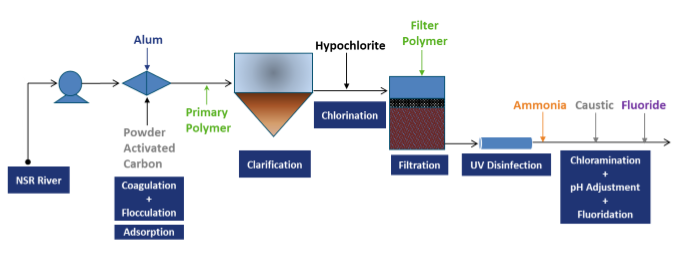
How does water treatment work in Edmonton?
Water comes from North Sask to a water treatment plant
Coagulation + Flocculation: add Alum to water - cation will bind to negative organic compounds, making a jelly like substance. Powder activated carbon also added in special occasions
Clarification - using gravity, jelly falls to bottom, and top cleaner layer is used
Chlorination - add hypochlorite
Filtration
UV disinfection
Ammonia added to remove the chlorine = chloramination
Caustic added for pH adjustment
Fluorine added to water to improve dental health
What are disinfection byproducts (DBPs)
Chemicals unintentionally formed when water disinfectants react with natural organic matter and contaminants in source water

When were DBPs discovered
Trihalomethanes discovered in 1974, with first guidlines developed in 1978
Examples of regulated DBPs
Trihalomethanes
Haloacetic acids (HAA5)
Inorganic DBPs (bromate, chlorite, chlorate)
N-Nitrosodimethylamine (NDMA)
Are we aware of all the DBP’s in our water?
No. We only know about 30% of total organic halogens
What is the human health risk of DBPs in our water?
>100 DBPs have shown to be cyto- and/or genotoxic in in vitro toxicity studies (Chinese hamster ovary cells)
Halogen trend of toxicity of DBPs
Iodinated > Brominated > Chlorinated
Lucky for us, we don’t have much halogens except chlorine
Epidemiological evidence for DBP risk for human health risk
Association of consumption of chlorinated tap water with increased risk of bladder cancer, colorectal cancer, and reproductive/developmental outcomes observed. No conclusive proof
What is the goal/balancing act of water disinfection
Completely inactivating pathogens while minimizing chronic chemical risk of DBPs
Why is changes to source water a huge challenge in water treatment
Globally, quantity and quality of freshwater sources are in decline, increasing complexity of precursor pool for DBP formation
In some places, water scarcity has led to municipalities adding highly treated wastewater blended into source water. This has shown increased amounts of estrogens, pharmaceuticals, and personal care products in water
What are the water reuse (adding wastewater to water) implications for DBPs
Effluent organic matter contains higher levels of organic nitrogen, causing formation of N-DBPs. N-DBPs have been shown to be more toxic than C-DBP’s
What have been some changes to water chemical treatment practices
In response to DBP regulations, utilities sought new disinfection technologies. Companies have been relying less on chlorine. and adding chloramine as a disinfectant
Issue of adding chloramine to water as a water disinfectant
Chloramination has been shown to promote formation of nitrosamines like NDMA, which are potent carcinogens
Water 1 has only added chlorine to treatment, while water 2 has added chloramines. What do the graphs indicate?
Water 2 has a smaller mass of DBPs in the water, but water 2 has more toxic DBPs. Water 2 is unsafer

What are the implications of DBP regulations
Water treatment plants need to control pathogens, regulated DBPs, and emerging DBPs of interest. Engineers will design systems that meet regulations, reaffirming the need to prioritize which DBPs to control
What are the challenges in distributing treated water?
Following water treatment, disinfected water flows through a distribution system, with residual chlorine levels being maintained to prevent opportunistic pathogens. However, DBP concentrations have exhibited temporal and spacial variations (increased nitrosamines)
DBP Transformation within water distribution system
Increased concentration of Nitrosamines with increased distance from treatment plant
DBPs could also form from residual disinfectant reacting with pipes, biofilm, deposits, etc
Measurements taken at water treatment plant may not be representative of water being used by end users (issue for epidemiologic studies
What are the 3 main challenges in water treatment
Changes to source water (adding waste water)
Changing chemical treatment practices (adding chloramines)
Challenges in the distribution system (more DBPs further from treatment plant)
Two approaches to research projects on water DBPs
Targeted analysis - detecting and quantifying pre-identified, specific substances within a sample
Nontargeted analysis - identify unknowns without prior knowledge regarding the chemical content of samples
Analytical workflow of water treatment researcg projects
Sample prep of water —> chromatographic separation —> MS detection —> data analysis
What is the EPCOR Spring Home Analysis Runoff Program (SHARP)
300 home analysists from across Edmonton monitor intensity and provide odor descriptor of water, and this information is used by water treatment operators to make informed decisions about control measures
Issue of spring runoff on water quality
Snowmelt can lead to increased organic matter entering source water, corresponding with complaints about water odor by end-users
What chemical marker can be used to predict a time to increase water treatment during spring runoff?
Amino acids in source water spike significantly before SHARP program reports odorous water

How do amino acids in spring water cause odorous water?
Amino acids combine with chlorine (treatment) to produce N-Chloroaldimines
What analytical techniques were used to isolate and identify N-chloroaldimine formation in drinking water?
Chromatography isolated the compound
High resolution MS was used for non-targeted analysis
Triple quadrupole mass spec used for targeted analysis

What were the conclusions made by the amino acid water study in edmonton?
Chlorine can effectively inactivate pathogens, but complex organics in source water can react with chlorine to produce odorous and non-odorous DBPs. Amino acids can indicate the onset of spring run off
Effects of tire-leaching compounds on water quality
Rubber derived chemical 6PPD can react with ozone to produce 6PPD-Q, which induces mortality in Coho salmon

What is the knowledge gap between tire-leaching compounds in source water and DBP formation?
Rainfall and snowfall carry 6PPD and 6PPD-Q into source water, which have serious effects on aquatic populations. However, there is limited understanding of how tire compounds will transform into DBPs (known as TPs, transformation products)

Objectives of the tire-leaching chemical water study
Investigate the transformation products (TPs) of 6PPD and 6PPD-Q during chlorination
Investigate the effects on treatment conditions (chlorine dose and pH)
Estimate the toxicities of 6PPD and 6PPD-Q and their TPs
Methods used to detect and identify unknown Transformation products of 6PPD and 6PPD-Q
Non-targeted analysis: identify unknowns and incorporate machine learning tool ChloroDBPFinder
Suspect screening analysis - compare molecular features to database of known or suspected chemicals
Optimal Chlorine Dose that caued formation of Cl-TPs from 6PPD
Favored at the molar ratio of 5:1 Cl2 : 6PPD

Optimal pH of disinfection that favored formation of 6PPD Transformation products
High pH (8) - hypocholorite ions predominant, and have a high reactivity with neutral precursors

Of the Chlorinated TPs, how were they evaluated for toxicity
US Environmental Protection Agency (EPA) developed Quantitative Structure Activity Relationship model, estimated the toxicity based on structure
Determined by 96 hour fathead minnow 50% lethal concentration (LC50)
Toxicity of Cl-TPs from 6-PPD
TP 315 and TP 317 were 9 and 7 times more toxic than 6PPD

Toxicity of Cl-TPs from 6PPD-Q
Toxicity increased with number of substituted chlorine atoms.
TP 293, 309, and 325 signficantly more toxic than 6PPD-Q
Conclusions of the 6PPD and 6PPD-Q Cl-TP study
Identified 12 and 28 Cl-containing TPs of 6PPD and 6PPD-Q, with 9 and 15 of these being novel
TPs formed predominantly at 5:1 Cl:Precursor molar ratio and at pH 8
Excess oxidative and acidic conditions might transform TPs to other DBPs
Many TPs were more toxic than the parent compounds, posing health risks to aquatic species and humans