Resilience
 Call Kai
 Learn
 Practice Test
 Spaced Repetition
 Match
 Flashcards
 Knowt Play
1/26

There's no tags or description
Looks like no tags are added yet.
27 Terms
What is resilience?
The ability to adapt or cope successfully with adversity or traumatic experiences, overcoming or avoiding negative outcomes.
How has our understanding of resilience changed?
Resilience was originally viewed as a fixed individual trait that someone either had or didn't have. Today, it is understood as a dynamic process that can develop and change.
Why is resilience considered content-specific and culture-specific?
Resilience can vary depending on the type of adversity (content) and a person's cultural environment.
What are promotive and protective factors and processes (PPFPs)?
Factors and processes that support resilience and positive development. They can operate at multiple levels, including the individual, family, and community.
What is the difference between protective factors and protective processes?
Protective factors: Resources or characteristics that buffer against negative outcomes.
Protective processes: Actions or strategies used to reduce the effects of adversity or stress.
Protective factor: Having strong social support.
Protective process: Seeking help and emotional support during difficult times.
What is the difference between promotive and protective factors?
Promotive: Improve positive outcomes and well-being.
Protective: Reduce negative outcomes by buffering against risks.
Whether something is promotive or protective depends on the circumstances.
What are the two types of promotive and protective factors?
Assets: Internal characteristics, such as coping skills, competence, and self-efficacy.
Resources: External supports, such as parental support, adult mentoring, and community organizations.
Socio-Ecological Approach
An approach that explains resilience through interactions between individual, relationship, community, and societal factors.
Most important exam takeaway: Resilience is not determined by individual characteristics alone. Multiple levels of a person's environment influence their ability to adapt to adversity.
What are the four levels of the socio-ecological approach to resilience?
Individual: Personal biology, characteristics, and coping skills.
Relationship (microsystem): Family and close relationships.
Community (meso/exosystem): Schools and neighbourhoods.
Societal (macrosystem): Broader societal systems and conditions.
What are the three categories of resilience models?
Compensatory
Protective
Challenge
What is the compensatory model of resilience?
A resilience model where a positive factor reduces negative outcomes, even when a risk factor is still present. Both factors affect the outcome independently of each other.
example)
A person has a high-pressure job (risk factor), which increases their stress.
However, practising mindfulness (compensatory factor) helps reduce their stress and improve their mental health.
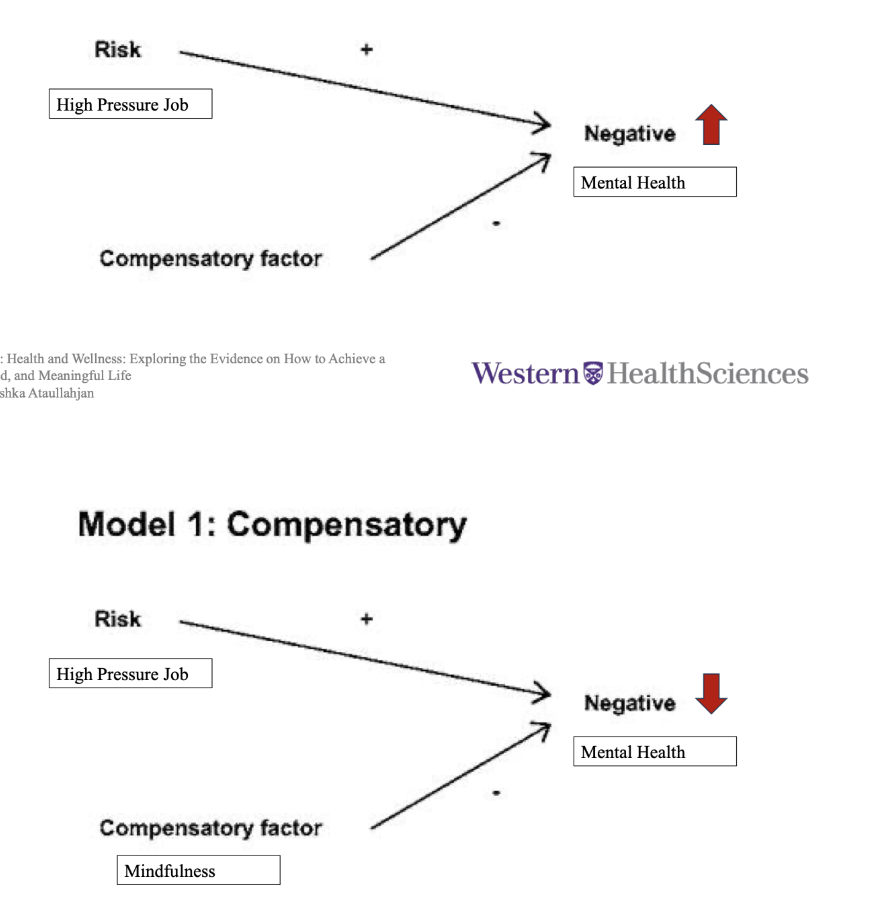

Imagine someone has a high-pressure job.
Their job causes ongoing stress.
This increases their risk of poor mental health.
That's why the arrow from risk → negative outcome has a + sign.
The + means an increase in negative outcomes.
Now imagine that same person regularly practises mindfulness.
Mindfulness may help them manage stress.
This can improve their mental health.
That's why the arrow from mindfulness → negative outcome has a − sign.
What is the protective model of resilience?
a protective factor weakens or reduces the negative effects of a risk factor, rather than necessarily removing the risk itself.
Example: Academic stress may worsen mental health, but access to counselling can reduce how strongly that stress affects someone.
What is the protective-stabilizing model of resilience?
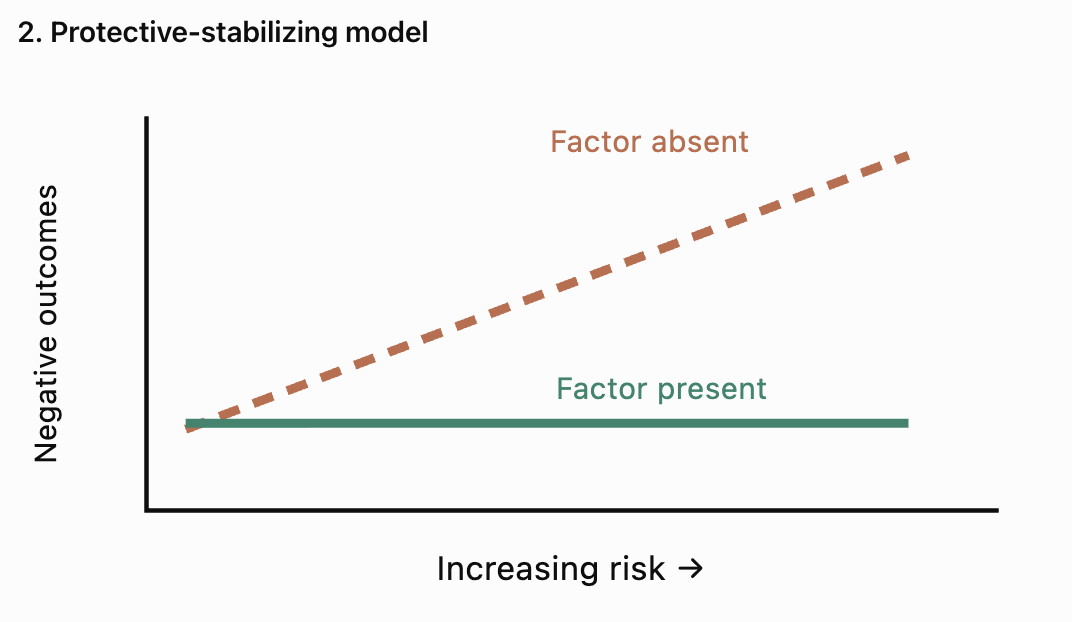

: A protective factor prevents negative outcomes from increasing, even as exposure to risk increases.
Example: Academic pressure increases, but students with access to mental health counsellors may maintain stable mental health.
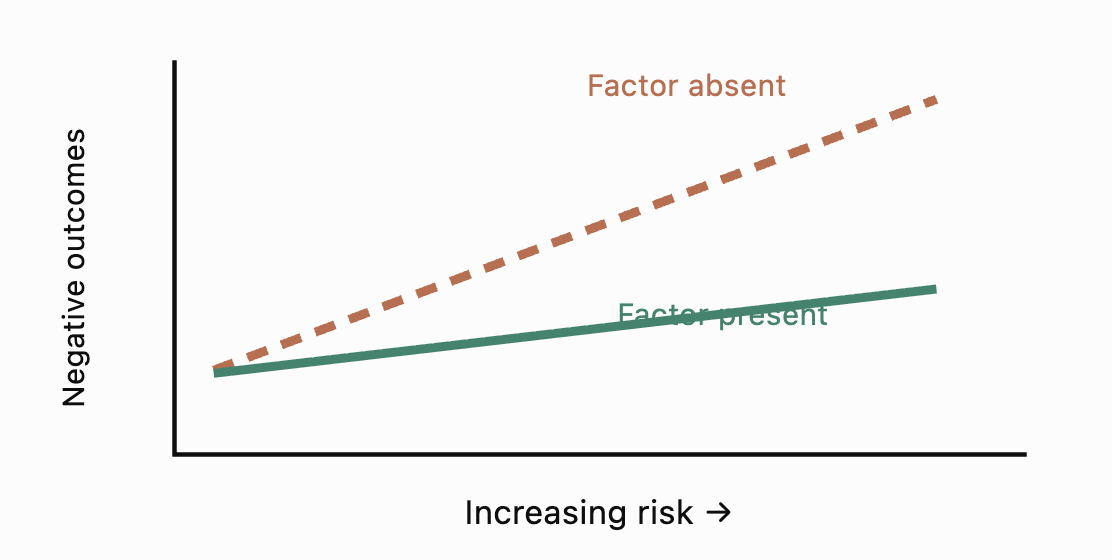
What is the protective-reactive model of resilience?
A protective factor reduces the negative impact of increasing risk, but does not completely prevent negative outcomes from increasing.
Example: Greater drug abuse risk is associated with more risky sexual behaviour, but comprehensive sex education can weaken this relationship.

Challenge Model
A model suggesting that moderate levels of risk can strengthen resilience by helping people develop coping skills, while too much risk can cause negative outcomes.
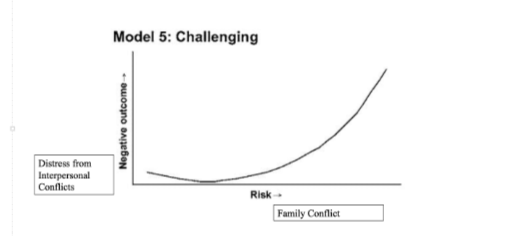
Why does the challenge model have a U-shaped curve?
Because moderate risk is associated with the fewest negative outcomes, while very low or very high risk is associated with more negative outcomes.
Example: Experiencing manageable family conflict may help someone learn coping skills, but excessive family conflict can become harmful.

What is the inoculation model of resilience?
A model suggesting that gradual exposure to manageable stressors over time can build coping skills, reducing the negative effects of future adversity.

Over time, the person encounters stressors but becomes better at coping, so negative outcomes may decrease despite continued exposure.
How is the inoculation model different from the challenge model?
Challenge model: Focuses on the amount of risk experienced and suggests moderate risk may be beneficial.
Inoculation model: Focuses on repeated experiences over time, where coping with manageable stress can build resilience.
Example: A child who gradually learns to manage disagreements with friends may develop skills to handle future conflicts more effectively.
What is a peptide?
A short chain of amino acids, typically around 2–50 amino acids long, that can act as a signal in the body.
What is the difference between approved peptide medications and research peptides?
Approved medications have undergone clinical testing and regulatory review, while research peptides have limited human evidence and are not authorized for routine human use.
Which peptide discussed in the slides has been tested in large human clinical trials?
Retatrutide, which has been studied in large Phase 3 clinical trials for weight loss and metabolic health.
What does the evidence suggest about BPC-157 and other research peptides?
Most evidence comes from animal studies or small human studies, so their safety and effectiveness in humans remain uncertain.
What is misleading about the claim that Big Pharma is hiding retatrutide?
Retatrutide has shown promising clinical trial results, but it is being openly studied and developed, not secretly withheld by pharmaceutical companies.
What did clinical trials find about retatrutide, and is it approved?
Retatrutide showed promising results, including 28.3% average weight loss over 80 weeks in a Phase 3 trial. However, the slides state it is not yet approved.
What are some potential serious side effects associated with retatrutide?
Pancreatitis, gallbladder disease, kidney injury, increased heart rate, and low blood sugar. Thyroid C-cell tumours have been observed in rodents with some related drugs, but the risk in humans remains unclear.
Why might some research peptides have limited human evidence?
Companies may have less financial incentive to fund expensive clinical trials for molecules they cannot patent. This is an incentive gap, not proof of a cover-up.
What three questions should you ask before trusting a video promoting peptides?
Has it been tested in humans or only animals?
Is it approved for human use?
Who is making the claim, and are they also selling it?