ITP Topic 6 Memory
 Call Kai
 Learn
Learn Practice Test
 Spaced Repetition
 Match
Match Flashcards
 Knowt Play
1/47

There's no tags or description
Looks like no tags are added yet.
Name | Mastery | Learn | Test | Matching | Spaced | Call with Kai | Chat |
|---|
No analytics yet
Send a link to your students to track their progress
48 Terms
Memory
the ability to store and retrieve information, allowing organisms to retain experiences for later use
Perception
The organization and interpretation of current sensory information to understand our environment.
Amnesia
a deficit in long term memory — resulting from disease, brain injury, or psychological trauma — in which the individual loses the ability to retrieve vast quantities of information
Amnesia types
Retrograde amnesia: loss of past memories for events, facts, or people
Anterograde amnesia: inability to form new memories
Amnesia types
Retrograde amnesia
loss of past memories for events, facts, or people
Amnesia types
Anterograde amnesia
inability to form new memories
Explicit (declarative) memory
Memory that involves conscious recollection of information.
It includes:
Episodic memory – personal experiences/events
Semantic memory – facts and general knowledge
Episodic memory (what is it, and the brain region)
a subtypes of explicit memory
personal experiences tied to a specific time and place
medial temporal lobe, especially the hippocampus (for formation); sensory cortex (for storage)
Sematic memory (what is it, and the brain region)
a subtype of explicit memory
knowledge of facts, concepts, and categories, independent of personal experience (e.g. the capital of Canada)
medial temporal lobe (acquisition); cortical regions
Implicit (non-declarative) memory
Memory that influences behaviour without requiring conscious recollection.
it includes:
procedural memory, priming, classical conditioning, and non-associative learning.
Procedural memory(what is it, and the brain region)
subtype of implicit memory
motor skills, cognitive skills, and habit (e.g. riding a bike, reading)
Basal ganglia, cerebellum
Priming
subtype of implicit memory
facilitated response to a stimulus die to recent experience (perceptual or conceptual)
relevant sensory/conceptual processing circuits
classical conditioning (in terms of implicit memory) (what is it, and the brain region)
subtype of implicit memory
learned associations between stimuli
basal ganglia, amygdala, cerebellum
non-associative learning as implicit memory (what is it, and the brain region)
subtype of implicit memory
habituation and sensitisation (changes in response to repeated stimuli)
neurons involved in perception
Memory operates over time in three phases
Encoding: taking in information and converting it into a memory
Storage & consolidation: maintaining and stabilizing information in memory traces
Retrieval: accessing stored information
Recall: producing information from memory
Recognition: identifying previously encountered information
Encoding
the process of transforming perception into a memory. it can be automatic or effortful
Factors influencing encoding
attention: the more attention paid to a stimulus, the more likely it is to be encoded. without attention, even familiar details (like the layout of a penny) are often not encoded
duel-coding hypothesis: information coded both verbally and visually is remembered better than information coded only verbally. concrete words (e.g dog) are easier to encode than abstract ones (e.g keep)
Levels of processing model
Visual (shallow): process appearance — “Is CAT in capitals?”
Acoustic (medium): process sound — “Does cat rhyme with hat?”
Semantic (deep): process meaning — “Is a cat an animal?”
Rehearsal strategies
maintenance rehearsal: repeating an item over and over (shallow)
elaborative rehearsal: linking new information to existing knowledge or making it personally relevant (deep)
Organisational tools
schemas: cognitive structure that help perceive, organise, and understand information based on past experience (e.g a “grocery shopping” schema). they can lead to errors if the new situation differs from the schema
chunking: breaking down information into meaningful units
mnemonics: strategies to improve recall through retrieval cues:
method of Loci (memory palace): associating items with physical locations
Peg method: hanging memories on mental “pegs”
Story method: linking items into a narrative
Organisational tools
Schemas
cognitive structure that help perceive, organise, and understand information based on past experience (e.g a “grocery shopping” schema). they can lead to errors if the new situation differs from the schema
Organisational tools
Chunking
breaking down information into meaningful units
Organisational tools
Mnemonics
strategies to improve recall through retrieval cues:
method of Loci (memory palace): associating items with physical locations
Peg method: hanging memories on mental “pegs”
Story method: linking items into a narrative
The Atkinson and Shiffrin model (1968) proposes three distinct storage system
Sensory memory: a temporary system tied to sensory input, lasting only a fraction of a second.
iconic memory: visual sensory memory (1/3 of a second)
echoic memory: auditory sensory memory (allows you to repeat the last few words spoken to you)
Working memory (short-term): an active process that retains and manipulates information for 10-30 seconds
capacity: historically cited as 7±2 items (Miller, 1956), though recent research suggests it may be as few as 4 items
maintenance: requires active focus or rehearsal; distraction causes rapid forgetting
Long term memory (LTM): a relatively permanent storage system with limitless capacity, lasting from minutes to a lifetime

Sensory memory
(Atkinson and Shiffrin)
a temporary system tied to sensory input, lasting only a fraction of a second.
iconic memory: visual sensory memory (1/3 of a second)
echoic memory: auditory sensory memory (allows you to repeat the last few words spoken to you)
Working memory (short-term)
(Atkinson and Shiffrin)
an active process that retains and manipulates information for 10-30 seconds
capacity: historically cited as 7±2 items (Miller, 1956), though recent research suggests it may be as few as 4 items
maintenance: requires active focus or rehearsal; distraction causes rapid forgetting
Long term memory (LTM)
(Atkinson and Shiffrin)
a relatively permanent storage system with limitless capacity, lasting from minutes to a lifetime
Serial position effect
primacy effect: better memory for items at the start of a list (encoded into long term memory)
recency effect: better memory for items at the end of a list (still in working memory)
Consolidation
it is the gradual process of forming lasting neural connections
so encoded information becomes stored in memory → transient and fragile potential memory contents are transformed into a more permanent state
Consolidation:
Long term Potentiation (LTP) and NMDA receptors
the strengthening of synaptic connections, making postsynaptic neurons more easily activated. this supports Hebbs law: “cells that fire together wire together”
NMDA receptors: glutamate receptors critical for LTP
Factors enhancing consolidation
sleep: neural circuits replay memories during sleep, strengthening connections
emotion: the amygdala facilitates consolidation in the hippocampus and basal ganglia when an event triggers autonomic arousal (stress hormones)

Reconsolidation
and
memory updating and memory strengthening
when a memory is retrieved, it enters an active state and must be stored again. this allows for:
memory updating: incorporating new relevant information
memory strengthening: making the memory more durable (triggered by retrieval practice)
Retrieval
The expression of stored memories — bringing previously stored information back to mind.
Principles of retrieval
encoding specificity principle: any stimulus encoded with an experience can trigger its memory
context-dependent memory: better recall when the physical environment matches the encoding environment
state-dependent memory: better recall when internal states mood, intoxication) match at encoding and retrieval
prospective memory: remembering to perform a future task. this often requires external cues (alarms, sticky notes) to avoid the effort of active monitoring
Principles of retrieval:
Encoding specificity principle
context-dependent memory
state-dependent memory
any stimulus encoded with an experience can trigger its memory
context-dependent memory: better recall when the physical environment matches the encoding environment
state-dependent memory: better recall when internal states mood, intoxication) match at encoding and retrieval
Principles of retrieval
Prospective memory
remembering to perform a future task. this often requires external cues (alarms, sticky notes) to avoid the effort of active monitoring
Patterns of forgetting
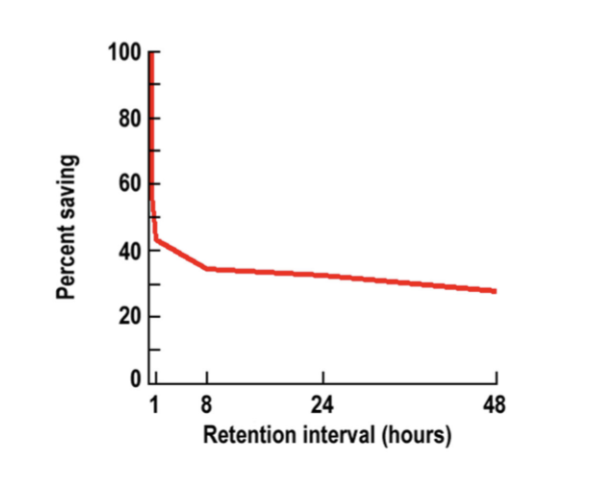
Ebbinghaus forgetting cues: forgetting is rapid initially and then levels off. if a memory persists for 5 years, it is likely to last a lifetime
retrieval induced forgetting: retrieving one item from LTM can impair the ability to recall related items (e.g remembering “apple” from a list makes it harder to later remember “orange”)
Memory distortions
flashbulb memories: vivid episodic memories of surprising, consequential, or emotional events (e.g 9/11)
accuracy: while people are highly confident in these memories, details are often inconsistent and inaccurate over time
source misattribution: forgetting the origin of a memory
false memories: constructing memories of events that did not occur, often influenced by schemas or misleading information
Memory distortions:
Flashbulb memories
vivid episodic memories of surprising, consequential, or emotional events (e.g 9/11)
accuracy: while people are highly confident in these memories, details are often inconsistent and inaccurate over time
Memory distortions:
Source misattribution
forgetting the origin of a memory
Memory distortions:
False memories
constructing memories of events that did not occur, often influenced by schemas or misleading information
Absentmindedness
the inattentive or shallow encoding of events
Memory decay
forgetting over time
Proactive interference
Old information interferes with remembering new information.
Example: You keep typing your old password instead of your new password.
PROactive = Past → interferes with Present/new
Retroactive interference
New information interferes with remembering old information.
Example: After learning your new password, you struggle to remember your old password.
RETROactive = Recent/new → interferes with old
Memory bias
the changing of memories over time so that they become consistent with current beliefs or attitudes
Suggestibility
The development of biased memories due to misleading information. Memories can be altered or even implanted by false information, leading questions, or existing knowledge/associations.
Example: Loftus showed that changing the wording of questions after an event can change how people remember the event.