MMED8115 exam 2
 Call Kai
 Learn
Learn Practice Test
 Spaced Repetition
 Match
Match Flashcards
 Knowt Play
1/582

There's no tags or description
Looks like no tags are added yet.
Name | Mastery | Learn | Test | Matching | Spaced | Call with Kai | Chat |
|---|
No analytics yet
Send a link to your students to track their progress
583 Terms
Proprioceptive sense (proprioception)
the sense of self-movement and body position, generated as a result of our own actions
Afferent signals
signals generated during a movement are processed to code for endpoint position of a limb
afferent input
a central body map to determin the location of the limbs in space
what do Afferent neurons do?
carry sensory info from receptors in skin/other organs to the central nervous system
what are afferent neurons also called?
sensory neurons
Where are the cell bodies of afferent neurons located?
outside the spineal cord
autonomic division
regulates involuntary body responses
somatic division
volunatary movement by skeletal muscles
What do efferent neurons do?
carry motor info from brain to peripheral nervous system
What are efferent neurons also called?
motor neurons
Where are the cell bodies for efferent neurons located?
in the ventral horn of the spinal cord
Where are receptors involved in proprioception located?
muscles, joints, skin
What types of proprioceptors monitor changes to muslce?
muscle spindles and Golgi tendon organs
What monitors change in muscle length?
muscle spindles
What monitors changes in muscle tension?
golgi tendon organs
Are muscle shortening and muslce contraction synonymous?
no
Where are muscle spindles located?
within the fleshy part of skeletal muscle (extrafusal fiber)
What do muscle spindles consist of?
5-15 specialized muscle fibers (intrafusal fibers)
Intrafusal fibers
the specialized muscle fibers that make up a muscle spindle
Primary sensory function of muscle spindles
detect changes in muscle length
Primary motor function of muscle spindles
maintain spindle stretch sensitivity during voluntary contractions

What is the red box?
extrausal muslce fibers
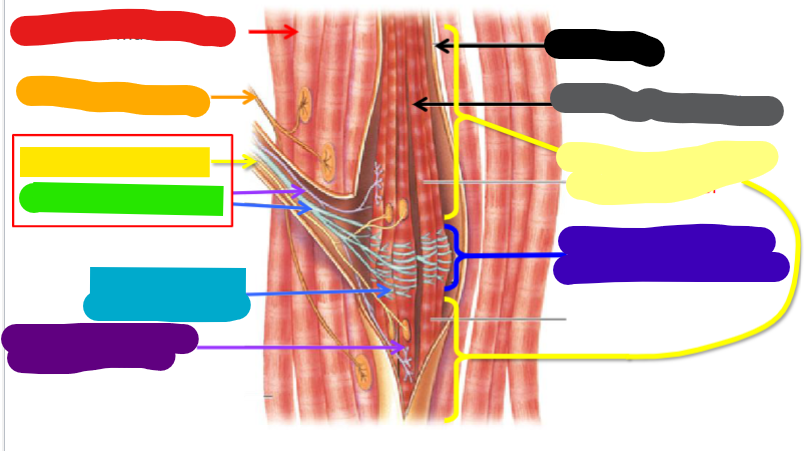
What is the orange box?
alpha-motor neuron axon

What is the dark yellow box?
gamma-motor neuron axon

What is the green box?
afferent neuron axons

What is the light blue box?
primary endings of afferent fibers

What is the purple box?
secondary endings of afferent fibers

What is the dark blue box?
non-contractile central portion of intrafusla fiber

WHat is the pale yellow box?
contractile end portion of intrafusal fiber

What is the grey box?
intrafusal muscle fibers
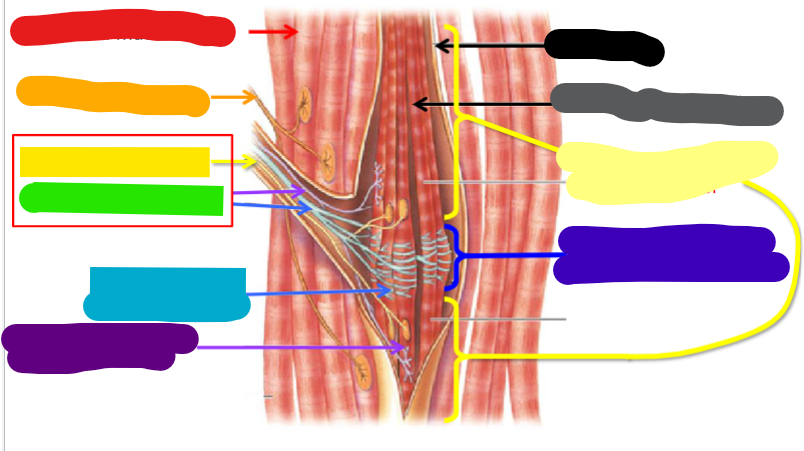
What is the black box?
capsule
What is the stretch flex?
contraction of a muscle in response to passive stretch
What is the purpose of having a stretch reflex?
protect muscle from stretching too rapidly, keep muscle in appropiate tension and ready to contract or relax as needed, support body posture
what is an example of stretch reflex?
patellar (knee-jerk) reflex
first step of the patellar reflex
tapping the patellar ligament stretches the quadriceps and exites its muscle spindles
second step of patellar reflex
afferent sensory impulses travel to the spinal cord, sensory axons make mono-synaptic excitatory synapses on alpha motor neurons and interneurons
third step of patellar reflex
alpha motor neurons send activating impulses to the quadriceps, causing it to contract, this leads to knee extension
fourth step of patellar reflex
interneurons make inhibitory synapes on apha motor neurons that innervate the antagonist muscles (hamstrings)
fifth step of patellar reflex
efferent motor nerve innervating the antagonist muscles remains silent, there is no antagonistic muscle contraction
maintaining proprioceptive signaling during passive stretch
extrafusal (ordinary) muscle fibers receive efferent stimulation from alpha motor neurons; intrafusal muscle fibers are activated by efferent gamma motor neurons that innervate the contractile ends of the spindle fiber
Role of gamma motor neurons: relaxed extrafusal muscle fibers
the spindle fiber is highly sensitive to the strech of muscle
Role of gamma motor neurons: activate only alpha motor neuron
if intrafusal spindle fibers are not activated, the contraction of extrafusal muscle fibers lead to slackened spindle fiber, this loses the sensitivity to stretch
Role of gamma motor neuons: active alpha and gamma motor neuons
co-activation of alpha and gamma motor neurons coordinates shortening of both intrafusal and extrafusal fibers, this maintains spindle fiber sensitivity to stetch, during reflex and voluntary contractions
What does co-activation of alpha and gamma motor neurons enable?
effective stretch reflexes, from different starting lengths of extrafusal fibers
What does the golgi tendon organ consists of ?
endings of a single afferent sensory nerve fiber entwined within bundles of connective tissues (collagen) fibers that make up the tendon
What do golgi tendon organs detect and respond to?
changes in muscle tension that are caused by musclar contraction, but not passive stretch
What type of information is sent from tendon organs to the brain for processing?
afferent information
What are primary endings?
non-contractile afferent sensory endings (muscle spindle sensors)
What are secondary endings?
contractile afferent sensory endings (muscle spindle sensors)
What are the primary factors that can be adjusted to accomplish gradation of whole-muscle tension?
motor-unit recruitment, twitch summation, length-thension relationship
What is motor-unit recuitment?
number of muscle fibers contracting within a muscle
What is twitch summation?
frequency of action potential firing
What is length-tension relationship?
starting muscle length
What is a motor unit?
a single motor neuron and all of the muscle fiber innervated by it
How do the muscle fibers within each motor unit fire action potentals?
in unison when stimulated by a motor neuron action potential
How are muscle fibers distributed within each unit?
distributed evenly throughout a large muscle
A weak muscle contraction
only utilize a single or small number of motor units
Motor-unit recruitment
with stronger contractions, more motor units are stimulated simultaneously
What does the degree of motor control depend on?
the size of motor units
What do small motor units allow for?
very precise adjustments in contraction strength
Is action potential duration longer or shorter than the skeltal muscle contractile response?
much shorter
skeletal muscle mechanics and kinetics: single twitch
when a mucle if stimulated twice at low frequency, the second twitch will be of the same magnitude as the first twitch; after the muscle relaxes first, the cytosolic/sarcoplasmic Ca2+ levels have returned to the resting level
skeletal muscle mechanics and kinetics: twitch summation
when a muscle fiber is stimulated at high frequency, the muscle tension bulds up and reaches maximal sustain contraction; muscle fiber does not have time to relax between stimuli, this is due to sustained elevation in cytosolic Ca2+ level and continued cross-bridge cycling
What is it called when the muscle fiber reaches a maximal sustained contraction?
tetanus
What does the skeletal muscle require ATP for?
cross-bridge cycling and SERCA (CA2+ pump)
What does cross-bridge cycling need ATP for?
to break myosin-actin interaction before ATP hydrolysis and to provide high energy for power stroke and muscle contraction after ATP hydrolysis
What does SERCA need ATP for?
to reuptake Ca2+ into SR and to enable muscle relaxation
What methods supply additional ATP as needed during muscle contractions?
creatine phosphate, glycolysis, oxidative phosphorylation
Creatine phosphatate as a primary energy reserve
Creatine phosphate (phosphocreatine) acts as an accessible energy store in rested muscle
About how much more creatine phosphatate is there in the rested muscle than free ATP?
5X
What does creatine kinase do?
catalyze transfer of a high energy phosphate both from ATP to creatine and the regeneration of ATP from creatine phosphatate
Storage of creatine phosphatate in muscle
is limited; once consumed in the first seconds of muscle contraction, it can only be regenerated by the re-phosphorylation of accumulated creatine in resting muscles
What provides energy in the first few seconds of exercise?
ATP and creatine phosphatate
What happens after the initial shources of ATP are consumed?
ATP must be regenerated from metabolic pathways
How many ATP molecules are produced per molecule of glucose?
32
Advantages of ATP production from anaerobic glycolysis
does not require O2, so it can function during an O2 defect; it is much faster than oxidative phosphorylation, so it can respond quickly to an energy need
Disadvantages of ATP production from anaerobic glycolysis
can produce only 2ATP per glucose and is much less efficient than oxidative phosphorylation; its ineffiency leads to a rapid depletion of glycogen stores, so it cannot sustain vigorous contractile activity for long; it can lead to a build up of lactic acid in blood and muscle
ATP production from aerobic glycolysis
oxidative phosphorlyation requires ample O2 in muscle to produce ATP; its effective as long as O2 delivery through breathing is supplied enough
What are the major types of muscle fibers?
slow-oxidative (type I) fibers (slow), fast-oxidative (type IIa) fibers (fast), fast-glycolytic (type IIx) fibers (ultra-fast)
What is classification of muscle fiber types based on?
fiber contractile speed and
Do fast or slow fibers have higher myoxin ATPase activity?
fast
Type 1 fibers
slow, red oxidative fibers; contain many mitochondria and abundant myoglobin
Where do red fibers derive energy from?
primarily from aerobic oxidative phosphorylation of fatty acids
What are type I fibers adapted for?
slow, continuous contractions over prolonged periods
Fibers required for postural mucscles of the back (low weight, high reps)
type I
Long distance endurance athletes often hav ea higher fraction of what fibers?
type I
Type IIa fibers
fast, intermediate oxidative fibers; have many mitochondria and much myoglobin and have considerable glycogen
Where do type IIa fibers get energy from
oxidative metabolism and anaerobic glycolysis
What are type IIa fibers adapted for?
rapid contractions and short bursts of activity
Type IIx fibers
fast, white glycolytic fibers; fewer mitochondria, abundant glycogen,very pale in color, typically small muscles with relatively large number of neuromuscular junctions
What form Type IIx fibers depend on for energy?
glycolysis
What are type IIx fibers adapted for?
rapid contractions, fatigue quickly; heavy weight, low reps
Characteristics of muscle fibers of a single motor unit
similar characteristics
Fiber types of one muscle with many motor units
different fiber types
Muscle fiber type(s) typically found in back, shoulders and legs used for posture and support
type I slow fibers
Muscle fiber type(s) typically found in muscles of legs and feet for quick movement, running speed bursts
type IIa and IIx fast fibers
Muscle fiber type(s) typicallly found in arms and hands used for quick response to loads, also muscles of the eye and fingers in need of precise, consistent response and repetitive movements
Type IIx fasti-glycolytic fibers
Aerobic enduracne exercise: enhanced oxidative capacity
the result of extensve aerobic exercise can be an increase in the numer of mitochondria and the number of capillaries supplying blood to muscle fibers, allowing muscles to use O2 more efficiently and endure prolonged activity without fatiguing,
resistance/weight training and muscle hypertrophy
increased muscle size can result from sustain anaerobic, shortpduration, high-intensity resistance training, such as weight lifting
Where does muscle enlargement come from with resistance/weight training?
primarily from an increase in diameter (hypertrophy) of the fast-glycolytic fibers resulting in increased synthesis of myosin and actin filaments, this increases the muscle’s contractile strength