Biotechnology, Genetic Engineering, and the Human Genome
 Call Kai
 Learn
 Practice Test
 Spaced Repetition
 Match
 Flashcards
 Knowt Play
1/28

Earn XP
Description and Tags
Vocabulary practice flashcards covering genetic engineering, recombinant DNA technology, cloning, gene therapy, and the Human Genome Project.
29 Terms
Recombinant DNA
DNA created by combining genetic material originating from two or more different sources or organisms.
Transgenic Organism
An organism that contains functional DNA inserted into its genome from another organism of a different species.

Restriction Enzyme
A bacterial enzyme that cuts DNA strands at specific nucleotide sequences, often producing uneven single-stranded sticky ends.
Sticky Ends
Single-stranded overhangs of unbonded nucleotides produced when a restriction enzyme cuts a double-stranded DNA duplex unevenly.
Vector
A biological carrier, such as a plasmid or a virus, used to transfer foreign genetic material into another cell.
Plasmid
A small, circular piece of double-stranded DNA naturally found in bacteria, widely utilized as a vector in recombinant DNA technology.
Bacterial Transformation
The procedure in which bacterial cells take up recombinant plasmids to replicate foreign genes and produce specific proteins, hormones, or enzymes.

Polymerase Chain Reaction (PCR)
A laboratory technique used to amplify and produce millions of identical copies of a targeted, small section of DNA.

Gel Electrophoresis
A laboratory method that separates cut DNA fragments based on their size by passing an electrical current through a gel matrix, allowing smaller fragments to travel farther than larger ones.
Gene Sequencing
The multi-step process of cutting DNA with restriction enzymes and sizing fragments by gel electrophoresis to determine the precise nucleotide order of a DNA sequence.

Gene Therapy
A clinical approach that delivers normal genes into somatic cells—often via modified viral vectors such as adenoviruses—to treat or cure genetic diseases at their source.

Severe Combined Immunodeficiency (SCID)
A genetic condition, also called 'Bubble Boy Disease,' where an individual lacks a functional immune system and must reside in a sterile environment.

CRISPR-Cas9
A targeted gene-editing technology comprised of Clustered Regularly Interspaced Short Palindromic Repeats and Cas9 nuclease that generates double-stranded DNA breaks for gene disruption or repair.
Reproductive Cloning
The transfer of a donor cell nucleus into an enucleated egg cell, followed by culture into an early embryo and implantation into a surrogate mother to produce a clone of the donor.
Therapeutic Cloning
The extraction and cultivation of embryonic stem cells from an early cloned embryo to induce differentiation into specialized tissues or cells for medical treatment.

Dolly
The world's first cloned mammal, produced by transferring the nucleus of an adult somatic cell into an enucleated sheep egg.

Humulin
Recombinant regular human insulin synthesized commercially by genetically engineered bacteria cultured in large fermentation vats.

Golden Rice
A genetically modified strain of rice bioengineered to synthesize beta-carotene, which is converted to vitamin A in the human body.

using recombinant DNA technology to produce useful products
1) isolate plasmids
2) isolate DNA containing the gene of interest
3) use restriction enzymes to cut DNA at specific sequences, allowing for the insertion of the gene into plasmids.
4) join the DNAs to form recombinant DNA plasmids
5) bacteria take up recombinant plasmids
6) clone the bacteria
7) isolate the gene of interest (use the proteins it produces or insert it into other organisms)
uses for recombinant DNA
recombinant DNA can be placed into bacteria to quickly produce proteins and hormones
-also used in dyes, cheese, paper, detergents, and sewage management
How is insulin synthesized?
-insulin producing gene is cleaved/produced in a lab
-restriction enzymes cut the plasmid to allow for insertion
-insert the gene into the plasmid
-once the bacteria take up the plasmid and undergo transformation, they can pass down the plasmid during division and use the gene to produce insulin
Uses of genetic application - agriculture
Transgenic food and GMOs
-benefits: faster growth, resist to pests, insecticides and droughts
-downsides: morality, environmental concerns, potential effects on humans
Transgenic animals - pros and cons
aid in synthesizing proteins for human use
-potentially harmful if GMOs spread their modified genes into wild populations
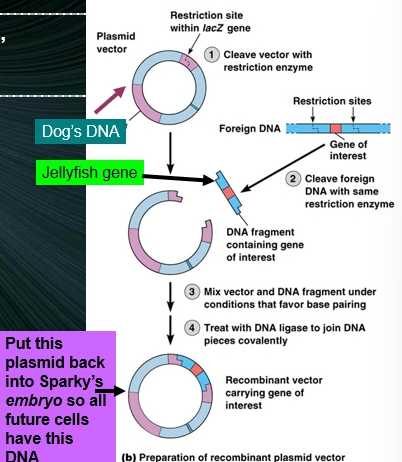
How would one make a “glow pet”?
1) use a plasmid vector and make a cut with restriction enzymes
2) cleave the foreign dna containing the gene of interest with the same restriction enzyme
3) mix the vector and dna fragment - pair the bases and use ligase to join the pieces
4) insert the recombinant plasmid vector carrying the gene of interest into the embryo of the pet so all future cells contain this dna

How to make a GMO?
1) use recombinant DNA tech to produce a gene of interest - cleave the gene of interest with restriction enzymes
2) use restriction enzymes to cut the plasmid vectors
3) insert the cleaved DNA into the vectors
4) some of the cells will take up the gene from the plasmid vectors, and undergo transformation
5) select the cells expressing the gene of interest and use them!
how to get segments of dna to insert?
-use a restriction enzyme to break the dna strand into manageable lengths
-put those through gel electrophoresis to get the exact segment wanted
-put it through PCR to make a million copies of that segment
-insert the segment into the cleaved plasmid
CRISPR-Cas9 allows us…
to delete, tweak, or replace genes in any organism
How does CRISPR-Cas9 work in bacteria?
-bacteria uses CRISPR against invaders such as viruses
-when viruses inject a bacterium, they insert their DNA into the bacteria in order to hijack the cell and produce more copies of themselves
-Cas9 is an enzyme that can cut DNA; bacteria use Cas9 to cut invading DNA in half and disable it
-the bacteria can insert a section of the viral DNA into a special area of its own genome
-over time the bacterium stores the DNA of intruders in this specific area for future identification
-the bacterium can copy these sequences into RNA, which is used as a guide for Cas9; when foreign DNA matches the RNA sequence, Cas9 can cut it and disable it!
How do we use CRISPR-Cas9
we can take a Cas9 enzyme and provide our own RNA guide molecule that matches the gene sequence of the gene we want to edit
-if we introduce this into a cell, Cas9 can snip the host’s genome in the specified spot to disable the gene
-we could then insert a new gene in place of the previous gene