Breathing Systems & IVFT
 Call Kai
 Learn
Learn Practice Test
 Spaced Repetition
 Match
Match Flashcards
 Knowt Play
1/47

Earn XP
Description and Tags
Clinical Skills - Year 2
Name | Mastery | Learn | Test | Matching | Spaced | Call with Kai | Chat |
|---|
No analytics yet
Send a link to your students to track their progress
48 Terms
What are the aims of general anaesthesia?
to render the patient unconscious
to provide analgesia
to allow muscle relaxation
What are the stages of general anaesthesia?
preoperative assessment
premedication (pain relief and sedative typically)
induction
maintenance
recovery
What are the 2 main forms of anaesthetic agents?
injectable agents and inhalational agents
What are the features of injectable anaesthetic agents?
administered intravenously
easy to administer
allow a rapid, smooth induction
short-acting
can be used for maintenance but typically used for induction
What are the features of inhalational anaesthetic agents?
volatile liquids
liquids are vaporised and saturate oxygen
allows delivery of oxygen to the patient
allows a rapid change in depth of anaesthesia
typically used for maintenance
What are the 5 main components of an anaesthetic machine?
fresh gas supply
flowmeter with bypass valve
vaporiser
breathing system
scavenging system
What is the function of a bypass valve on an anaesthetic machine?
to bypass the anaesthetic and deliver only oxygen from the flowmeter to the patient (without anaesthetic)
Where on a flowmeter do you read the level of gas?
top of the bobbin or the centre of the ball
What does the scavenging system of an anaesthetic machine do?
collects and safely removes exhaled and excess waste anaesthetic gases from the patient’s breathing circuit and ventilator to prevent them from leaking into the operating room
What are the problems with using a face mask in an anaesthetic breathing system?
anaesthetic can leak out into the operating room
What is the function of breathing systems in an anaesthetic machine?
to delivery anaesthetic vapour
to deliver oxygen
to remove carbon dioxide
What are the 5 main components of breathing systems?
adapter that connects to an endotracheal tube
expiratory valve
reservoir bag to allow intermittent positive pressure ventilation
fresh gas tubing
expired gas tubing
What is the function of a soda lime canister in an anaesthetic machine?
to absorb carbon dioxide exhaled by the patient during anaesthesia
How do you know when a soda lime canister needs to be replaced?
it will change colour either from white to pink or pink to white when saturated with carbon dioxide
What are the features of a non-rebreathing system?
the patient does not rebreathe expired gas
expired gas is flushed from the system before the patient’s next breath
less economical
less resistance
At which weight must an animal use a rebreathing system instead of non-rebreathing?
above 25kg
Which patients are a Mapleson A breathing system used on?
patients over 10kg, as at this weight they can overcome the resistance of the system
Which patients are a Mapleson D breathing system used on?
patients under 10kg as this system has a lower resistance
What modifications were made to the Mapleson A breathing system to create the Parallel Lack system?
a second tube was added to allow the APL valve to be moved further away from the head during head surgery
this model can be used on patients over 7kg
What modifications were made to the Mapleson D system to create the Co-axial Bain system?
the fresh gas tubing was passed through the expiratory tubing
What is the pathway of gas flow in a non-rebreathing system?
fresh gas enters the system and fills the reservoir bag
patient inspires, filling lungs with fresh gas causing the reservoir bag to decrease in size
patient expires causing lungs to reduce in size and force expired gas into the tubing
the reservoir bag is now full of gas displaced from tubing by the expired gas
during the expiratory pause fresh gas continues to enter the system but cannot re-enter the lungs
pressure builds and opens the expiratory valve and expels expired and dead space gas
How do you ensure that the flow rate is correct in a non-rebreathing circuit?
ensure that the fresh gas flow rate exceeds the minute volume by a certain amount (depending on the circuit) in order to prevent rebreathing of expired gases
What is minute volume?
the volume of gas expired per minute
What is the approximate minute volume of a patient in a non-rebreathing system?
200 ml/ kg/ min
What are the features of a rebreathing system?
soda lime canister
expiratory valve and connector with one-way valves
patient rebreathes expired gas
economical
increased resistance
Which patients are suitable for rebreathing systems?
patients over 15kg
What is the approximate minute volume of a patient in a rebreathing system?
10-50 ml/ kg/ min
What is wrong with having a gas flow rate too high?
a lot of anaesthetic and gas will be wasted
What is wrong with having a gas flow rate too low?
expired gas will not be fully removed during the expiratory pause and the patient will rebreathe carbon dioxide
What are the different types of fluid used in IVFT?
crystalloids
colloids
protein-based solutions
What is the tonicity of a fluid?
the osmolarity of the solution relative to plasma
What is dehydration?
the loss of fluid from the intravascular and interstitial space
What is required to calculate the volume of isotonic fluid required to restore the body fluid of a patient to normal?
maintenance requirement
percentage dehydration (deficit)
ongoing losses
What clinical signs would you look for to identify dehydration?
demeanour
skin turgor
mucous membranes
globe/eye position
What is hypovolaemia?
loss of fluid from the intravascular space
What is the response to shock in a patient?
need to administer fluids as quickly as possible to increase intravascular volume to maintain cardiac output
What equipment do you need to administer an IV catheter?
catheter
bung
needle/ stylet
connector
cap
How should you set up a fluid giving set?
attach fluid bag to drip stand
note the volume of the drip (usually 20 drips/ml)
eliminate air bubbles
get fluids running at appropriate rate
stop fluid from running until ready to attach to the catheter
How do you calculate how much fluid to administer to a dehydrated patient?
calculate maintenance requirement: 2ml/kg/hr
calculate water deficit: % dehydration x bodyweight(kg) x 1000
factor in ongoing losses: volume per episode (ml) x frequency of loss per 24 hours
What equipment will you need for this skill?
anaesthetic machine
anaesthetic breathing systems
endotracheal tubes
scavenger
fluid bag
giving set
intravenous injection limb
calculator
intravenous catheter
catheter tape
Which stage of anaesthesia is associated with the greatest risk of mortality?
recovery
What are the 2 main types of breathing system?
rebreathing and non-rebreathing

Which component of a breathing system is shown here?
adapter to connect to an ET tube

Which component of a breathing system is shown here?
expiratory valve

Which component of a breathing system is shown here?
reservoir bag
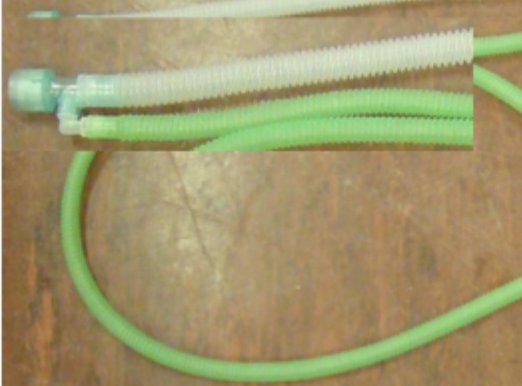
Which component of a breathing system is shown here?
gas tubing

Which component of a breathing system is shown here?
soda lime (only in rebreathing)