3.1.5.1 structure of DNA and RNA
 Call Kai
 Learn
 Practice Test
 Spaced Repetition
 Match
 Flashcards
 Knowt Play
1/22

There's no tags or description
Looks like no tags are added yet.
23 Terms
structure of a DNA nucleotide
⭐️base = adenine, thymine, cytosine, guanine
G-C
A-T

tRNA structure and function
-small, single stranded and folded into clover leaf shape
-3 bases called an anticodon, which pairs with complementary codon on mRNA
-longer section attached to AA

tRNA structure and function
-small, single stranded and folded into clover leaf shape
-3 bases called an anticodon, which pairs with complementary codon on mRNA
-longer section attached to AA

comparison of DNA, tRNA and mRNA
DNA: double-helix, deoxyribose, long, thymine, hydrogen bonding
tRNA: clover shape, ribose, short, uracil, no hydrogen bonding
mRNA: single stranded, ribose, medium, uracil, hydrogen bonding
what makes DNA stable and why is this beneficial
sugar-phosphate backbone protects organic bases inside double helix
many hydrogen bonds link organic base pairs between G-C, making it more stable
other forces between base pairs hold them together (base stacking)
stable-can pass from generation to generation without change
hydrogen bonding- allows strands to separate in DNA replication
large molecule- lots of information
helix- compact
base pairs- transfer information to mRNA to code for amino acids
what are the 3 theories of DNA replication, and which one is actually true and what provides that it is
-Conservative= The original DNA double helix stays completely intact, and a brand-new double helix (two new strands) is made.
-semi-conservative= Each new DNA molecule contains one original (template) strand and one newly synthesised strand.
-dispersive= Each strand in the new DNA molecules is a random mix (patchwork) of old and new DNA segments.
DNA was found to be semi conservative. this is because of the Meselson and Stahl experiment:
1. Start (grown in N15 for many generations):
All DNA has two heavy strands (N15/N15).
Result: 1 heavy band near the bottom.
2. Transfer to N14 for 1 division (Generation 1):
Every DNA molecule now has one old N15 strand and one new N14 strand.
Result: 1 intermediate/hybrid band in the middle.
What this proves: Rules out conservative replication (which would give 2 bands: 1 heavy + 1 light).
3. Leave in N14 for a 2nd division (Generation 2):
Half the DNA molecules are hybrid (N15/N14) and half are completely light (N14/N14).
Result: 2 bands in a 1:1 ratio (1 intermediate/hybrid band + 1 light band near the top).
What this proves: Rules out dispersive replication (which would stay as 1 single band shifting higher).
what end of the original and new strand can bind to DNA polymerase and why
Old strand = 3’
New strand= 5’
this is due to the strand being anti-parallel so there are different nucleotides on each strand, therefore DNA polymerase is only complementary to these active sites
what are introns and exons
introns= sections of DNA that DONT code for amino acids, found within a gene
exons= sections of a gene that DO code for amino acids, found within a gene
DNA in eukaryotes compared to prokaryotes and chloroplasts/mitochondria
Eukaryotes:
-linear and long DNA
-introns
-histones
-located in nucleus
Prokaryotes:
-circular
-no introns or histones
-located in cytoplasm
short
Chloroplasts/mitochondria:
-circular
-located in organelles
-short
-no histones or introns
structure of a gene
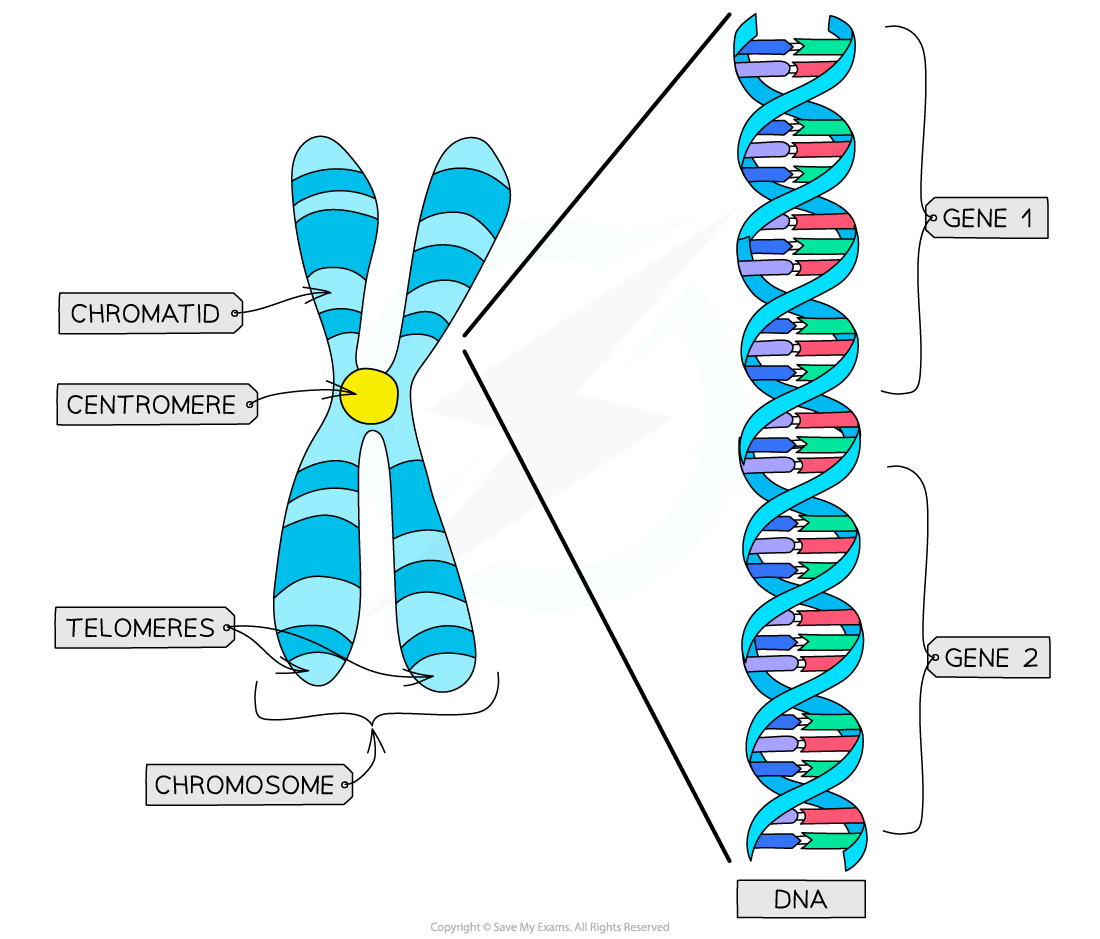
what’s a gene
section of DNA that codes for amino acids and functional RNA
what’s a locus
fixed location of a gene on a chromosome
if 2 bases code for one amino acid, how many different amino acids could there be?
if 3 bases coded for one amino acid, how many different amino acids could there be?
16 (4 squared)
64 (4 cubed)
4 features of the genetic code
Degenerate: most amino acids are coded for by more than one triplet
Non-overlapping: each base in a sequence is only read once
Universal: the same specific base for triplets code for the same amino acids in all living organisms
Start/stop codons: specific triplets that signal the beginning and end of a polypeptide chain during translation
Semi conservative DNA replication
DNA strand uncoils
DNA helicase separates the 2 strands by breaking hydrogen bonds
DNA double strand has separated and free activated nucleotides are attracted to their complementary base pairs on the template strand
DNA polymerase joins adjacent nucleotides via phosphodiester bonds
2 identical strands are produced. each double stranded molecule of DNA contains one new strand and one old strand (semi-conservative)
why do not all bases code for amino acids
some are STOP coding and some may be introns
what’s an allele
an alternative form of a gene
what are homologous pairs
one complete set of chromosomes comes from sperm, and one from the egg therefore one chromosome is each pair is paternal and one is maternal. both chromosomes have the same genes but different alleles.
what can result in a non-functional protein
change in base sequence due to mutation, produces new allele of a gene, produces a
different amino acids, different polypeptides and hence a different protein
Transcription (in nucleus)
DNA helicase breaks hydrogen bonds between opposite DNA strands to expose the nucleotides
one DNA strand acts as a template
RNA nucleotides are attached to the exposed bases (A-U/T, G-C)
RNA polymerase moves along DNA , joining together RNA nucleotides via phosphodiester bonds to synthesise pre-mRNA (3’ to 5’)
RNA polymerase reaches a stop codons, causing it to detach
pre-mRNA strand is spliced to remove introns, forming mature mRNA, only exons remain (only happens in eukaryotes at prokaryotes don’t contain introns)
Translation (in the cytoplasm)
mRNA leaves the nucleus through nuclear pores to ribosome
ribosome attaches to the start codon of the mRNA
tRNA brings amino acids to the ribosome (tRNA anticodon is complementary to mRNA codon)
ribosomes moves along mRNA, bringing 2 tRNA molecules at a time
peptide bonds form between amino acids using an enzyme and ATP which is hydrolysed to release energy
tRNA detaches and collects amino acid
up to 50 ribosomes can pass immediately behind the first so many identical polypeptides can be assembled simultaneously
this continues until the ribosome reaches a stop codon, then mRNA, tRNA and ribosome all separate and the polypeptide chain is complete
what’s a gene
sequence of DNA bases that code for a polypeptide
structure of a protein
polymer of amino acids
joined by peptide bonds, formed by condensation
primary structure= order of AA
secondary structure= folding of polypeptide chain due to hydrogen bonding (alpha helix, beta pleated)
tertiary structure = further folding due to hydrogen/ionic/disulphide bonds
quaternary structure= two or more polypeptide chains