Lecture 1 - Structure of the Brain
 Call Kai
 Learn
Learn Practice Test
 Spaced Repetition
 Match
Match Flashcards
 Knowt Play
1/23

There's no tags or description
Looks like no tags are added yet.
Name | Mastery | Learn | Test | Matching | Spaced | Call with Kai | Chat |
|---|
No analytics yet
Send a link to your students to track their progress
24 Terms
HOw should we study the brain?
Understand this pathway and look into different components within

What are the 4 approaches to studying the brain?
Approaches:
1. Molecular and cellular neuroscience (proteins, genes, cell
cultures, brain slices)
2. Systems neuroscience (single to populations of neurons in
intact models)
3. Computational neuroscience (theoretical, modeling and
simulation)
4. Cognitive neuroscience (EEG, brain imaging, fMRI, PET, MEG)
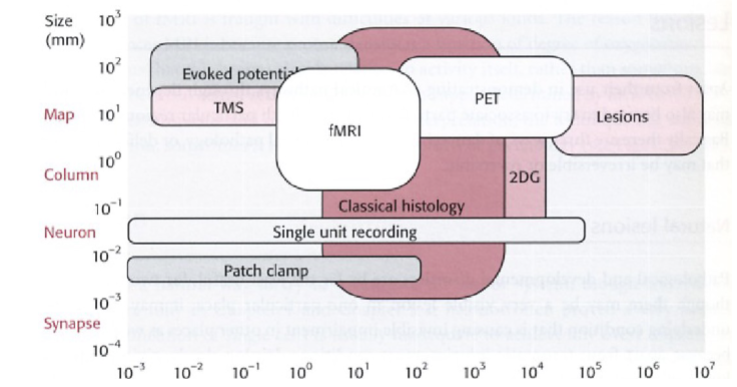
What is the typical scale of problems in neuroscience within the scope of this class?
Systems and Computational

What are some experimental methods used to explore the brain?
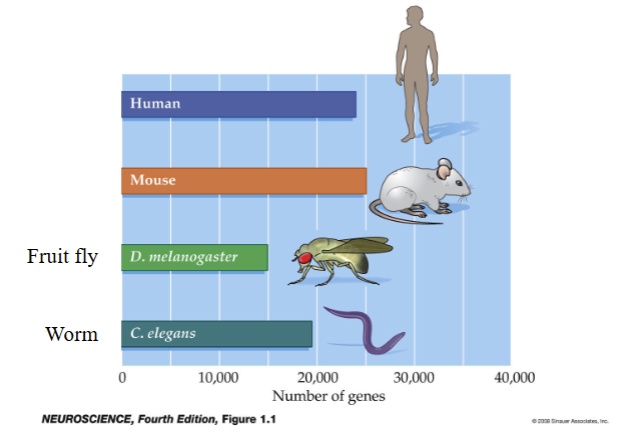
• The number of genes ____ correlate with organismal complexity
• There is a complex relationship between ____ and ____
• The number of genes does not correlate with organismal complexity
• There is a complex relationship between genetics and behaviors
What are the major components of the nervous system?
Brain, Spinal Cord, and surrounding nerves
What are the 2 divisions of the nervous system?
Peripheral Nervous System;
Central Nervous System

How does Infomation get processed?
Sensation - PNS - CNS → PNS →Reaction

What is special about Einstein’s Brain?

Despite Cortical Differences, we still do not know what specifically makes one person different from another, on an anatomical level
What is the difference in cortical areas among species
Areas associated with sensation take up a lot more space in non-human species

As the brain evolved from one species to another, how did certain brain areas change/stay the same? What is the significance
Certain brain areas grew/shrunk. However, the areas stay conserved (humans inherited brain areas from other animals.
Hence, you can use animals to look into the activity and extrapolate that info for humans

Difference between rats/mice and primates
Rats/Mice have lots of brain area dedicated to somatosensation compared to primates

Compared to small animals, primate brains are more _______.
complicated
As species evolve, the brain gets ____ and the # of neurons gets _____
bigger
denser
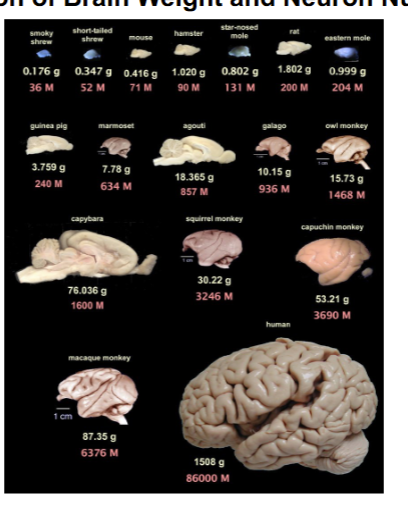
What is special about Human/Primate brain weight compared to body weight?
Primates have high brain weight - body weight ratio.

Gray matter - ____
White Matter - _____
Neurons
Fibers/axons connecting gray matter
Larger Brains require ____ fibers to communicate between distant cortical areas.
longer

More neurons in _____ _____ ______.
Primate Cerebral Cortex

Neuronal density decreases uniforml across species as the cerebral corte gains neurons, except in _____.
Primates

More neurons in _____ _____.
primate cerebellum

Comparison between the brains of primate species
Similar regions (sensory cortext highly conserved among primates), but humans have highly developed frontal cortex compared to other primates

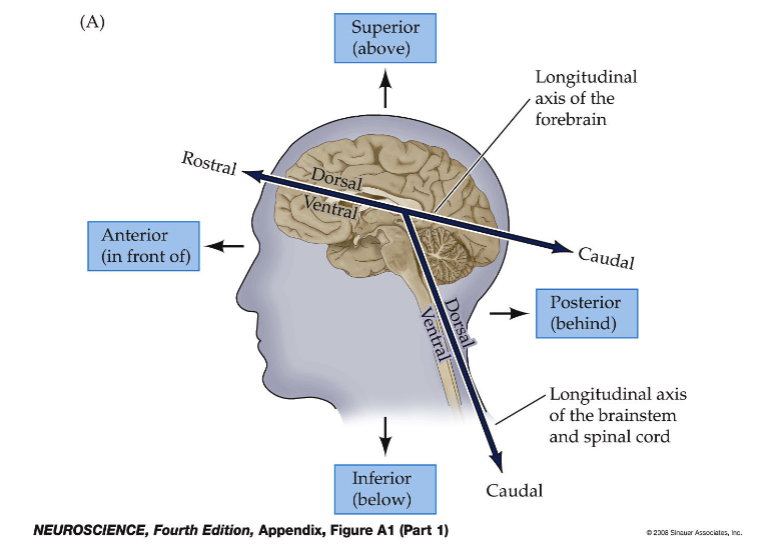
Terminologies used in neuroscience for axes
Rostral-Anterior
Caudal-Posterior
What are wrinkles called in the brain
Sulcus
What are the anatomical planes?
