interspecific interactions
 Call Kai
 Learn
Learn Practice Test
 Spaced Repetition
 Match
Match Flashcards
 Knowt Play
1/33

There's no tags or description
Looks like no tags are added yet.
Name | Mastery | Learn | Test | Matching | Spaced | Call with Kai | Chat |
|---|
No analytics yet
Send a link to your students to track their progress
34 Terms
Predation
Consuming all, or part of another
carnivory is animals eating other animals
Carnivorous plant species also consume animals
Omnivores consume any and all types of food
The Remarkable Coevolution Of Predator And Prey Species In Communities
Predators Evolved Adaptations To -
•Attract Prey
•Avoid Detection By Prey
•Capture Prey
•Detect Prey And Target Weak Prey
•Digest Prey Tissues
•Inactivate Prey Toxins
•Kill Prey
Sensory systems
____ ____ of predators detect prey in creative ways
avoid
Predators evolved traits to ____ detection by prey
cooperative
Some species evolved ____ behaviors
these behaviors which increase the probability of prey capture include tactics and teamwork
All of the above

All of the above

Killer Whales Form A Team To Make Sunfish More Edible
One Whale Holds The Captured Sunfish
•Another Whale Rams The Sunfish
•This Shatters The Sunfish
•The Soft Sunfish Tissues Are Released Into The Water
Interspecific cooperative hunting
Groupers And Moray Eels Interact Temporarily To Capture Prey
•Their Complementary Hunting Styles Enable The “Two-Trap Strategy
Interspecific Cooperative Hunting Among Dolphins And Marine Birds
Teamwork Among Predator Species Prevents The Bait Ball From Moving Laterally And Vertically
Reduce
Prey species have evolved many traits that ____ their risk of predation
●Attack Predators
●Avoid Detection
●Cooperative Behavioral Defenses
●Confuse, Injure, Kill, Poison, Or Stun Predators
●Detect Predators
●Elude Predators
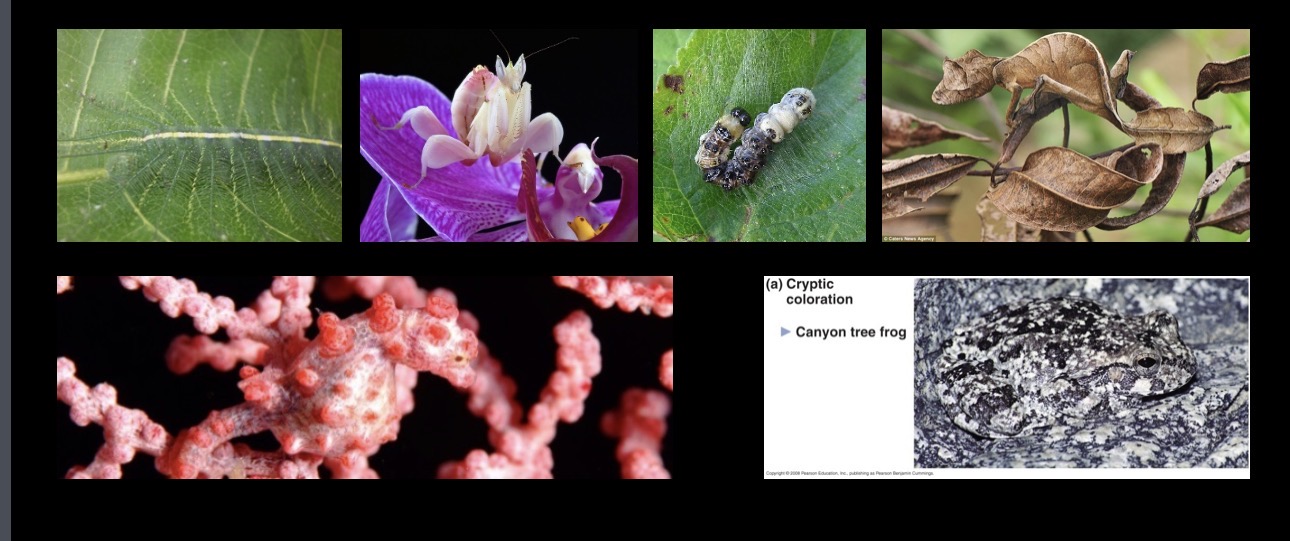
camouflage
Prey species evolved ____ to reduce their risk of detection
Masquerade, Also Called Misidentification, Is A Type Of Camouflage That Resembles An Abiotic Substance Or Inedible Substance
The Mimic Octopus, Thaumoctopus mimicus
●It Adjusts Its Color, Shape, And Skin Texture To Resemble Other Species In Its Community To -
•Attract Prey
•Deter Predators
Batesian mimicry
A Harmless Species Gains An Advantage By Resembling A Toxic Species In Its Community
●The Harmless Species Exploits The Chemical Defenses Of The Harmful Species To Reduce Its Risk Of Predation
Mullerian mimicry
A Toxic Species Gains An Advantage By Resembling Other Toxic Species In Its Community
•All The Mullerian Mimic Species Are Harmful

Chemical defense and coloration
Bright colors advertise toxicity
Warning coloration is also called aposematism
Some prey are able to reduce their risk of predation while sleeping
Bottlenose Dolphins And Northern Fur Seals Sleep Unihemispherically
•One Brain Hemisphere And One Eye Are Active
●Great Frigatebirds Sleep Unihemispherically On Rising Air Currents
•“Sleeping On The Wing”
●Northern Elephant Seals Hold Their Breath And Sleep Bihemispherically At Deeper, Safer Depths
●Sperm Whales Sleep (10-15 Minutes) Unihemispherically In Groups And Hang Vertically Often At Shallow Depths
Behavior
The fear of predators influence prey ____
Prey Avoid Habitats That Facilitate Their Detection And Capture And that have Predators
Refuges
____ for prey help reduce predation
flying
Hiding on land or in water
Inhabiting isolated habitats without natural enemies
Sleeping on a cliffside or high in the forest canopy
Some prey species form high density populations to reduce their risk of predation
Predator Satiation Is Also Called Predator Swamping
● Cicada Reproductive Cycles Are 13 And 17-Years, Which Are Prime Numbers
•The Emergence Of Cicada Adults Produces 4,000,000 Individuals Per Hectare
Herbivory
Consuming part or all of a photosynthetic species
herbivores consume algae, microalgae, phytoplankton, photosynthetic prokaryotes, and plants
Coevolution of herbivore species and plant species
●Herbivores Evolved Traits That Optimize Plant-Based Diets
•Access To Plants
•Avoidance And/Or Inactivation Of Plant Toxins
•Digestive Systems That Enable Plant Tissue Digestion
oCoevolved Mutualisms With Microbes That Digest Plant Tissues
oObtained Cellulase And Lignase Genes From Other Species
•Jaw Bones And Muscles For Chewing
•Teeth That Grind And Tear Plant Tissues
Digestive systems
Some herbivores evolved complex ____ ____
They Also Evolved Mutualisms With Microbes That Digest Cellulose And Lignin
The Complex Digestive Fermentation Chambers Facilitate Plant Tissue Digestions By The Mutualistic Microbes
Migration
____ enables some herbivores to follow seasonal plant foods
Herbivory
Flowering plants evolved biochemical traits that reduce the risk of ____
Their Effective Immune Systems, Including Biochemical Defenses, Are -
•Constitutive
•Inducible
●They Form Tissues That Are -
•Indigestible
•Low In Calories
Herbivory
Flowering Plants Evolved A Variety Of Physical Traits That Reduce Their Risk Of ____
(Thorns, tough/hard flesh)
Trichomes
____ reduce the risk of Herbivory
These Leaf Hairs Provide With Plant Organs With -
•Chemical Defenses
•Physical Defenses
Reduce
Some plants species evolved camouflage to ____ the risk of Herbivory
Harvesting By Humans Selected For Camouflage In Fritillaria delavayi
Reduce
Some plant species Evolved mutualisms with animals to ____ the risk of Herbivory
Acacia Trees (Vachellia species) And Ants (Pseudomyrmex ferruginea)
Sudden leaf movement
____ ____ ____ can startle herbivores
●Mimosa pudica Is The Sensitive Plant
•Leaves Fold Inward And Droop When Touched
oThis Dislodges Small Insects, Which Reduces Feeding
•Leaf Movement Is Due To Changes In Turgor Pressure Changes In Specialized Leaf Base Cells Called Pulvini
Mimicry
Some flowering plant species show Batesian ____
The Seed Pod Of This Legume Species Resembles A Toxic Insect Species In Its Community
Mullerian mimicry
____ ____ occurs in some flowering plant species
Boquilla Trifoliolata, The Chameleon Vine, Mimics The Color, Orientation, Size, Shape, And Spines Of The Toxic Tree It Climbs
Refuges
____ reduce the risk of Herbivory by herbivore avoidance
Seeds Can Be Dispersed To Isolated Habitats Without Natural Enemies
Herbivore satiation
Some flowering plants show ____ ____
Masting Or Mast Seeding Is Similar To Predator Satiation In Prey Species
•Beech, Hickory, Oaks
•Blueberries, Citrus, Raspberries