L15 - Lymphocyte development: B-cell development
 Call Kai
 Learn
 Practice Test
 Spaced Repetition
 Match
 Flashcards
 Knowt Play
1/50

There's no tags or description
Looks like no tags are added yet.
51 Terms
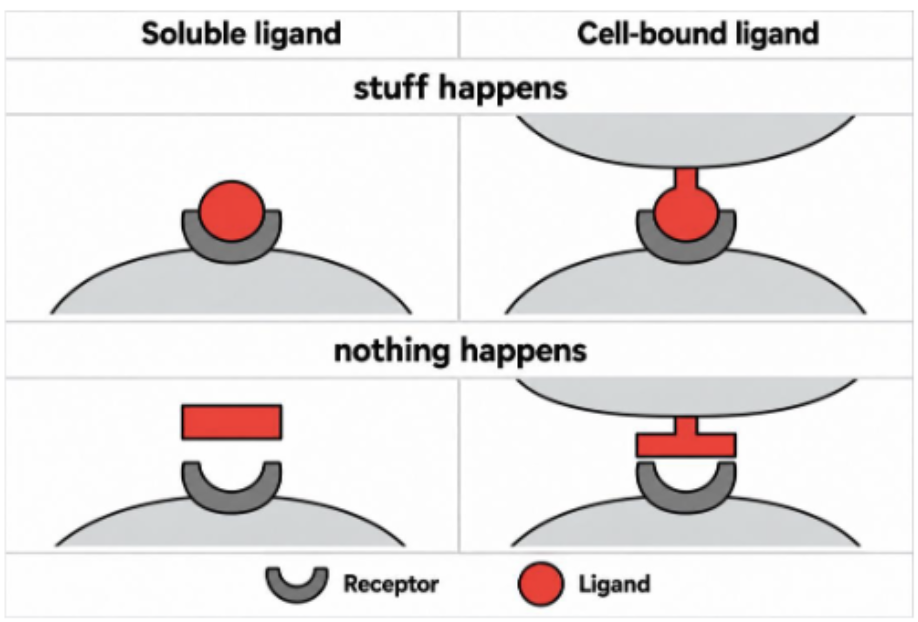
What are the Two Universal Rules of Immunology?
Receptor–ligand interactions are required for recognition
Responses are often mediated by cytokines and chemokines
How does Antigen Recognition differ between Innate and Adaptive Immunity?
Innate: conserved motifs via PRRs, generally shared across cells
Adaptive: diverse epitopes via clonally distributed BCRs and TCRs

How does the Timing of Innate vs. Adaptive Immunity differ?
Innate responses are immediate
Adaptive responses are delayed
What are the Main Lymphocyte Types and Their Receptors?
B cells express B-cell receptors (BCRs)
T cells express T-cell receptors (TCRs)
What are the Four Main Hematopoietic Lineages?
Lymphocytic
Granulocytic
Megakaryocytic
Erythrocytic
What Structural Features do BCRs and TCRs share?
Antigen-binding sites
Variable regions
Constant regions
Transmembrane regions

How do BCRs differ from TCRs in Antigen Binding and Secretion?
BCRs have two equivalent binding sites and can be secreted as antibodies
TCRs have one binding site and remain cell-bound

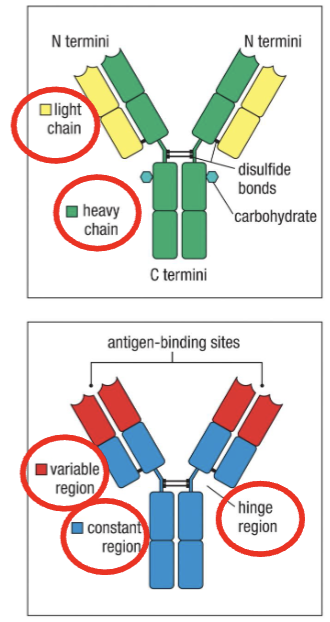
What is the Basic Structure of an Immunoglobulin?
Based on: Peptide structure
Two identical light chains
Two identical heavy chains
Hinge region
Based on: Function
Variable and region
Constant region
What are the Functions of the Variable and Constant Regions?
Variable region: antigen specificity
Constant region: antibody function

QUESTION: How Many Epitopes can One Immunoglobulin bind, and are They Identical?
ANSWER → Two epitopes simultaneously
Both binding sites recognize the same epitope
What are the Fab, Fc, and Hinge Regions?
Fab binds antigen
Fc interacts with Fc receptors on other cells
Hinge provides flexibility

QUESTION: What can a Macrophage with an Fc Receptor bind?
ANSWER → The constant (Fc) region of an immunoglobulin
What are the Five Immunoglobulin Isotypes?
Their classes are determined by the heavy-chain type
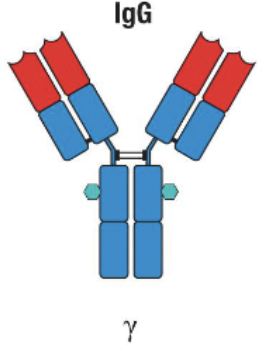
IgG
IgM
IgD
IgA
IgE

How do IgA and IgM differ in their Multimeric Structures?
IgA can form dimers
IgM can form pentamers
Increasing their cross-linking potential
What is the Main Characteristic of IgM?
First antibody isotype to appear and disappear after infection
Often associated with recent exposure

What is the Main Characteristic of IgG?
Most abundant and long-lasting immunoglobulin in blood
Commonly monitored in vaccine titers
What are the Main Functions of IgE and IgA?
IgE: allergies and parasite responses
IgA: mucosal protection, including the intestinal lumen

What is the Difference between an Antigen and an Epitope?
Antigen: whole molecule
Epitope: specific portion recognized by an antigen receptor

What Types of Molecules can B Cells recognize as Antigens?
Proteins
Lipids
Carbohydrates
Nucleic acids such as DNA
What is the Difference between Linear and Conformational Epitopes?
Linear: consecutive amino acids
Conformational: amino acids brought together by protein folding or assembly

What happens to Conformational Epitopes during Denaturation?
They may be lost when tertiary or quaternary structure is disrupted
What are Hypervariable Regions, and Which is Most Important?
Highly variable amino acid regions within the variable region of an immunoglobulin that interact with antigens and determine binding specificity
Also known as complementarity-determining regions: CDR1, CDR2, and CDR3
CDR3 is especially important for specificity

QUESTION: What Two Mechanisms initially generate BCR Diversity?
Random recombination of gene segments
Different V, D, and J gene segments are randomly combined to create unique BCRs
Addition of random nucleotides at joining sites
Extra nucleotides are added at the junctions between gene segments, creating even more diversity
Why is Somatic Recombination Necessary for BCR Diversity?
It generates millions of receptor specificities from a limited number of protein-coding genes
What is Combinatorial Diversity?
Creation of different receptor sequences by mixing and matching available gene segments
How does Random Nucleotide Addition increase BCR Diversity?
Adding nucleotides at gene-segment junctions creates additional unique sequences
Where and When does Initial BCR Diversity develop?
In the bone marrow during B-cell development, BEFORE antigen exposure
What is the Principle of Clonal BCR Specificity?
Each B-cell clone has one antigen-binding specificity
Different clones can recognize different epitopes
Which Gene Segments form the Heavy and Light Chains?
Heavy chain: V, D, and J segments
Light chain: V and J segments
Why can Heavy Chains generate Greater Junctional Diversity than Light Chains?
Heavy chains have three segment types and two junctions
Light chains have two types and one junction
What is V(D)J Recombination?
DNA-level rearrangement of V, D, and J gene segments that generates diverse antigen receptors
QUESTION: Why is DNA-Level BCR Rearrangement Important?
Daughter cells inherit the rearranged receptor genes and maintain the same antigen specificity
QUESTION: Which Molecules transmit Signals from the BCR into the Cell?
ANSWER → Igα & Igβ
Which relay antigen recognition into intracellular signaling pathways and ultimately the nucleus

QUESTION: How are Membrane-Bound and Secreted Immunoglobulins generated?
ANSWER → Differential mRNA processing (alternative splicing) produces membrane or secretory heavy-chain tails

QUESTION: Does Alternative Splicing change the Antigen Specificity of an Immunoglobulin?
ANSWER → No
Membrane-bound and secreted forms recognize the same epitope
QUESTION: How do you think the two tails differ in their amino acid composition?
A hydrophobic segment in its membrane tail anchors it to the cell membrane

What is the Difference between V(D)J Recombination and Alternative Splicing?
V(D)J: permanent DNA rearrangement for diversity
Splicing: RNA processing for membrane vs. secreted forms

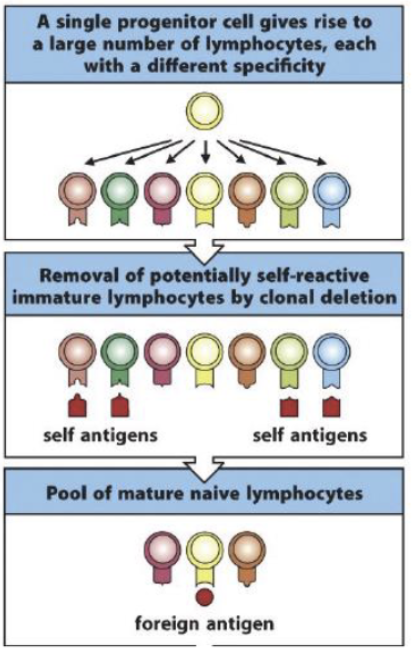
What Two Requirements must Developing B Cells meet before Maturation?
They must express a functional antigen receptor
Avoid inappropriate self-reactivity
What is the Goal of B-Cell Selection in the Bone Marrow?
To produce functional, non-self-reactive B cells ready to respond to foreign antigens
PRACTICE QUESTION: Unlike in innate immunity, B-cell receptors:
a) Are entirely germline encoded
b) Recognize the exact same repeating structures
c) Cannot directly bind an epitope
d) Uniquely recognize a single epitope
ANSWER → d) Uniquely recognize a single epitope
PRACTICE QUESTION: The ability to bind to many different types of epitopes is:
a) Due to recombination events during B-cell development
b) After the epitope is encountered
c) When random nucleotides are incorporated
d) T-cell dependent
e) A and C
ANSWER → e) A and C
a) Due to recombination events during B-cell development
c) When random nucleotides are incorporated
PRACTICE QUESTION: B-cells with antibodies reactive to an epitope, can lose this reactivity during class switch recombination (making a different isotype)
a) True
b) False
ANSWER → False
TABLE 1. Innate vs. Adaptive Immunity
Feature | Innate Immunity | Adaptive Immunity |
Recognition | Broadly conserved motifs (PAMPs/DAMPs) | Highly diverse epitopes |
Receptors | Pattern recognition receptors (PRRs) | BCRs and TCRs |
Receptor distribution | Generally similar across cells of the same type | Clonal; different lymphocytes have different receptors |
Receptor diversity | Hundreds | Millions (~10 million) |
Response timing | Immediate | Delayed |
Generation of diversity | Receptors encoded in inherited genes | Somatic gene rearrangement |
Remember: Innate immunity recognizes shared patterns, while adaptive immunity recognizes highly specific epitopes.
TABLE 2. BCR vs. TCR vs. Secreted Antibody
Feature | BCR | TCR | Secreted Antibody |
Found on | B cells | T cells | Soluble form |
Antigen-binding sites | 2 | 1 | 2 |
Variable region | Yes | Yes | Yes |
Constant region | Yes | Yes | Yes |
Membrane-bound | Yes | Yes | No |
Secreted form | Yes, as antibody | No | Already secreted |
Main role | Antigen recognition | Antigen recognition | Antigen binding and immune functions |
Key concept:
BCRs and secreted antibodies can recognize the same epitope.
TCRs remain membrane-bound.
TABLE 3. Immunoglobulin Structure and Function
Component | Structure / Function |
Heavy chains | 2 identical chains |
Light chains | 2 identical chains |
Variable region | Determines antigen specificity |
Constant region | Determines antibody function |
Fab region | Fragment antigen-binding; binds epitopes |
Fc region | Fragment crystallizable; binds Fc receptors on other cells |
Hinge region | Provides flexibility to antigen-binding arms |
Antigen-binding sites | 2 identical binding sites recognizing the same epitope |
Remember:
Variable = specificity
Constant = function
TABLE 4. Immunoglobulin Isotypes
Isotype | Main Characteristic | Clinical Relevance |
IgM | First to appear and disappear after infection; can form pentamers | Often indicates recent exposure |
IgG | Most abundant and long-lasting in blood | Vaccine titers and longer-term antibody responses |
IgE | Associated with allergies and parasites | Hypersensitivity and parasite responses |
IgA | Secreted at mucosal barriers; can form dimers | Mucosal immunity, especially the gut |
IgD | Fifth isotype; not emphasized | Know it exists |
TABLE 5. Antigen Recognition: Linear vs. Conformational Epitopes
Feature | Linear Epitope | Conformational Epitope |
Other name | Continuous | Discontinuous |
Amino acids | Consecutive in sequence | Brought together by folding or assembly |
Depends on 3D structure? | No | Yes |
Effect of denaturation | May remain recognizable | May be lost |
Structural basis | Primary sequence | Tertiary or quaternary structure |
Remember:
Antigen = entire molecule
Epitope = specific portion recognized
TABLE 6A. BCR Mechanisms of Diversity
Mechanism | How It Works | Result |
Combinatorial diversity | Random mixing of gene segments | Different receptor sequences |
Random nucleotide addition | Adds nucleotides at joining sites | Additional sequence diversity |
Heavy/light chain pairing | Different heavy and light chains combine | Further increases diversity |
V(D)J recombination | Rearranges receptor genes at DNA level | Stable specificity inherited by daughter cells |
TABLE 6B. Heavy vs. Light Chain Recombination
Feature | Heavy Chain | Light Chain |
Gene segments | V, D, J | V, J |
Number of segment types | 3 | 2 |
Joining sites | 2 | 1 |
Junctional diversity | Greater | Less |
Rearrangement | DNA level | DNA level |
Important: BCR diversity is initially generated in the bone marrow before antigen exposure.
TABLE 7A. BCR Generation vs. Antibody Secretion vs. B-Cell Development: DNA Recombination vs. RNA Splicing
Feature | V(D)J Recombination | Alternative Splicing |
Level | DNA | RNA |
Purpose | Generate receptor diversity | Produce membrane-bound or secreted Ig |
Permanent DNA change? | Yes | No |
Inherited by daughter cells? | Yes | No |
Changes antigen specificity? | Yes, during initial receptor generation | No |
Key result | Unique BCR specificity | Different forms with the same specificity |
TABLE 7B. BCR Generation vs. Antibody Secretion vs. B-Cell Development: B-Cell Development and Selection
Stage / Concept | Key Event |
Bone marrow development | BCR genes undergo rearrangement |
Functional receptor selection | Developing B cell must produce a functional receptor |
Self-reactivity selection | Inappropriately self-reactive cells are selected against |
Central tolerance | Selection against self-reactivity in bone marrow |
Peripheral tolerance | Additional tolerance mechanisms outside bone marrow, including spleen |
Final result | Mature, functional, non-self-reactive B cells |