Medulla
 Call Kai
 Learn
 Practice Test
 Spaced Repetition
 Match
 Flashcards
 Knowt Play
1/65

There's no tags or description
Looks like no tags are added yet.
66 Terms
Major ascending tracts in medulla
Fasciculus cuneatus, fasciculus gracilis, arcuate fibers, spinothalamic tract, trigeminothalamic tract
FUnctions of Dorsal Column/ Medial Lemniscal system
fine touch, proprioception, pressure, vibration sensations from the body to the brain.
1, 2 , 3 order neurons of Dorsal column
Dorsal Root Ganglia, Nucleus Gracilis and Cuneatus, Ventral Posterolateral nucleus of thalamus
Levels of DRG’s of Dorsal Column
Fasciculus gracilis T7 and below; Fasciculus Cuneatus - T6 and above
Decussation place in Dorsal column
Caudal medulla as Internal arcuate fibers
Lesions in Fasciculus Gracilis and Cuneatus (write first*); Lesion in Medial lemniscus
ipsilateral deficit in touch pressure, vibration; contralateral deficit
Clinical signs of lesion
Astereognosis, agraphesthesia, loss of discrimination, vibration sensation, position and movement, positive Romberg sign
Anterior spinothalamic tract function
crude touch, pressure, tickle and itch
Lateral spinothalamic tract
pain and temperature from body
Decussation in Spinothalamic tract and decussating fibers
Anterior white comissure of spinal cord; second order neurons (Lamina 1,2,3&4)
Lesion in spinothalamic tract
loss of pain and temperaure from Contralateral side of body
Trigeminothalamic pathway function
pain and temperature from face
Cells of origin of Trigeminothalamic pathway (1st order neuron)
trigeminal ganglion
Decussation of Trigeminothalamic p.
Caudal medulla, Caudal and rostral pons
Lesion in descending spinal tract of V (it’s bundle of 1 order neuron fibers that enters pons and descends)
Ipsilateral deficit in pain and temperature from face, teeth, ant.2/3 tongue and palate
lesion of trigeminothalamic tract
contralateral deficits
Major descending tracts in medulla
Pyramidal/corticospinal, medial longitudinal fasciculus, Spinal tract of V, reticulospinal, vestibulospinal, tectospinal
Lateral Corticospinal tract decussation (85%)
pyramids
Upper Motor Neurons originate in (ant.&lat. corticospinal tracts)
motor cortex
Lateral corticospinal tract terminates along… , for
entire spinal cord; movement of contralateral limbs
Anterior corticospinal tract terminates in … ,for
cervical and upper thoracic cord; bilateral control of axial and girdle muscles
Lower motor meuron of corticospinal tracts
vental horn
Corticospinal tract cells origin
Precentral gyrus, Premotor cortex, Supplementary motor cortex
Lesion rostral to decussation (write first*); lesion caudal to decussation (in spinal cord) corticospinal tract
contralateral hemiplegia; ipsilateral hemiplegia
Does Trigeminal system (motor nucleus of V) decussate?
No, as it is a Lower Motor Neuron system
Lesion of motor nucleus of V
Ipsilateral atrophy of all muscles of mastication, opened jaw deviate ipsilaterally
External features of medulla (lower and upper parts)
Lower - encloses central canal; upper is in front of fourth ventricle

anterior surface of medulla
anterior median sulcus, pyramid, olive, anterolateral sulcus, posterolateral sulcus, pyramidal decussation, CN 9, 10, 11, 12

posterior surface of medulla, gracile tubercle, cuneate tubercle, tubere cinereum, stria medularis, inf cerebellar peduncle, vestibular area, hypoglossal area, vagal triangle,
posterior medial sulcus
Autonomic nuclei in medulla ( по идее надо знать что они делают еще) 25 slide*
Cardiovascular centers, respiratory rhythmicity centers, additional centers
Sensory and motor nuclei of cranial nerves in medulla
vestibular, glossopharyngeal, vagus, accessory, hypoglossal
Relay nuclei and what they do
nucleus gracilis and cuneatus - somatic sensory info to thalamus; olivary nuclei relay- info from spinal cord, cerebral cortex, brainstem to cerebellar cortex

Major tracts in caudal medulla
fasciculus gracilis, fasciculus cuneatus, spinal tract of V, spinothalamic tract, decussation of pyramids

other tracts in medulla
internal arcuate fibers, medial lemniscus, spinal tract of V, spinothalamic tract
Contains LMN innervating ipsilateral tongue
hypoglossal nucleus CNXII
Contains 2nd order neurons of Trigemino- Thalamic pathway mediating pain & temp from ipsilateral face
spinal nucleus of V
Contains preganglionic parasympathetic neurons of CN X
dorsal motor nucleus of X
Contains neurons innervating smooth muscles of pharynx, & larynx
nucleus ambiguus CN IX,X,XI
contains neurons projecting to the contralateral cerebellum as climbing fibers
inferior olivary nuclei
contain 2nd order neurons in vestibular pathway
vestibular nuclei CN VIII
◦contains 2nd order neurons of taste pathway & sensory neurons of CN IX & X
solitary nucleus CN VII,IX,X
contain 2nd order neurons in auditory pathway
cochlea nuclei VIII
contains diverse neurons with diverse functions
reticular formation

nuclei in medulla
hypoglossal, dorsal motor nucleus of X, solitary, nucleus ambiguus, medial vestibular, inferior vestibular, spinal nucleus of V, inferior olivary

Tracts in rostral medulla
spinal tract of V, solitary tract, spinothalamic tract, medial lemniscus, pyramid
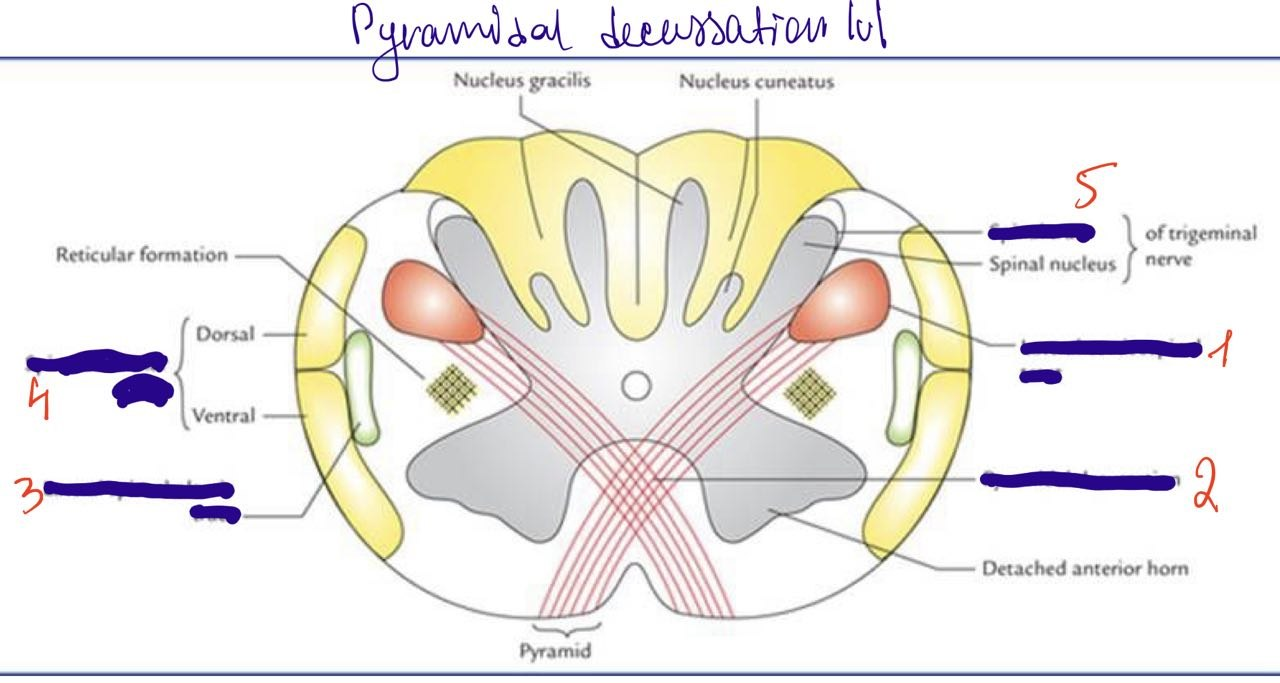
Pyramidal decussation level tracts and structures
Lateral corticospinal tract, pyramidal decussation, lateral spinothalamic tract, spinocerebellar tract, spinal tract

lemniscal decussation level structures
nucleus gracilis, nucleus cuneatus, internal arcuate fibers, medial lemniscus
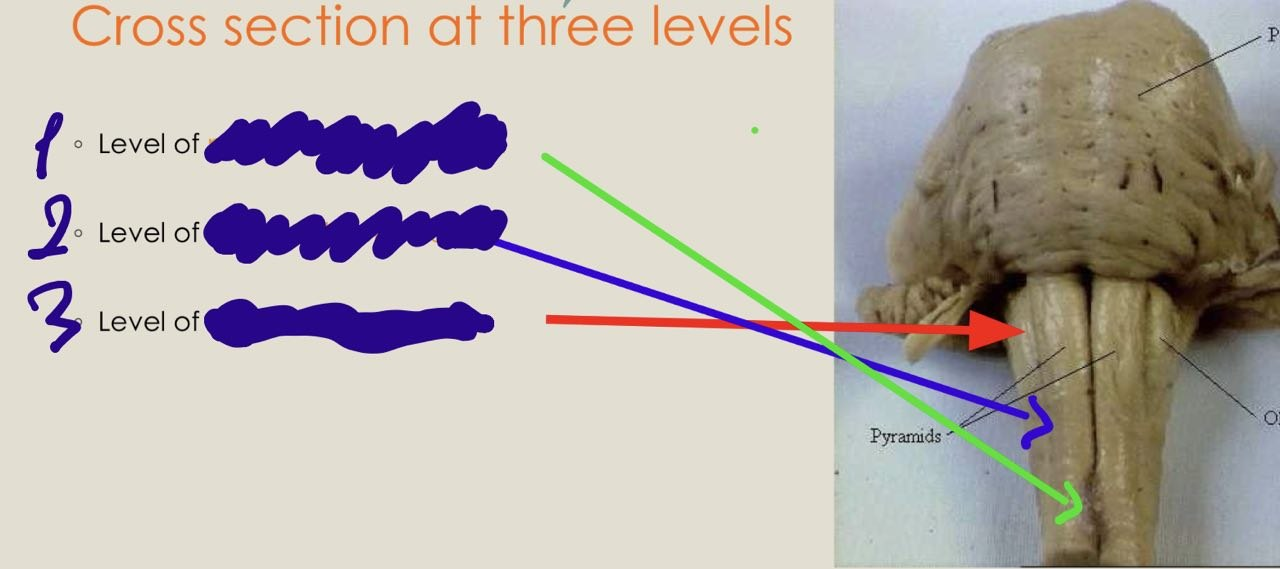
identify levels of medulla
pyramidal decussation, lemniscal decussation, inferior olivary nuclei
what we see in level of inferior olives (пж посмотрите 39 слайд)
hypoglossal nucleus, medial and inferior vestibular nuclei, arcuate nuclei, MLF, inferior cerebellar peduncle, inferior olivary nuclei

cranial nuclei of medulla
Nucleus ambiguus, spinal trigeminal tract, nucleus solitarious, vestibular nuclei, dorsal motor nucleus of X, CN XII (hypoglossal nucleus?)
what nuclei/tracts have CN IX glossopharyngeal n
Nucleus solitarious, Nucleus ambiguus, spinal trigeminal tract, inferior salivatory
what nuclei have CN X vagus n
dorsal motor nucleus of X, N. solitarious, N. ambiguus, spinal trigeminal tract
Spinal trigeminal tract IX supply
sensation behid ear
Nucleus solitarious IX supply
posterior 1/3 of the tongue
N. ambiguus IX supply
stylopharyngeus - lifts pharynx
inf salivatory nucleus
parotid gland, parasympathetic
Dorsal motor nucleus of X
parasympathetic preganglionic
spinal trigeminal tract CN X supply
ear
N solitarious CN X
epiglottis, taste, cardiorespiratory
N ambiguus CN X
pharynx, larynx
Medial medullary syndrome (Dejerine syndrome/ inf alternating hemiparesis) is caused by occlusion of
vertebral artery/ anterior spinal artery in medulla
Medial medullary syndrome affects which structures
corticospinal tract, medial lemniscus, hypoglossal nucleus nerve
Medial medullary syndrome signs
contralateral hemiplegia, contralateral loss of position and vibratory sense and discriminative touch, deviation of tongue ipsilaterally, muscle atrophy and fasciculation
Lateral medullary syndrome (Wallenburg syndrome or PICA) caused by occlusion of
posterior inferior cerebellar artery - branch of vertebral
Lateral medullary syndrome affects
Inferior cerebellar peduncle, Spinothalamic tract, Descending sympathetic fibers, Nucleus ambiguus, Nucleus Solitarius, Spinal nucleus and tract of Trigeminal
Lateral medullary syndrome signs
Contralateral loss of pain and temperature of body
Ipsilateral loss of pain and temperature of face
Dysphagia, soft palate paralysis, hoarseness, diminished gag reflex
Ipsilateral Horner syndrome
Nausea, diplopia, tendency to fall to ipsilateral side
Ataxia to ipsilateral side