5.5: Plant and animal responses
 Call Kai
 Learn
 Practice Test
 Spaced Repetition
 Match
 Flashcards
 Knowt Play
1/205

There's no tags or description
Looks like no tags are added yet.
206 Terms
Why is it important for plants to respond to the environment?
to avoid abiotic stress
to avoid herbivory
to maximise photosynthesis
to help ensure germination
to survive long enough to reproduce
What is abiotic stress?
on-living factors in the environment that can negatively affect an organisms survival
What are some examples of abiotic stresses?
Changes in day length.
Excessive cold and heat.
Lack of water or excess water.
High winds.
Changes in salinity.
What are some plant responses to herbivory?
tannins
alkaloids
pheromones
What are alkaloids?
bitter nitrogen-containing compounds which are a feeding deterrent to animals
What are the effects of alkaloids?
acts as drugs and affect the metabolism of animals, discouraging herbivores from consuming them
like caffeine and nicotine are toxic or poisonous to animals
What are tannins?
compounds that have a bitter taste and are toxic to insects. In the roots, they prevent the infiltration of pathogenic microorganisms
What are pheromones?
chemicals made by organisms that affect the behaviour or physiology of another
What are tropisms?
a directional growth response of plants in which the direction of the response is determined by the direction of the external stimulus
What are key examples of tropisms?
phototropism
geotropism
hydrotropism
chemotropism
thigmotropism
What is phototropism?
the plants response to light
What is the difference between positive and negative phototropism and where does each happen in a plant?
positive - growth towards light - stem tip - to get max light for photosynthesis
negative - growth away from light - root tip - less chance of drying out
What is geotropism?
growth response to the earth’s gravitational field. This anchors them in soil and helps them to take up water and nitrates
What is the difference between positive and negative geotropism and where do they happen?
positive - grow towards gravity - roots
negative - grow away from gravity - shoots
What is hydrotropism?
plant’s growth response to the earth’s water - plants show positive because they grow toward water
What is chemotropism?
a directional growth response in plants to chemicals e.g on a flower, pollen tubes grow down the style, attracted by chemicals
What is thigmotropism?
a plant’s growth response to the touch (e.g mimosa pudica folds its leaves when touched)
What are non-directional responses to external stimuli called?
nastic responses
What are the ways that hormones travel around plants?
active transport
diffusion
mass flow in the phloem sap or xylem vessels
What are the key plant hormones to be aware of?
cytokinins
abscisic acid
auxins
gibberelins
ethene
What is the effect of cytokinins?
promote cell division in roots and shoots
other: delay leaf senescence (aging), promote cell expansion
What is the effect of gibberellins?
controls stem elongation and seed germination
Outline the process of germination
seed absorbs water causing embryo to synthesise gibberellin
in response, amylase (starch to glucose) and protease (protein to amino acid) are synthesised and break down the food store
glucose is then used in respiration for energy and growth, and amino acids used to make proteins
What is the effect of abscisic acid (ABA)?
inhibits seed germination and growth ; causes stomatal closure when plant is stressed
What is the effect of auxin (IAA)?
promote cell elongation; maintain apical dominance (inhibit lateral growth) ; inhibit leaf abscission; inhibits ethene
What is the effect of ethene?
promotes fruit ripening and leaf fall
Where is auxin produced?
in the shoot tips
What is apical dominance?
inhibition of lateral buds further down the shoot
the main shoot (apical bud) grows more than side shoots
Why is apical dominance useful?
plant grows taller
better access to light
reduces competition between its own branches
What can override apical dominance?
directly applying cytokinins to buds
What does “antagonistic hormones” mean?
Hormones that have opposite effects on the same process
How do auxins and cytokinins act antagonistically?
Auxins → inhibit lateral bud growth (maintain apical dominance)
Cytokinins → stimulate lateral bud growth
How do gibberellins and ABA act antagonistically in seed germination?
Gibberellins → promote germination
ABA → maintain seed dormancy and inhibit germination
Where does auxin accumulate in phototropism?
On the shaded side
What happens when light shines all over the plant?
auxin is spread promoting even growth
What happens to auxin in geotropism when in the shoots?
negative geotropism - It accumulates on the lower side due to gravity - stimulates cell elongation - lower side elongates and bends upwards
What happens to auxin in geotropism when in the roots?
positive geotropism - accumulates on lower side - inhibits cell elongation - upper side elongates downwards
What is a clinostat?
A device that rotates plants.
What does a clinostat show?
That gravity controls growth direction
Why are plant hormones useful commercially?
They allow control of growth, timing, and yield
Which hormone is used in rooting powders?
Auxin
What do auxins do in rooting powder?
Stimulate root initiation
What cellular process do auxins stimulate?
Cell elongation and differentiation into root tissue - good for producing seedless plants
Why is cloning beneficial?
Produces genetically identical plants
What happens if auxin concentration is too high?
Growth is inhibited
What type of auxins are used as weed killers?
Synthetic auxins
How do synthetic auxins kill plants?
high amounts cause uncontrolled growth in broad leaved weeds that plant can’t support→ death
What are the advantages of auxin as a weed killer?
cheap and less harmful to the environment
Why are they selective?
broad‑leaved weeds absorb and transport synthetic auxins more rapidly than monocot crops
Why do plants die from excess growth?
Resources depleted and tissues damaged
Which hormone controls fruit ripening?
Ethene
What does ethene do to enzymes?
Increases enzyme activity
What happens to cell walls?
Broken down → fruit softens
Why are fruits picked unripe?
To prevent damage during transport, specifically from warmer to cooler climates
When is ethene applied?
During storage before sale
Why is this useful commercially?
Controls timing and ensures uniform ripening
How are gibberellins useful commercially?
used in beer brewing to produce malt (used to delay ripening and ageing of fruit)
How are cytokinins useful commercially?
prevent ageing in ripened fruit, extending shelf life. also in micropropagation in the formation of shoots
What structures make up the CNS?
Brain and spinal cord (many relay neurons and synapses)
Function of CNS?
Processes information and coordinates responses
What does the PNS include?
All nerves outside the CNS that connect it to the rest of the body
What does the PNS branch into?
sensory system and motor system (which contain sensory and motor neurons)
What does the PNS further divide into?
the somatic and autonomic nervous system
What does the somatic nervous system control?
Voluntary movement/ conscious movement e.g moving arm
Which muscles does it control?
Skeletal muscles
What does the autonomic nervous system control?
Involuntary actions / subconscious control (e.g heart beat)
What effectors are involved?
Smooth muscle, cardiac muscle, glands
What is a ganglion?
A cluster of neuron cell bodies in the PNS, forming a swelling on a nerve fibre
What does the autonomic nervous system divide into?
the sympathetic nervous system and parasympathetic nervous system
Function of sympathetic nervous system?
Fight or flight
What neurotransmitter does the sympathetic nervous system release?
adrenaline and noradrenaline
Describe the neurone lengths in the sympathetic nervous system.
Short preganglionic neurones; long postganglionic neurones.
What are some of the effects of the sympathetic nervous system?
increases heart rate
increases ventilation rate
dilates pupils
reduces digestive activity
orgasm
What is the overall function of the parasympathetic nervous system?
Rest and digest responses
Which neurotransmitter is used by the parasympathetic nervous system?
Acetylcholine
Describe the neurone lengths in the parasympathetic nervous system.
Long preganglionic neurones; short postganglionic neurones.
What are some of the effects of the parasympathetic nervous system?
decreases heart rate
constricts pupils
reduces ventilation rate
increases digestive activity
sexual arousal
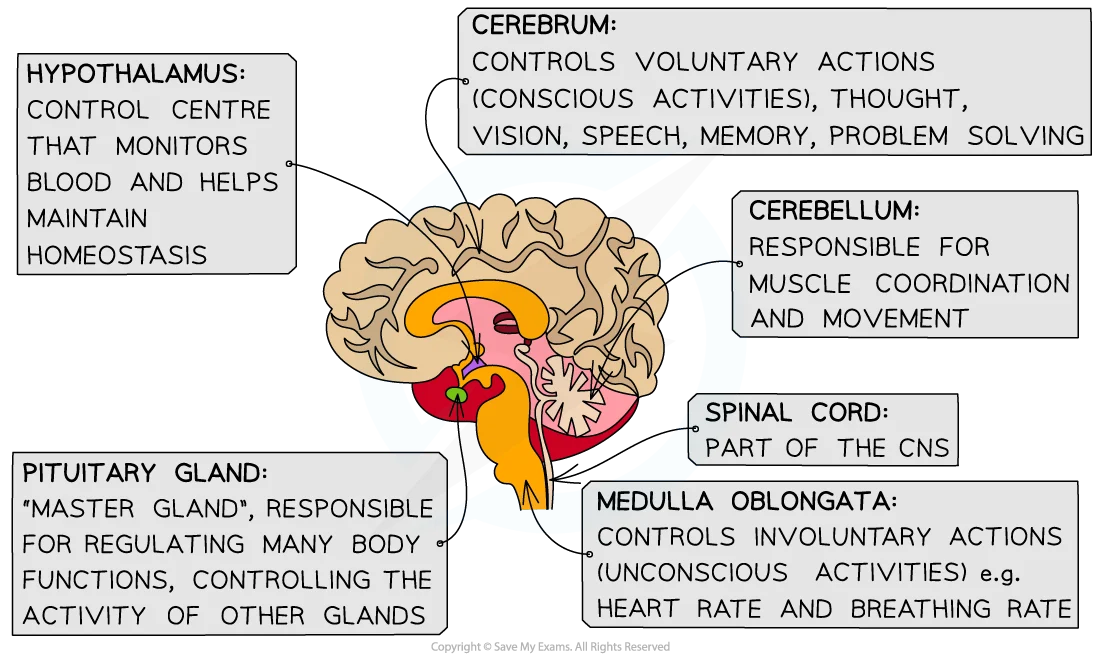
What are the 5 key parts of the brain I need to know?
cerebellum
cerebrum
medulla oblongata
pituitary gland
hypothalamus
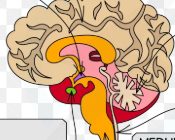
Label this brain
Why is the brain highly folded?
Increases surface area
Allows more neurones → more processing
What is the cortex?
Outer layer containing grey matter
What is white matter?
Myelinated axons
What does the cerebrum do?
controls voluntary actions, such as learning, memory, personality, conscious thought and movement
What is some of the structure of the cerebrum?
largest part of brain
divided into 2 cerebral hemispheres
connected by corpus callosum
What does the cerebellum do?
controls unconscious functions such as posture, balance and non-voluntary movement
What does the medulla oblongata do?
it is used in autonomic control e.g controlling heart rate, swallowing and breathing rate
What does the pituitary gland do?
controls the endocrine system - stores and releases hormones that regulate many body functions e.g FSH, LH, GH (it is controlled by the hypothalamus)
What are the 2 main sections of the pituitary gland?
the anterior (FSH) and posterior pituitary gland (ADH)
What does the hypothalamus do?
maintains homeostasis - regulatory centre for body temp and balance of blood water potential (osmoreceptors and thermoreceptors found here)
What is a reflex action?
a response that does not involve any processing by the brain
Why are reflexes important?
survival value - they prevent injury, protect vital organs, maintain posture and balance
How do reflexes have survival value?
involuntary response
not having to be learnt - present at birth
extremely fast
What is a reflex arc?
Pathway of a reflex action
What is the pathways of the reflex arc?
Stimulus → Receptor → Sensory neurone → Relay neurone (in CNS) → Motor neurone → Effector → Response
Why are reflexes fast?
Short pathway
doesn’t go to conscious brain initially
Few synapses
synapses slow transmission due to chemical transmission
Automatic
no decision-making
What is a spinal reflex?
A reflex where the co‑ordination centre is the spinal cord.
What is a cranial reflex?
A reflex where the co‑ordination centre is in the brain (brainstem)
What is the knee-jerk reflex?
a spinal reflex that is monosynaptic and is used to help maintain balance and posture
Why is the knee-jerk reflex monosynaptic?
as there is no relay neurone
Describe the knee-jerk reflex
tap on patellar tendon (just under knee cap) stretches the quadriceps muscle
stretch receptors (muscle spindles) in quadriceps detect stretch
muscle spindles send impulse along a sensory neurone to spinal chord
here, sensory neurone synapses directly with a motor one
motor neurone carries impulse back to quadriceps muscle
quadriceps contract suddenly, causing lower leg to kick forward
brain is informed afterwards