Cranial Nerves - Motor Innervation
 Call Kai
 Learn
Learn Practice Test
 Spaced Repetition
 Match
Match Flashcards
 Knowt Play
1/19

There's no tags or description
Looks like no tags are added yet.
Name | Mastery | Learn | Test | Matching | Spaced | Call with Kai | Chat |
|---|
No analytics yet
Send a link to your students to track their progress
20 Terms
what 6 cranial nerves and one plexus provide motor innervation to the swallowing mechanism?
trigeminal nerve (V)
facial nerve (VII)
glossopharyngeal (IX)
vagus (X)
accessory (XI)
hypoglossal (XII)
cervical plexus

the mandibular branch of the trigeminal nerve provides motor innveration to which 7 muscles?
temporalis
masseter
medial pterygoid
lateral pterygoid
tensor veli palatini
mylohyoid
anterior belly of the digastric

what are the 3 closer muscles of mastication? what nerve are they innervated by and what is their function?
all innervated by trigeminal nerve - mandibular branch
temporalis
elevates, closes, and retracts the mandible
masseter
elevates and closses the mandible
medial pterygoid (aka internal pterygoid)
elevates and closes the mandible

what is the 1 opener muscle of mastication? what nerve is it innervated by and what is its function?
innervated by trigeminal nerve - mandibular branch
lateral pterygoid muscle (aka external pterygoid muscle) (pterygoid = “like a wing” in latin)
depresses, opens, protrudes the mandible
permits side to side chewing motion

name these two muscles. what are their functions? what nerve and branch are they innervated by?
top: temporalis → elevate and close the mandible
bottom: masseter → elevate and close the mandible
innervated by mandibular branch of trigeminal nerve
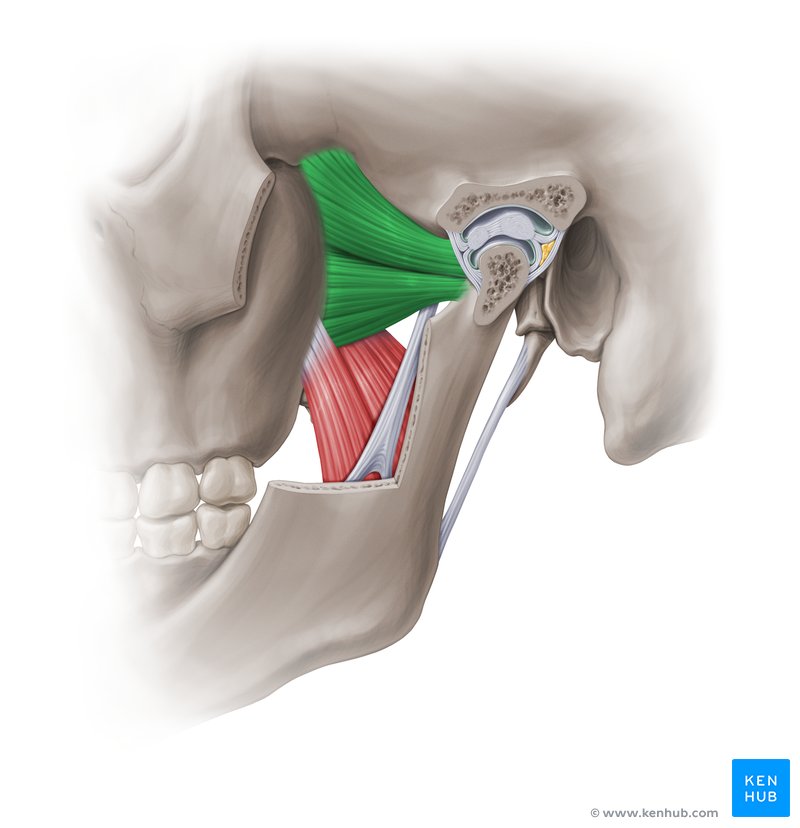
name these two muscles. what are their functions? what nerve and branch are they innervated by?
green: lateral pterygoids → opens the mandible (Lowers the jaw)
pink: medial pterygoids → elevates and closes the mandible
both innervated by mandibular branch of the trigeminal nerve

what is the function (unilaterally and bilaterally) of the tensor veli palatini? what nerve is it innervated by?
unilaterally: tenses and pulls the soft palate laterally towards the same side
bilaterally: tenses and flattens the soft palate
innervated by mandibular branch of the trigeminal nerve
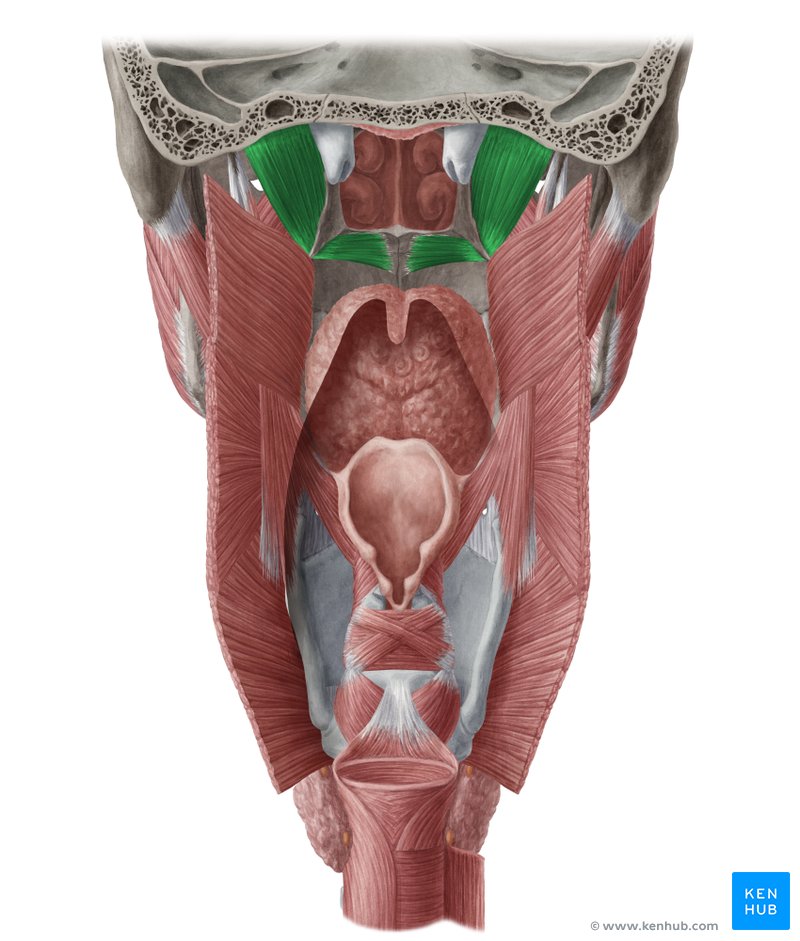
name this muscle and innervation
tensor veli palatini, mandibular branch of trigeminal nerve

what is the function of the mylohyoid? origin and insertion?
what nerve is it innervated by?
elevates the hyoid bone during swallowing, forms the floor of the oral cavity.
origin: mandible
insertion: hyoid bone

what are the two functions of the anterior belly of the digastric for swallowing? what nerve is it innervated by?
elevates the hyoid when jaw is fixed during the swallow
depresses the jaw when the hyoid is fixed during chewing
innervated by the mandibular branch of the trigeminal nerve

what are the two branches of the facial nerve we care about?
buccal and mandibular

which 3 muscles innervated by the facial nerve are we interested in? what is their function?
buccinator (trumpeter muscle): provides tone, flattens and puffs cheek, holds food in contact with cheek
orbicularis oris: closes, opens, protrudes, inverts, and twists the lips
stylohyoid: elevates hyoid and BOT, helps to retract the BOT
![<p>the facial nerve provides [bilateral/unilateral] UMN innervation to the <strong>upper</strong> face. what does this mean?</p>](https://assets.knowt.com/user-attachments/73db8563-c51f-4b83-a815-cb5f8b769a16.jpg)
the facial nerve provides [bilateral/unilateral] UMN innervation to the upper face. what does this mean?
bilateral → means that the nerve sends info to both contralateral and ipsilateral sides
![<p>the facial nerve provides [bilateral/unilateral] UMN innervation to the <strong>lower</strong> face. what does this mean?</p>](https://assets.knowt.com/user-attachments/2d6425ae-9b3a-4b58-827c-77321cd2f44e.jpg)
the facial nerve provides [bilateral/unilateral] UMN innervation to the lower face. what does this mean?
unilateral → means that the nerve sends info to only contralateral side

if a patient has a left sided stroke, as pictured, name the percentage of impairment for each quadrant of the face
A: 50 % impairment
B: 50% impairment
C: 100% impairment
D : 0% impairment

what is the only portion of the glossopharyngeal nerve (IX) that is motor? what is its function? is it a horizontal or longitudinal muscle of the pharynx?
stylopharyngeus muscle (styloid process → pharynx)
longitudinal muscle → elevates and DILATES the pharynx, as it is pulled slightly posteriorly
![<p>most pharyngeal muscles have [horizontal/longitudinal] fibers that squeeze the esophagus</p>](https://assets.knowt.com/user-attachments/f5b6a9ae-204b-426b-8399-a779059abab7.jpg)
most pharyngeal muscles have [horizontal/longitudinal] fibers that squeeze the esophagus
horizontal fibers

what 3 branches of the vagus nerve (X) are we interested in for motor innervation?
pharyngeal
superior laryngeal branch (external)
recurrent laryngeal nerve
what are the 8 muscles of the pharyngeal branch (vagus nerve) that we are interested in? what are their functions?
palatoglossus (aka anterior faucial pillars): palate → tongue. an extrinsic tongue muscle that either lowers the soft palate or raises the tongue
palatopharyngeus (aka posterior faucial pillars): palate → pharynx. elevates the pharynx
salpingopharyngeus: eustachian tube → pharynx. elevates upper posterior pharyngeal walls and nasopharynx
levator veli palatini: raises soft palate, seals nasopharynx during swallowing
3 constrictors (superior, medial, inferior): circular contraction of the pharynx, squeezes the bolus down
cricopharyngeal muscle: helps make up UES

what are the 3 longitudinal pharyngeal muscles, their function, and their innervation?
stylopharyngeus: elevating and dilating the pharynx. innervated by CN IX (glossopharyngeal)
palatopharyngeus: elevates the pharynx
salpingopharyngeus: elevates the upper posterior pharyngeal walls and nasopharynx, blends with palatopharyngeus