lecture 7 - tissues: epithelial tissue

0.0(0)
Studied by 0 people
call kaiCall Kai
learnLearn
examPractice Test
spaced repetitionSpaced Repetition
heart puzzleMatch
flashcardsFlashcards
GameKnowt Play
Card Sorting

1/49

encourage image

There's no tags or description

Looks like no tags are added yet.

50 Terms

1
New cards

4 main types of tissues

  1. epithelial

  2. connective

  3. muscle

  4. nervous


2
New cards

histology

looking at the cellular + non-cellular components of tissue via staining or imaging techniques at a microscopic level

3
New cards

3 ways tissues are classified

  1. structure/shape of cells

  2. how they function

  3. extracellular matrix


4
New cards

extracellular matrix

non-cellular component that surrounds cells

5
New cards

what does epithelial tissue do?

  • protective coverings of surfaces inside + outside the body

    • skin

    • lines digestive, respiratory + urogenital systems

    • heart + blood vessels

    • line body cavities

  • forms glands

  • permit the passage of substances (e.g. helps kidney filter out toxins)

  • secreting substances (e.g. pancreas)

  • absorbing substances (e.g. lining of small intestine)


6
New cards

what are the 3 distinct cell surfaces of epithelium?

  • free (apical)

  • basal

  • lateral


7
New cards

free/apical surface

type of epithelial cell surface (top of epithelial cells)

  • lines:

    • lumen of ducts

    • inside of vessels

    • space in cavity


<p>type of epithelial cell surface (top of epithelial cells)</p><ul><li><p>lines:</p><ul><li><p>lumen of ducts</p></li><li><p>inside of vessels</p></li><li><p>space in cavity</p></li></ul></li></ul><p></p>
8
New cards

basal surface

type of epithelial cell surface

  • attached to the basement membrane


<p>type of epithelial cell surface</p><ul><li><p>attached to the basement membrane</p></li></ul><p></p>
9
New cards

basement membrane

  • holds all the cells together (“glue”)

  • also helps attach the epithelial tissue to the underlying connective tissue

  • lies underneath the cells

  • typically porous (permeable)


<ul><li><p>holds all the cells together (“glue”)</p></li><li><p>also helps attach the epithelial tissue to the underlying connective tissue</p></li><li><p>lies underneath the cells</p></li><li><p>typically porous (permeable)</p></li></ul><p></p>
10
New cards

how is the basement membrane formed?

  • secretions of epithelial + connective tissue


<ul><li><p>secretions of epithelial + connective tissue</p></li></ul><p></p>
11
New cards

lateral surface

type of epithelial cell surface

  • sides of the epithelial cells


<p>type of epithelial cell surface</p><ul><li><p>sides of the epithelial cells</p></li></ul><p></p>
12
New cards

characteristics of epithelial tissue

  • many closely packed together

  • little to no extracellular matrix

  • avascular

  • capable of regeneration


<ul><li><p>many closely packed together</p></li><li><p>little to no extracellular matrix</p></li><li><p>avascular</p></li><li><p>capable of regeneration</p></li></ul><p></p>
13
New cards

characteristics of connective tissue

  • scattered cells

  • surrounded by large amounts of extracellular matrix


14
New cards

it is the components of the __________ _____, along with the cell types, that differentiate b/w different types of connective tissue

extracellular matrix

15
New cards

what is the most common cell surface modifications?

microvilli (brush border)
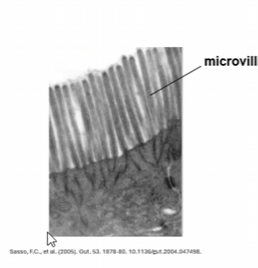
<p>microvilli (brush border)</p>
16
New cards

microvilli (brush border)

the most common cell surface modifications

  • finger-like projections that come out of the free (apical) surface of epithelial cells

  • increase surface area for absorption/secretion


<p>the most common cell surface modifications</p><ul><li><p>finger-like projections that come out of the free (apical) surface of epithelial cells</p></li><li><p>increase surface area for absorption/secretion</p></li></ul><p></p>
17
New cards

what is another common cell surface modification?

cilia

<p>cilia</p>
18
New cards

cilia

a common cell surface modification

  • help move materials along a surface


<p>a common cell surface modification</p><ul><li><p>help move materials along a surface</p></li></ul><p></p>
19
New cards

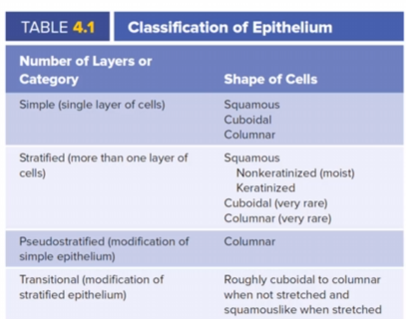
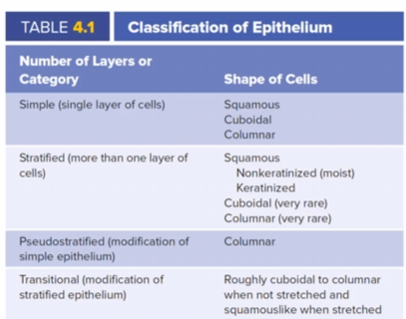
how are epithelial tissues classified?

  1. # of layers of cells

  2. shape of cells


<ol><li><p># of layers of cells</p></li><li><p>shape of cells</p></li></ol><p></p>
20
New cards

simple

1 layer of cells

<p>1 layer of cells</p>
21
New cards

stratified

more than 1 layer of cells

<p>more than 1 layer of cells</p>
22
New cards

if a tissue is stratified, it is the shape of the tissue on the ___ layer that’s used to name the tissue

free

<p>free</p>
23
New cards

in a stratified epithelium tissue, only the _____ layer attaches to the basement membrane. all the other layers will attach to the cells that are just beneath them

bottom

<p>bottom</p>
24
New cards

pseudostratified

appears to be stratified (isn’t) but all cells connect w/ the basement membrane

  • nuclei are found in different areas


<p><u>appears</u> to be stratified (isn’t) but all cells connect w/ the basement membrane</p><ul><li><p>nuclei are found in different areas</p></li></ul><p></p>
25
New cards

squamous

flat, scale-like cells

<p>flat, scale-like cells</p>
26
New cards

cuboidal

cells shaped like cubes

<p>cells shaped like cubes</p>
27
New cards

columnar

cells shaped like columns

<p>cells shaped like columns</p>
28
New cards

characteristics of simple epithelial tissues

  • diffusion of gases

  • filtration of blood

  • secretion

  • absorption


<ul><li><p>diffusion of gases</p></li><li><p>filtration of blood</p></li><li><p>secretion</p></li><li><p>absorption</p></li></ul><p></p>
29
New cards

characteristics of stratified epithelial tissues

  • protection (particularly against abrasion)


<ul><li><p>protection (particularly against abrasion)</p></li></ul><p></p>
30
New cards

characteristics of pseudostratified epithelial tissues

  • modification of simple epithelial tissues

  • secretion and moving of mucus


<ul><li><p>modification of simple epithelial tissues</p></li><li><p>secretion and moving of mucus</p></li></ul><p></p>
31
New cards

characteristics of squamous epithelial tissues

  • diffusion

  • filters


<ul><li><p>diffusion</p></li><li><p>filters</p></li></ul><p></p>
32
New cards

characteristics of cuboidal + columnar epithelial tissues

  • secretion/absorption

  • may include goblet cells


<ul><li><p>secretion/absorption</p></li><li><p>may include goblet cells</p></li></ul><p></p>
33
New cards

goblet cells

cuboidal/columnar epithelial cells that produce and secrete mucus
<p>cuboidal/columnar epithelial cells that produce and secrete mucus</p>
34
New cards

keratinized

outer layer of cells is made of dead cells that contain the protein keratin

  • makes the tissue more durable + moisture resistant (e.g. skin)


<p>outer layer of cells is made of dead cells that contain the protein keratin</p><ul><li><p>makes the tissue more durable + moisture resistant (e.g. skin)</p></li></ul><p></p>
35
New cards

what types of tissues are rare in the body?

stratified cuboidal and stratified columnar

<p>stratified cuboidal and stratified columnar</p>
36
New cards

transitional epithelium

stratified cuboidal or columnar tissue that can stretch and appear to be squamous
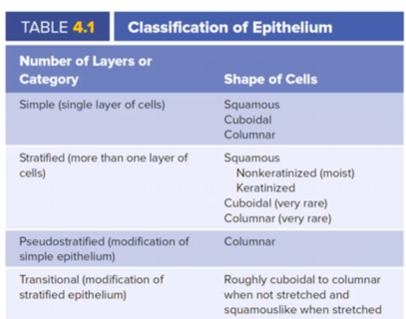
<p>stratified cuboidal or columnar tissue that can stretch and appear to be squamous</p>
37
New cards

simple squamous epithelium description

  • single layer of flat cells

  • function:

    • diffusion

    • filtration

    • secretion

  • location:

    • lining of blood vessels (endothelium)

    • alveoli

    • Bowman’s capsule

    • lining of serous membranes


<ul><li><p>single layer of flat cells</p></li><li><p>function:</p><ul><li><p>diffusion</p></li><li><p>filtration</p></li><li><p>secretion</p></li></ul></li></ul><ul><li><p>location:</p><ul><li><p>lining of blood vessels (endothelium)</p></li><li><p>alveoli</p></li><li><p>Bowman’s capsule</p></li><li><p>lining of serous membranes</p></li></ul></li></ul><p></p>
38
New cards

simple cuboidal epithelium description

  • single layer of cube-shaped cells

  • location:

    • kidney tubules

    • glands + ducts

    • surface of ovaries

  • functions:

    • secretion + absorption


<ul><li><p>single layer of cube-shaped cells</p></li><li><p>location:</p><ul><li><p>kidney tubules</p></li><li><p>glands + ducts</p></li><li><p>surface of ovaries</p></li></ul></li><li><p>functions:</p><ul><li><p>secretion + absorption</p></li></ul></li></ul><p></p>
39
New cards

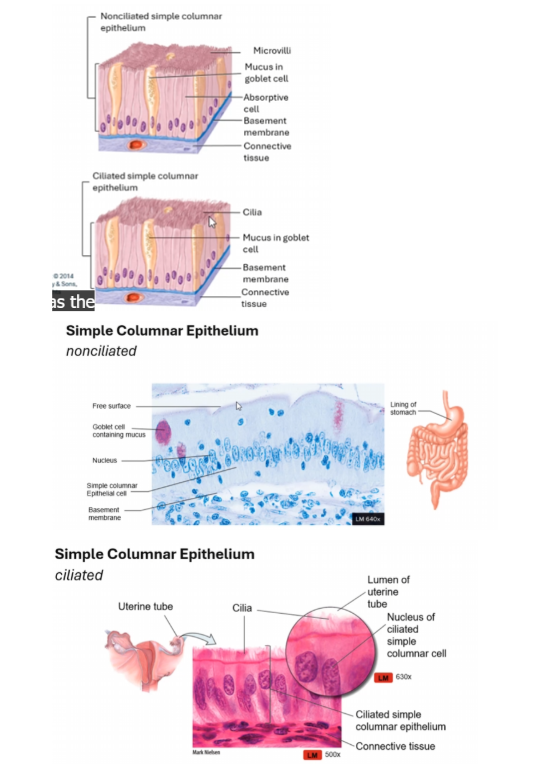
simple columnar epithelium description

  • single layer of tall narrow cells

    • some have cilia or microvilli

  • location:

    • glands

    • bronchioles

    • uterus

    • uterine tubes

    • stomach

    • intestines

    • gallbladder

    • ventricles of the brain

  • functions:

    • movement of particles out of the bronchioles

    • movements of oocytes through uterine tubes by ciliated cells

    • secretion by glands of the stomach + intestine

    • absorption by cells of the intestine


<ul><li><p>single layer of tall narrow cells</p><ul><li><p>some have cilia or microvilli</p></li></ul></li><li><p>location:</p><ul><li><p>glands</p></li><li><p>bronchioles</p></li><li><p>uterus</p></li><li><p>uterine tubes</p></li><li><p>stomach</p></li><li><p>intestines</p></li><li><p>gallbladder</p></li><li><p>ventricles of the brain </p></li></ul></li><li><p>functions:</p><ul><li><p>movement of particles out of the bronchioles</p></li><li><p>movements of oocytes through uterine tubes by ciliated cells</p></li><li><p>secretion by glands of the stomach + intestine</p></li><li><p>absorption by cells of the intestine</p></li></ul></li></ul><p></p>
40
New cards

microvilli are also called a ____ _____

brush border (bc they give the appearance of a brush)

<p>brush border (bc they give the appearance of a brush)</p>
41
New cards

pseudostratified columnar epithelium description

  • all cells reach basement membrane

    • almost always ciliated + associated w/ goblet cells

  • locations:

    • lining of most upper respiratory tracts (ciliated)

    • male urethra + epididymis (nonciliated)

  • functions:

    • create + secrete mucus

    • move mucus/fluid that contains foreign particles

    • absorption + protection


<ul><li><p>all cells reach basement membrane</p><ul><li><p>almost always ciliated + associated w/ goblet cells</p></li></ul></li><li><p>locations:</p><ul><li><p>lining of most upper respiratory tracts (ciliated)</p></li><li><p>male urethra + epididymis (nonciliated)</p></li></ul></li><li><p>functions:</p><ul><li><p>create + secrete mucus</p></li><li><p>move mucus/fluid that contains foreign particles</p></li><li><p>absorption + protection</p></li></ul></li></ul><p></p>
42
New cards

stratified squamous epithelium description

  • flat with multiple layers

  • locations:

    • nonkeratinized:

      • mouth

      • throat

      • esophagus

      • anus

      • vagina

    • keratinzed:

      • skin

  • functions:

    • protection against abrasion

    • protection against UV radiation

    • protection against water loss

    • protection against infection


<ul><li><p>flat with multiple layers</p></li><li><p>locations:</p><ul><li><p>nonkeratinized:</p><ul><li><p>mouth</p></li><li><p>throat</p></li><li><p>esophagus</p></li><li><p>anus</p></li><li><p>vagina</p></li></ul></li><li><p>keratinzed:</p><ul><li><p>skin</p></li></ul></li></ul></li><li><p>functions:</p><ul><li><p>protection against abrasion</p></li><li><p>protection against UV radiation</p></li><li><p>protection against water loss</p></li><li><p>protection against infection</p></li></ul></li></ul><p></p>
43
New cards

transitional epithelium description

  • stratified cells that can change shape depending on the amount of swelling/distention of the organ

  • location:

    • lining of urinary system (e.g. bladder)

  • functions:

    • accommodates fluctuations in the volume of fluid in an organ/tube

    • protects against caustic effects of urine


<ul><li><p>stratified cells that can change shape depending on the amount of swelling/distention of the organ</p></li><li><p>location:</p><ul><li><p>lining of urinary system (e.g. bladder)</p></li></ul></li><li><p>functions:</p><ul><li><p>accommodates fluctuations in the volume of fluid in an organ/tube</p></li><li><p>protects against caustic effects of urine</p></li></ul></li></ul><p></p>
44
New cards

glands

epithelium w/ a supporting network of connective tissue

  • single cell or mass of epithelial cells adapted for secretion


<p>epithelium w/ a supporting network of connective tissue</p><ul><li><p>single cell or mass of epithelial cells adapted for secretion</p></li></ul><p></p>
45
New cards

2 types of glands formed by the epithelium

  1. endocrine glands

  2. exocrine glands


<ol><li><p>endocrine glands</p></li><li><p>exocrine glands</p></li></ol><p></p>
46
New cards

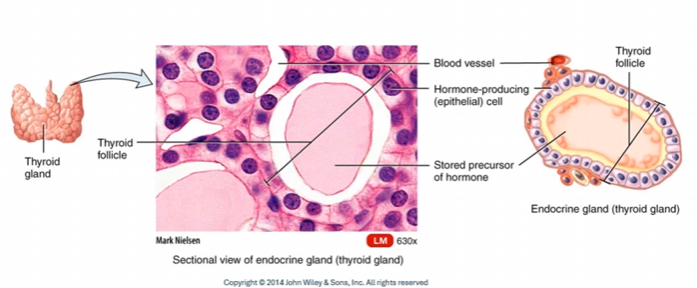
endocrine glands

  • no open contact w/ exterior

  • no ducts

  • produce hormones


<ul><li><p>no open contact w/ exterior</p></li><li><p>no ducts</p></li><li><p>produce hormones</p></li></ul><p></p>
47
New cards

exocrine glands

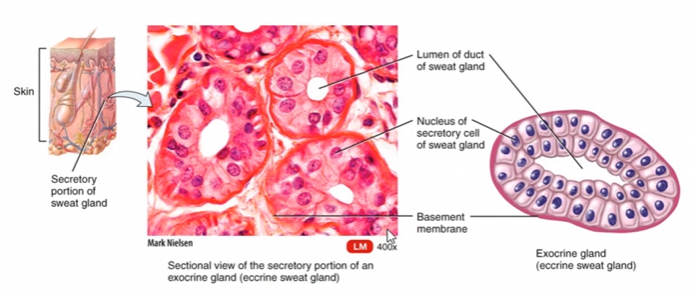
  • open contact w/ exterior

  • have ducts


<ul><li><p>open contact w/ exterior</p></li><li><p>have ducts</p></li></ul><p></p>
48
New cards

exocrine glands examples

  • sweat glands

  • oil glands

  • mammary glands


<ul><li><p>sweat glands</p></li><li><p>oil glands</p></li><li><p>mammary glands</p></li></ul><p></p>
49
New cards

what epithelium type is subclassified into keratinzed and non-keratinized?

stratified squamous epithelium

<p>stratified squamous epithelium</p>
50
New cards

true or false: glands that secrete mucus into the digestive tract lumen are exocrine because the lumen is considered an "exterior surface"

true