Cultural Psych: Chapter 6
 Call Kai
 Learn
 Practice Test
 Spaced Repetition
 Match
 Flashcards
 Knowt Play
1/23

Earn XP
Description and Tags
Self and Personality
24 Terms
Independent view of self
Self derives its identity form inner attributes:
Distinct form their relationships
Stable across situations and life span
Unique, self-contained, and coherent
Fluid between ingroups and outgroups

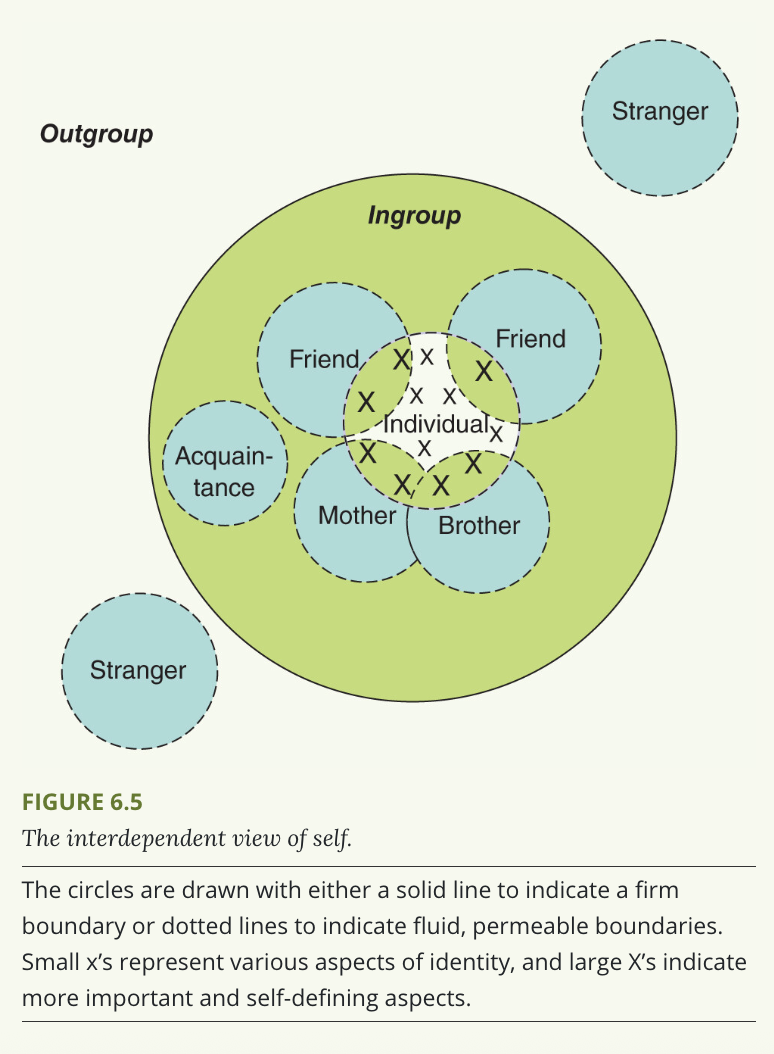
Interdependent view of self
The individual is a relational entity who is fundamentally connected to, and sustained by, a number of significant relationships
Model views themselves as being defined by social relationships and roles
Behavior depends on the perceptions of others’ thoughts/feelings/actions
Identity is experienced as somewhat fluid and permeable, and the role the person occupies in a situation, and the experience itself will vary accordingly
People do not easily become ingroup members, nor do close relationships turn into outgroup relationships
Individualism + independent view of self
Individualistic cultures
encourage thoughts and behaviors fostering independent self-concepts
Value distinctiveness from others and being self-sufficient
Collectivism + interdependent view of self
Encourage thoughts and behaviors fostering interdependent self-concepts
Value close relationships and group members
Higher SES + individualism/independent self
In Iceland higher SES predicts higher individualism and middle-class American parents emphasize importance of teaching children self-direction
because financial and material resource availability reduces a person’s physical + social dependence on others
Lower SES + collectivism/interdependent
In Iceland lower SES predicts higher collectivism and working-class Americans parents emphasize conforming to authority figures
because limited access to material resources and financial security makes interpersonal reliance a necessity for survival
High gender egalitarianism
women should be treated the same as men (Finland, Germany)
Low gender egalitarianism
men should be granted more rights, privileges, and power than women (Pakistan, Nigeria)
Shifting cultivation
soil is dug up with a tool similar to a garden hoe and women do most of the agricultural work
More egalitarian gender roles
Plow cultivation
a large animal pulls a plow, which is generally controlled by a man
women tend not to participate in labor outside and focus on domestic matters
children stay with women due to the dangers of being around plows
the places that adopted the plow are low on gender egalitarianism and female labor force participation today
Self-consistentency
The drive to keep our thoughts, beliefs, values, and actions aligned with our personal self-concept
In a study when participants described themselves while in different contexts with a professor and a fellow student
Japanese participants varied in their self-descriptions depending on the context
American participants responded similarly across contexts
Cognitive Dissonance
a distressed feeling from observing ourselves behaving inconsistently
Cognitive Dissonance Theory
Because we are motivated to be consistent, when we observe our own inconsistencies leads to distress
Self-consistency motivates us toward dissonance reduction (attempts to resolve distress)
changing behaviors to match attitudes
changing attitudes to no longer appear to be inconsistent
Different cultures show dissonance reduction differently
Canadians rationalized their decisions after making a choice for themselves
Japanese rationalized decisions after making a choice for someone else
North Americans appear to aspire toward self-consistency, where EA are more concerned with being consistent with others
Subjective self-awarness
taking the perspective of the subject
an “I” perspective that is focused on the outside world, not the self
usually independent self
less concerned with others’ assessment of us
Objective self-awareness
Experiencing the self as the object
a “me” perspective that is forced to focus inward and conscious of how others see and evaluate us
usually interdependent self
more concerned with others’ assessments
Incremental theory of self (growth mindset)
belief that abilities and traits are malleable and can change or improve
focus on efforts and strategies use
generally characteristic of people with interdependent sense of self (Asian cultures)
Entity theory of self (fixed minset)
belief that abilities and traits are largely fixed and resistant to change, reflecting innate features of the self
blame one’s own innate lack of abilities
generally characteristic of people with independent sense of self (North Americans)
Five-factor model of personality
OCEAN:
1.) Openness to experience
2.) Conscientiousness
3.) Extraversion
4.) Agreeableness
5.) Neuroticism
Openness to experience
creativity and curiosity about the world
Conscientiousness
responsible, dependable, self-discipline
Extraversion
outgoing, social, dominant
Agreeableness
warm, pleasant, considerate
Neuroticism
emotional instability and unpredictability