Green Food Processing
 Call Kai
 Learn
 Practice Test
 Spaced Repetition
 Match
 Flashcards
 Knowt Play
1/19

There's no tags or description
Looks like no tags are added yet.
20 Terms
What is Green Food Processing?
The discovery and design of technical processes that reduce energy, water, and chemical consumption, reduce CO2 generation, allow recycling of by-products through bio-refinery, and ensure safe, high-quality products.
Is any food processing technology inherently green?
No. Context determines the answer. You must define the
product
objective
alternative
system boundary
metrics

What are the five steps to judge if a process is greener?
Product (What are we processing?)
Objective (What must change?)
Alternative (Compared to what?)
System boundary (Processing only or shelf life?)
Metrics (Energy, water, quality, cost).

What is pasteurization?
A conventional preservation method applying heat (60–95 °C for 15–30 seconds) to kill pathogenic microorganisms.
Can cause side effects on nutrients, color, flavor, and freshness.
There is a energy cost (heat)

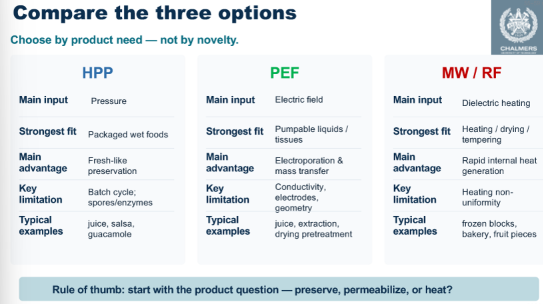
What is High Pressure Processing (HPP)?
A non-thermal preservation technique that uses intense isostatic pressure (100-1000 MPa) to inactivate vegetative microorganisms while minimizing effects on taste, texture, and nutrition (no heat).

How does HPP inactivate microorganisms?
The intense pressure physically disrupts and crushes the microbial cell structure, causing loss of vitality.
Does HPP work well on bacterial spores? (sterilization?)
No. Spores are highly resistant to pressure and require higher pressures (>600 MPa) combined with high temperatures for inactivation.
What is a major limitation of HPP?
It is a batch processing system, which can be a throughput bottleneck, and it has high capital costs.
What types of food is HPP best suited for?
High-moisture, fresh-like foods where quality matters (e.g., guacamole, salsa, juices), that can tolerate compression in flexible packaging.
What is Pulsed Electric Field (PEF)?
A non-thermal processing technique using short, high-voltage electrical pulses (10-60 kV) to induce electroporation in cells.
What is electroporation?
The formation of temporary pores in cell membranes caused by an electric field, leading to a loss of barrier function and leakage of intracellular contents.
How is PEF used for microbial inactivation?
The pores cause cell leakage and loss of vitality, effectively acting as a mild pasteurization for liquids (like juices).
How is PEF used for extraction and drying?
Electroporation disrupts plant cell membranes, allowing intracellular compounds (sugars, bioactives) to move out more easily, reducing the need for solvents and shortening drying times.
What is a major limitation of PEF?
High capital cost, inefficiency against spores, and operational issues if bubbles are present (causing non-uniform treatment).
What is the main difference between conventional heating and dielectric heating?
Conventional heating moves from the outside to the inside (slow, uneven).
Dielectric heating (Microwave/radiofrequency) is volumetric, heating from the inside out (fast, more uniform).
How do Microwaves and Radio Frequency (RF) generate heat?
Through dipole rotation and ionic conduction. Electromagnetic waves cause polar molecules (like water) to rapidly rotate and collide, generating friction and heat.
What is the main difference between Microwave and Radio Frequency (RF)?
Microwaves have higher frequencies and shallower penetration (good for fast heating, but risk of hot spots).
RF has lower frequencies and deeper penetration (better for bulk tempering, drying, and disinfestation).

Why is RF heating useful for frozen meat blocks?
RF provides deep penetration, allowing rapid and uniform volumetric tempering of large, thick blocks before cutting.
What is the main takeaway regarding "Green" processing?
Green food processing is a decision problem, not a technology label. Novel or non-thermal does not automatically mean green; it must be justified by physics, product fit, and measured sustainability trade-offs.
Summary: