Kinematics (2)
 Call Kai
 Learn
Learn Practice Test
 Spaced Repetition
 Match
Match Flashcards
 Knowt Play
1/21

There's no tags or description
Looks like no tags are added yet.
Name | Mastery | Learn | Test | Matching | Spaced | Call with Kai | Chat |
|---|
No analytics yet
Send a link to your students to track their progress
22 Terms
Position
Where object is at time, relative to reference frame
Displacement
Change in position of an object. Has a direction and magnitude (+ or - based on direction)
Δ x = xf - xo
Displacement = final position - initial position
Distance & distance travelled
Magnitude of displacement
Distance travelled is the total length of the path travelled (can be greater than the magnitude of the displacement)
A cyclist rides 3 km west and then turns around and rides 2 km east. (a) What is their displacement? (b) What distance do they ride? (c) What is the magnitude of their displacement?
(a) The rider’s displacement is Δ𝑥=𝑥f−𝑥0=−1km. (The displacement is negative because we take east to be positive and west to be negative.)
(b) The distance traveled is 3km+2km=5km.
(c) The magnitude of the displacement is 1km.
Vectors
Any quantity with both magnitude and direction
Direction in 1D motion given by + or -
Represented by arrows
Time & elapsed time
Interval over which change occurs
Elapsed time Δ𝑡 is the difference between the ending time and beginning time,
Δ𝑡=𝑡f−𝑡0
Average & instantaneous velocity
Average: displacement (change in position) divided by the time of travel,
v=ΔtΔx=ti−toxf−xo
Instantaneous: is the average velocity over an infinitesimally small time interval (typically requires limits/calculus)
Instantaneous & average speed
Instantaneous: magnitude of instantaneous velocity
Average: distance traveled divided by elapsed time (can be greater than average velocity. E.g. driving from home to store and back, zero displacement = zero velocity)
Average acceleration
Rate at which velocity changes in m/s²
ā=ΔtΔv
A change in velocity can be a change in magnitude (or speed), but it can also be a change in direction
Deceleration vs. Negative acceleration
Deceleration: acceleration opposite to the direction of motion/velocity. Always reduces speed
Negative acceleration: acceleration in the negative direction in the chosen coordinate system
Instantaneous acceleration
Acceleration at specific time. Found using average acceleration representative of motion.
if air resistance and friction are negligible, then in a given location all objects fall toward the centre of Earth with the same ___
Constant acceleration, independent of their mass
Free fall
Falling without air resistance or friction, with acceleration due to gravity
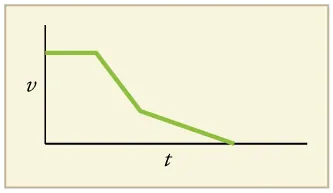
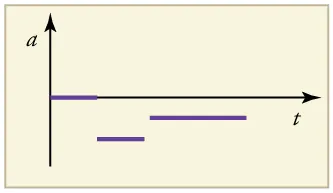
A graph of velocity vs. time of a ship coming into a harbor is shown below. (a) Describe the motion of the ship based on the graph. (b)What would a graph of the ship’s acceleration look like?
(a) The ship moves at constant velocity and then begins to decelerate at a constant rate. At some point, its deceleration rate decreases. It maintains this lower deceleration rate until it stops moving.
(b) A graph of acceleration vs. time would show zero acceleration in the first leg, large and constant negative acceleration in the second leg, and constant negative acceleration.
you walk out and back at constant speed on a 100m track in 2.0 minutes. What is. Your displacement?
0 m
you walk out and back at constant speed on a 100m track in 2.0 minutes. What is. Your average velocity?
0 m/s

Which represents your displacement on the 100 m track
B)


Which represents velocity on the 100 m track
C


Which curve represents displacement
A


Which graph represents the acceleration down the 100 m track
C

At what time is acceleration maximum
A
