Cellular Principles Exam 3
 Call Kai
 Learn
 Practice Test
 Spaced Repetition
 Match
 Flashcards
 Knowt Play
1/93

There's no tags or description
Looks like no tags are added yet.
94 Terms
process of target engagement to response
ligand-target interaction → molecular responses → cellular responses → disease modification
general receptor target interactions
agonists: increase activity
antagonists: decrease activity
general ion channels target interactions
blockers: decrease activity
modulators: can increase or decrease activity
general enzyme and transporter target interactions
inhibitor: decrease activity
substrate: increase activity
modifications made to corticosteroids to improve potency
double bond for stability
9-F for mineralocorticoid activity
11-OH group for activity
21-OH for mineralocorticoid activity
17-OH esterification for permeability
16-OH for glucocorticoid activity (inhibits mineralocorticoid)
3-keto for corticosteroid activity
4-5 double bond for corticosteroid activity
ligand vs drug
ligands: endogenous compounds
drugs: exogenous compounds
estrogen receptor ligand vs drug example
ligand: estrogen/estradiol (agonist)
drug: raloxifene (antagonist)
examples of general estrogen receptors
nuclear receptors
ER alpha: reproductive tissues, bone density, breast cancer
ER beta: prostrate, ovaries, lungs, brain, immune system
membrane receptors
GPER1: triggers rapid, non-genomic signaling pathways
effect of radical DNA damage on ligand-target interactions
bases change conformation due to radicals, becoming their oxo form. 8-oxoA and 8-oxoG cause base-change mutations
Ka definition
association rate constant
Ka = [AB] / [A][B]
Kd definition
dissociation rate constant
Kd = [A][B] / [AB]
Ki definition
dissociation constant for enzyme inhibitors
Ki = [A][B] / [AB]
IC50 definition and equation
concentration of drug that blocks 50% of binding
IC50: Ki x (1 + [S]/Km)
Km definition
Michaelis constant: substrate concentration at half its maximum velocity of complex formation
Km = [S] at ½ Vmax
functions of different serotonin (5-HT) receptors
5-HT1A: inhibits anxiety (agonists used)
5-HT2A: increases anxiety (antagonists used)
5-HT1B: inhibits aggression
5-HT2B: regulates necessary cardiac function
effect of 5-HT1A agonists
increase the inhibition of anxiety and depression
effect of 5-HT2A antagonists
decrease the excitation of depression, migraines, schizophrenia
serotonin receptors definition
GPCRs that bind serotonin, epinephrine, norepinephrine, dopamine
serotonin (5-HT) synthesis process
L-tryptophan → oxidized → L-5-hydroxytryptophan → decarboxylated → 5-hydroxytryptophan (5-HT)
serotonin (5-HT) degradation process
catalyzed by monoamine oxidases (MAOs)
5-HT → oxidized → 5-HI acetic acid
5-HT → reduced → alcohol form
5-HT → acetylated → melatonin
MAOIs effect
inhibit serotonin degradation
selectivity equation
a + b → ab vs a + c → ac (b,c can be ligands or targets)
selectivity = pKiab - pKiac
higher pKi: more selective
dihydrofolate reductase (DHFR) definition/role
enzyme in thymidylate cycle that is a common drug target for cancer and infectious diseases; drugs made selective for pathogenic DHFR features
classes of enzymes and their definition
oxidoreductases: catalyze oxidation/reduction by transferring electrons & hydrogens
transferases: transfer functional groups between substrates
hydrolases: form two produces from a substrate via hydrolysis
lyases: non-hydrolytic addition or removal of groups from substrates
isomerases: intramolecular rearrangement
ligases: join together two molecules with ATP breakdown
cofactors definition and examples
metals necessary for some enzyme function
ex. Zn2+, Fe2+/3+, Cu+/2+, Mg2+
coenzymes definition and examples
organic molecules that bind to enzymes to help catalyze biochemical reactions
ex. NAD+/NADH, coenzyme A
apoenzyme vs holoenzyme
apoenzyme: inactive enzyme with no coenzyme
holoenzyme: active enzyme with coenzyme complex
activation energy definition
amount of energy needed to overcome transition state barrier
first step of Michaelis-Menten enzyme kinetics
association of enzyme and substate (E + S ←→ ES)
reversible step
forward rate constant: k1
reverse rate constant: k-1
second step of Michaelis-Menten enzyme kinetics
catalysis of substrate to product by enzyme (ES → E + P)
irreversible step
rate constant: k2
enzyme/substrate association and dissociation rate equations
association: ES = k1[E][S]
dissociation: E + S = k-1[ES]
enzyme product formation reaction rate equation
V0 = Vmax [S] / (Km + [S])
catalytic efficiency & kcat equations
catalytic efficiency = kcat/ Km
kcat = Vmax / [E]
substrate analog definition
chemical compound that resembles the substrate in an enzyme-catalyzed reaction
binds active site of enzyme to competitively inhibit enzyme
building blocks of nucleic acid
nucleobase: nitrogenous base
nucleoside: nitrogenous base + sugar
nucleotide: nitrogenous base + sugar + phosphate group(s)
anticancer nucleotide analog drugs
gemcitabine (cytidine analog)
5-fluorouracil (uracil/thymine analog)
6-thioguanine (guanine analog)
mechanism of action of 5-fluorouracil
covalently binds TS enzyme in thymidylate cycle to inactivate it; combined with oxaliplatin (cis-platin analog) for best results
mechanism of action of gemcitabine
inhibits replication in S phase
converted into triphosphate, incorporated into DNA to act as chain terminator
inhibits ribonucleotide reductase to inhibit DNA replication
cyclooxygenases
oxidoreductase enzymes involved in prostaglandin synthesis
COX-1: constituently expressed in most cells
COX-2: induced expression in macrophages during inflammation
common use of kinase inhibitor drugs
anticancer drugs (oncogenes are kinases and tumor suppressors are phosphatases)
types of kinase inhibitors
type I: ATP competitive; binds to adenine, sugar, and phosphate binding regions
type II: non-ATP competitive; binds to adenine and allosteric sites
imatinib: kinase inhibitor used for chronic myeloid leukemia
vemurafenib: kinase inhibitor used for late-stage melanoma
target of DNA alkylating agents
covalently bind to DNA at alkylation sites of major grooves (N3 on adenine or N7 on guanine), resulting in enol tautomer, which causes mutations
mutations caused by DNA alkylation
deletion of alkylated base (A or G)
mismatches from keto-enol tautomerization
strand brakes due to spontaneous depurination exposing AP sites vulnerable to cleavage
inability to replicate due to alkyl conjugations
DNA alkylation mechanism of action
nucleophilic atom on DNA attacks drug carbocation to form iminium ion, resulting in alkylation. This step is repeated to form a second alkylation, resulting in cross-links
examples of DNA alkylating agents
cisplatin: forms intrastrand cross-links from repeated alkylation covalent bonds
melphalan: forms interstrand cross-links from repeates alkylation covalent bonds
non-covalent ligand-DNA interactions
minor groove binders and intercalating agents, which form intermolecular forces with DNA
example of minor groove DNA binder
distamycin; binds AT rich regions with positively charged terminal amidine
examples of intercalating agents
daunomycin/doxorubicin and dynemicin A
daunomycin/doxorubicin class and effect
anthracycline antibiotic (four fused rings in a line) that intercalates into DNA major groove to inhibit topoisomerase progression in replication
dynemicin A class and effect
anthracycline (four linear fused rings) and enediyne (diene w/ two triple bonds) that intercalates into DNA minor groove to cleave strand(s)
antiviral nucleotide analog drugs
zidovudine (AZT): dehydroxylated (3’-OH) nucleoside to form azido group (prevents elongation)
adefovir: phosponated nucleotide (increase stability) w/ opened nucleoside (prevents elongation)
cellular responses to DNA damage
DNA damage repair: takes energy and resources, but fixes damage
DNA damage tolerance: continued replication deemed less damaging (translesion synthesis)
mRNA functions
transcription
intron removal (splicing)
non-miRNA regulates stability
splicing process
donor splice site at 5’ intron end and acceptor splice site at 3’ intron site cause separation of exons and introns
introns definition
untranslated regions (UTRs) of mRNA that contain miRNA information
role of miRNA regulation
gene silencing: inhibition of translation
methods of gene silencing by miRNAs
translation repression: prevent the mRNA from being translated into protein
RNA cleavage: destroy the mRNA
biogenesis process of miRNAs
drosha (nuclear RNase) cuts pri-miRNA into pre-miRNA
dicer enzyme processes hairpin pre-miRNA, and cuts it into ds miRNA
helicase: cuts ds miRNA into single strands
AGO (catalytic components of RISC) binds miRNA and siRNA to regulate gene expression
siRNA definition and role
synthetic miRNA (short, double stranded) that is used to knockdown specific target mRNAs (temporary gene silencing)
siRNA drug example
patisiran, which consists of a guide and passenger strand with dinucleotide overhangs. guide strand binds target mRNA
siRNA backbone modifications
modifications to improve stability
S added to phosphate group
2’-O-methyl group
2’-fluoro group
2’-O-methoxyethyl group
modifications to improve delivery
LPS packaging
GalNAc conjugation
mechanisms of action of antisense oligonucleotides (ASOs)
steric blocking of mRNA splicing in nucleus (main mechanism)
steric blocking translation in cytoplasm (prevents ribosome association)
mRNA cleavage and destruction in cytoplasm by recruiting RNase H
mipomersen
ASO drug that targets mRNA encoding Apo B-100 for cleavage by RNase H to lower LDL
four major types of receptors
ion channel receptors for conductance
G protein coupled receptors for cell signaling
receptor tyrosine kinases for cell signaling
nuclear receptors for transcription and translation
signal transduction definition
extracellular ligands (first messenger) bind receptor to regulate intracellular processes using second messengers
general receptor actions
transducer: can pass along a signal, often via a new form
discriminator: selectively responds to some signals but not others
amplifier: increases magnitude of a response
affinity vs efficacy vs potency
affinity: ability of a ligand to bind a target
efficacy: ability of an activated receptor to initiate a response
potency: how much of a ligand is needed to produce effects
occupancy theory
number of receptor interactions impacts the magnitude of effect (not linear)
occupancy theory reaction
occupancy = [D] / ([D] + Kd)
fractional occupancy (when reaction is not complete): f = [LR] / ([R] + [LR])
rate theory
rate/frequency of ligand-receptor association and dissociation impacts the magnitude of effect
rate theory equation
Kd = koff / kon = k-1 / k1
general types/effects of ligands
agonist: ligand that binds a receptor to stimulate a response (efficacy α = 1)
partial agonist: small stimulus that results in small effect on response (0 < α < 1)
inverse agonist: ligand stimulates an opposite response to favor inactive receptor ( -1 < α < 0)
antagonist: ligand binds a receptor to prevent a response
types of antagonists
competitive: compete with agonist to decrease potency (no effect on efficacy)
irreversible: decreases potency and efficacy
physiological antagonism: two receptors have opposite effect on same second messenger
classes of second messengers
hydrophobic molecules: membrane associated (PIP3, DAG)
hydrophilic molecules: cytoplasm associated (cAMP, cGMP, IP3, Ca2+)
gases
adenylyl cyclase kinase cascade
adenylyl cyclase activated by receptor causes 3’-OH of ATP ring to attack α-P, resulting in cAMP
cAMP binds protein kinase A, inducing a conformation change
PKA becomes active, causing series of phosphorylation events, leading to activation of CRB transcription factor
receptor tyrosine kinases definition
receptors that dimerize to cause downstream sequence of phosphorylation events
growth factor receptors definition
receptor tyrosine kinases that lead to cell proliferation, gene expression, and cell migration
GFR mechanism of action
ligand binds to receptor’s extracellular domain (N-terminal), causing dimerization
intracellular catalytic domain (C-terminal) autophosphorylates tyrosine residue on other dimer
tyrosine kinase region activates and transfers phosphate from ATP to signaling protein
EGFR mechanism of action
MAPK cascade
ligands cause dimerization
active phosphorylated catalytic region has SH2 binding domains, which bind Grb2 protein
bound Grb2 protein phosphorylates Ras protein, initiation phosphorylation cascade
EGFR → Grb2 → Ras → MEK-PO4 → MAPK-PO4 → transcription factors
GFR families
epidermal growth factor receptors (EGFR/HER/ERB)
fibroblast growth factor receptors (FGFR)
vascular endothelial growth factor receptors (VEGFR)
insulin-like growth factor receptors (IGFR)
drugs that inhibit EGFR
biologic monoclonal antibodies that block ligand binding extracellular domain
cetuximab binds EGFR in cancer
bevacizumab binds VEGFR in cancer and macular degeneration
daclizumab binds IL2 in multiple sclerosis
trastuzumab binds HER2 in breast cancer
small molecules that block ATP binding on intracellular domain
geftinib
erlotinib (binds active EGFR after EGF binds)
VEGFR mechanism of action
IP3 signaling pathway
receptor dimerization increase phospholipase C activity, which elevates IP3 concentrations
IP3 stimulates release of Ca2+ from intracellular stores
Ca2+ stimulates phosphatase calcineurin, which dephosphorylates NFAT transcription factor
NFAT dephosphorylation activates it and translocates it to nucleus
drug that inhibits VEGFR
cyclosporine: immunosuppressant that inhibits phosphatase calcineurin from dephosphorylating NFAT
dose definitions
medical: amount of drug administered at a given time to achieve desired response
biochemical: amount of drug necessary to yield a desired concentration at the active site
endpoints used to measure drug response
measured parameter of a desired effect
physiological, biochemical, toxicological, behavioral
measurements of percent of a population (human/animal) affected
death, desired improvements, toxic effects
stages of drug-receptor interactions
drug binding to the receptor (affinity)
production of an effect (efficacy)
four important parameters of a dose response curve
threshold response: first drug concentration where there’s an effect
maximal response: more drug can’t increase effect
slope: amount of drug effect that a given drug concentration has
steep: small change in [drug] → major impact
shallow: large change in [drug] → subtle impact
EC50 (potency): drug concentration that gives 50% maximal response
how potency differences are shown on dose response curve
differences in EC50 (left shift = greater potency), but no change in Emax
potency not very important in choosing drug candidate
how efficacy differences are shown on dose response curve
differences in Emax (higher Emax = higher efficacy), but no change in EC 50
efficacy very important when choosing drug candidate
how types of antagonists are shown on dose response curves
competitive on left, irreversible on right
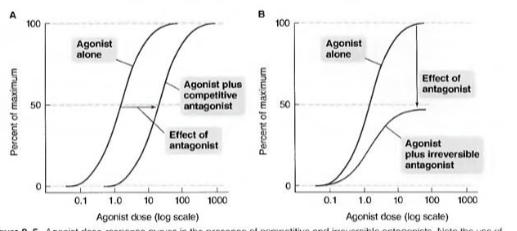
how types of agonists are shown on dose response curves

parameters of population dose response curves
ED50: dose at which 50% of population reaches therapeutic endpoint
TD50: dose at which 50% of population reaches toxic endpoint
LD50: dose at which 50% of population dies
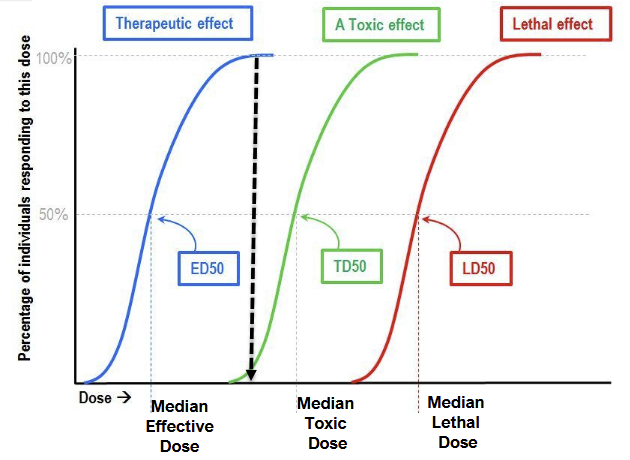
therapeutic index
TD50 / ED50 or LD50 / ED50
higher therapeutic index = wider therapeutic window = safer drug
types of population dose response curves
symmetric histogram: standard curve from continuous endpoint, which mean in the middle of a bell curve
skewed histogram: asymmetric bell curve with outlier populations that required varied dosing due to other factors
bimodal histogram: two peaks present due to different results in different subpopulations