ADM 1513 - Test 1
 Call Kai
 Learn
Learn Practice Test
 Spaced Repetition
 Match
Match Flashcards
 Knowt Play
1/37

Earn XP
Description and Tags
Chapters 1 to 5: Intro to OB, Organizational Commitment, Job Satisfaction, Stress, Motivation
Name | Mastery | Learn | Test | Matching | Spaced | Call with Kai | Chat |
|---|
No analytics yet
Send a link to your students to track their progress
38 Terms
What is Organizational Behaviour?
Field of study devoted to understanding, explaining, and ultimately improving the attitudes and behaviours of individuals and groups in organizations.
What is Human Resource Management?
Takes the theories and principles studied in OB and explores the practical applications.
What is Strategic Management?
Focuses on the product choices and industry characteristics that affect and organization’s profitability.
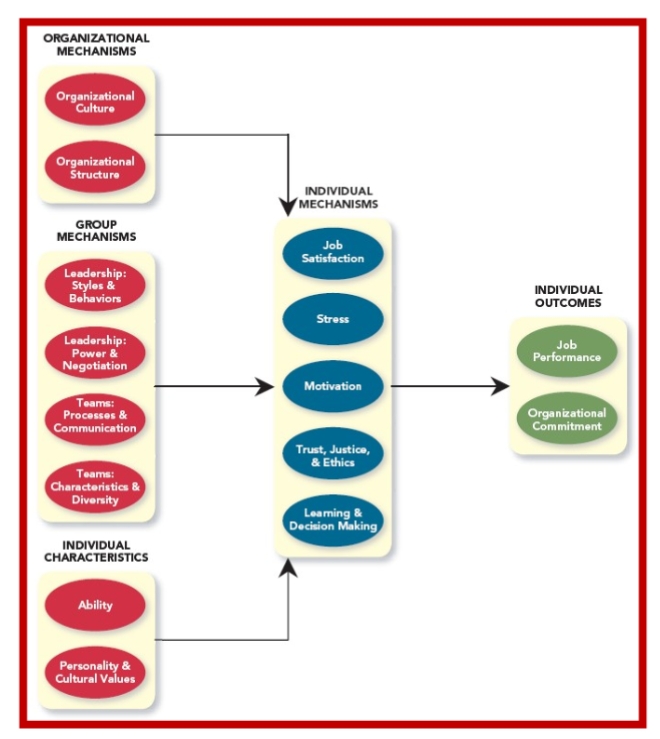
Integrative Model of OB (flip)
Scientific Method Diagram (flip)

How do we understand hypotheses and relationships? What kind of relationships come out of the correlation?
Hypotheses are testable by examining the correlation r between variables in the hypotheses.
If a correlation is 0 < r <= +1, it's a positive relationship, if 0 > r >= -1, it's a negative relationship
What is a casual inference? What are the three requirements?
Establishes one variable really does cause another.
Two variables must be correllated
The presumed cause must precede the presumed effect in time
No alternative explanation can exist for the correlation.
Best test of a theory is to conduct many studies that differ as much as possible.
What is job performance? How is it different from objective job performance?
The value of the set of employee behaviours that contribute, either positively or negatively, to the organizational goal accomplishment.
Objective Job Performance is tangible, observable outcomes like sales, points for a sports team, grades in school, etc.
What are the three types of job performance?
Task - directly involved in the transformation of organizational resources into the final product.
Citizenship - voluntary behaviour that contributes to organizational goals by improving work context.
Counterproductive - behaviours that intentionally or knowingly hinger organizational goal accomplishment.
What are the two typies of Citizenship Behaviour?
Interpersonal - directed at (intended to help) other people in the organziation
Organizational - directed at the organization
What are the types of counterproductive behaviours?
property deviance - harm org's assets/possessions
production deviance - reduces efficiency of work output
political deviance - intentionally disadvantage other individuals
personal aggression - hostile verbal and physical actions directed to other employees
What is organizational commitment?
An employee's desire to remain a member of the organization.
What is withdrawal behaviour?
A set of actions that employees perform to avoid the work situation.
What is focus of commitment?
Source that can inspire a desire to remain with the organization or other entity/target.
Chart for organizational commitment relationship with employee withdrawal (flip).

What are the three types of commitment?
Affective - desire to remain due to emotional attachment and involvement with the org (stay because you want to)
Continuance - desire to remain a member of an org because of an awareness of the costs associated with leaving (stay because you have to)
Normative - desire to remain a member of org due to a feeling of obligation (stay because you ought to)
Types of social network models of turnover
Erosion model - employees with fewer bonds will be most likely to quite the org.
Social influence - employees who have direct linkages with those who leave will become more likely to leave
How does embeddedness affect commitment?
The more links someone has to the org and the community, the more “embedded" they are (i.e., the more reasons they have to stay)
Four types of commitment withdrawal
Exit - destructive response where the person quits
Voice - active, constructive response where the individual attempts to improve the situation
Loyalty - a passive, constructive response that maintains public support while privately hoping for improvement
Neglect - a passive, destructive response in which interest/effort declines
Four types of employees for commitment and task performance

3 explanatory forms of withdrawal
Independent - uncorellated with eachother, occur for different reasons, and fulfill needs on the employee
Compensatory - negatively correlated, doing one = less likely to do the other
Progression - positively correlated, doing one = more likely to do other things
Two broad types of withdrawal
physchological - daydreaming, looking busy, socializing, etc.
physical - tardiness, long breaks, etc.
What is job statisfaction? What are values?
Job Satisfaction - The pleasurable emotional state resulting from the appraisal of one's job or job experiences.
Values - things that people conciously or subconciously want to seek or attain
What is the Value-Percept Theory?
The theory that job satisfaction depends on whether you perceive you job supplies the things that you value.
Dissatisfaction=(Vwant−Vhave)(VIMPORTANCE)
What are the most common predictors of job satisfaction?
Work, coworkers, and supervisors.
What are the five characteristics in job satisfaction?
Variety
Identity
Significane
Autonomy
Feedback
How does growth need strength affect satisfaction?
The higher the growth need strength, the more satisfaction with higher job satisfaction characteristicis filled.

How does mood come in to play with job satisfaction?
Job satisfaction affects the mood one feels. It's mild in intensity and lasts for a long period of time, not explicitly stated or caused by anything.
What is the difference of emotions from moods?
Emotions are intense and often last in short bursts, and are clearly direfcted/caused by someone or a circumstance. Can be positive or negative.
What are the three components of stress?
Stress - psychological response to demands that possess certain stakes and that tax or exceed a person's capacity for resources.
Stressors - demands that cause people to experience stress.
Strains - negative consequences that occur when demands tax or exceed one's capacity or resources.
Stressors → Stress → Strains
What is primary and secondary appraisal in stress?
Occurs as people evaluate the signifcance and meaning of stressors they confront. Secondary is what one does about the stressor.
What types of stressors are there?
Hindrance - hindering progress toward personal accomplishments or goal attainment
Challenge - stressful demands that are perceived as opportunities for learning, growth, and achievement.
What are the three ways of coping with stressors?
Coping in general is behaviours and thoughts people use to manage stressful demands.
Behavioural - set of physical activities used to deal with a stressful situation.
Cognitive - thoughts involved in trying to deal with a stressful situation.
Problem-focused - behaviours and cognitions intended to manage the stressful situation
What are the three types of strains?
Physiological - illness, high blood pressure, back pain, etc.
Psychological - depression, anxiety, anger, etc. Burnout can happen from this (i.e., emotional, mental, and physical exhaustion from ongoing stress)
Behavioural - grinding teeth, nuisance, excessive smoking, etc.
How can someone manage sress?
Assessment - estimate the stress levels may be a problem or not.
Reduce stressors - job sharing, sabbatical, etc.
Provide resources - training interventions, supportive practices
Reduce strains - relaxation techniques, cognitive-behavioural techniques, health and wellness
What is the expectancy theory in motivation?
Describes the cognitive process that employees go through to make choices among different voluntary behaviours/responses.
Effort (expectancy: if I study hard, I will do well) → Performance (instrumentality: if I do well on the test it will help with my overall grade) → Outcomes (I want a good grade!)
What is psychological empowerment?
An energy rooted in the belief that work tasks contribute to some alrger purpose.
Meaningfulness - value of a work goal relative to individual's ideals and passions
Self-determination - sense of choice in the initiation and continuation of work tasks
Competence - belief in his/her capability to perform work successfully
Impact - sense a person's actions “make a difference"
What are the components of SMART goals?
Specific
Measureable
Achievable
Results-based
Time-sensitive