1_NRL_Protection of Natural Resources: The International Framework
 Call Kai
 Learn
 Practice Test
 Spaced Repetition
 Match
 Flashcards
 Knowt Play
1/33

There's no tags or description
Looks like no tags are added yet.
34 Terms
Natural Resources in Law and Policy
Stockholm Declaration, Principle 2: “Natural resources include ‘the air, water, land , flora and fauna and especially representative samples of natural” ecosystems’
SDG: 12.2: “Achieve the sustainable management of efficient use of natural resources by 2030”
“Any material from nature having potential economic value or providing for the sustenance of life, such as timber, mineral, oil, water and wildlife”
NR as a commodity, traditionally anthropocentric approach
5 threats to biodiversity
Land and sea use change: including habitat loss and degradation e.g. agriculture
Pollution: makes the environment unsuitable for survival directly and indirectly
Species overexploitation: e.g. overfishing
Climate change: forcing animals to shift range or confounding the signals that trigger seasonal events and more
Invasive species and disease: compete with native species for space, food and other resources, sometimes spread disease
Intertwined factors threatening biodiversity
Demographic and sociocultural
Economic and technological
Institutions and governance
Conflict and epidemics
> Land/sea use change, direct exploitation, climate change, pollution, invasive and alien species
Value of biodiversity
Goods: actual or potential use of biological resources (including genetic resources)
Ecosystem services
Ethical, aesthetic and intrinsic value of nature
Generally International Law on Nature Conservation
Man has a special responsibility to safeguard and wisely manage the heritage of wildlife and its habitat, which are now gravely imperilled by a combination of adverse factors. Nature conservation, including wildlife, must therefore receive importance in planning for economic development” – 1972 Stockholm Declaration Principle 4
Nature protection has to be integrated with other economic policies
Tug of war: permanent sovereignty over natural resources vs nature conservation
Strike a balance
The gradual development of IL on natural resources
Environment as a renewable source - exploitation
Protection of specific species
1893 Bering’s seals case (future generations / sustainable use)
The first time where the US seems to use a language that relates to SD
1946 International Whaling Convention
Regulation of whaling, as biodiversity concern starts, whaling cannot take place unless for scientific purposes
> sites and habitats
> ecosystem approach: take the whole ecosystem into account e.g. CBD
> biodiversity
Big Five: Key Global Conventions
1971 Convention on Wetlands of International Importance (Ramsar Convention)
1972 Convention Concerning the Protection of the World Cultural and Natural Heritage (WHC)
1973 Convention of International Trade in Endangered Species of Fauna and Flora (CITES)
1979 Bonn Convention on the Conservation of Migratory Species of Wild Animals (CMS)
1992 Convention on Biological Diversity (CBD)
‘Big four’: sectoral, address specific problems
each targets a specific conservation issue
International specific sites, ecosystems and protected species
CBD: general obligations to conserve biodiversity as such (broader)
Web of conservation related agreements - multiple interlinkages
they overlap and complement each other
Not strictly preservationist approach: wise, rational use of sustainable exploitation is allowed!
How does international law try to tackle the biodiversity challenge?
Common regulatory mechanisms:
Area based conservation measures
listing of protected areas, protection of habitats, restriction on activities
Species protection: prohibition of taking of species
listing of species under annexes, appendices
establishment of seasons/ periods during which taking is permitted
permits for the exploitation of natural resources
Trade measures: prohibitions / regulation of trade in protected species
Environmental Impact Assessment, Monitoring, Reporting
Financial assistance and capacity building
Compliance mechanisms (facilitative / coercive)
1971 Convention on Wetlands of International Importance (Ramsar Convention) - Generally 1
Objective: conservation and wise use of wetlands as regulators of water regimes and as habitats supporting a characteristic flora and fauna, especially waterfowl
‘wise use’ > not sustainable, but has similar meaning
Broad definition of wetlands: natural, artificial, freshwater or saltwater (art. 1)
Main feature: listing system to protect wetlands - art 2(1)
designate the wetland, to get on the list fro protection under Ramsar
Three types of wetlands
all wetlands: doesn’t matter if its on the list or not
listed wetlands: enhanced protection
Montreux Record: wetlands under risk
There are some criteria to put it on the list
List of Wetlands of International Importance (& Montreux Record) art. 2(2)
Significance in terms of zoology, hydrology, limnology, or ecology
Duty to designate suitable wetlands (at least ONE upon ratification) art. 2(4)
BUT right to delist/restrict boundaries for “urgent national interest” art. 2(5)
Inform the Secretariat and take compensatory measures (art. 4 para 2)
Oversight by the treaty boundaries
Compensatory measures by designating another area within the territory
Listed wetlands remain subject to territorial sovereignty (art 2 para 3), but the exercise of that sovereignty is not unfettered!
Ramsar Convention Generally 2
Overarching duty of “wise use” of all wetlands in their territory (art 3 & 4)
Establish nature reserves to promote conservation (art 4 para 1)
Endeavour to increase waterfowl populations (art 4 para 4)
Obligation of means (due diligence) not just whether you achieved the result, but tried your best to achieve the objective
More demanding obligations concerning listed wetlands
Establish and implement national planning to conserve wetlands (art 3 para 1)
Monitoring and reporting obligations – detect even likely deterioration of ecological character due to human interference (art 3 para 2)
Duty to consult about implementing obligations in case of transboundary wetlands (art 5 para 1) – endeavour to coordinate measures
Institutional arrangements (‘institution-light’ agreement)
CoP every three years: advice on conservation measures (art 6)
Wetlands Conservation Fund created to assist developing States
Weakness of the Ramsar Convention
Each party is individually responsible for the designation of wetlands
No prohibition / restriction on taking species, even though such activities can affect the ecological character of wetlands
Not applicable in deep marine waters ( “…including areas of marine water the depth of which at low tide does not exceed six meters”)
Issues of interpretation due to the general nature of its provisions
Restrictive interpretation of duties under the Convention by the ICJ (see Costa Rica v Nicaragua, 2015)
Do they have a duty to notify that might have an effect on the wetlands
Interpreting article 2(3) – monitoring & reporting obligation
Yes, you have an obligation to report to the secretariat, Costa Rica did so
Nicaragua does not provide a threat, no need to report
Consult – very general obligation
Customary IL: not allow the use of your territory to create possible transboundary harm > potential to do EIA
World Heritage Convention - Generally 1
The relocation of the Abu Simbel temples
Financing from 50 different states outside of Egypt, transcend the boundaries of a single state
Move these and relocate them to where they would not be affected by this project
Creating a convention that would protect sites both natural and cultural heritage
“Natural heritage”: natural features, geological and physiological formations and precisely delineated areas ‘which constitute the habitat of threatened species of animals and plants of outstanding universal value from the point of view of science or conservation’, and natural sites (art 2)
Mostly protect sites, species cannot be designated, the habitat indirectly might protect them tho
Still fall under the sovereignty of the state
“World heritage”: outstanding universal value
Not defined under WHC
Criteria provided in Operational Guidelines
So exceptional it transcends natural boundaries, common importance to present and future generations
World heritage ≠ common heritage of mankind
Regulatory approach: the list technique
World Heritage Convention - Generally 2
World Heritage List (article 11: paras 1, 2, 3)
States where site is located nominate -> World Heritage Committee accepts or rejects (art 11 para 6)
States’ consent required - challenge when sovereignty is contested (see Cambodia v Thailand)
List of World Heritage in Danger (article 11: para 4)
Sites threatened by serious and specific dangers
World Heritage Committee decides
States’ consent not required – cannot veto (but usually cooperation is sought)
The Obligations
Obligations in all natural heritage sites:
Duty to implement domestic measures to identify, protect, conserve, present and transmit to future generations (Art 4) – conservation measures (art 5)
Duty to cooperate to protect ‘world heritage’ (Art 6 para 1)
Duty to not deliberately damage (prevention principle) (art 6 para 3)
Obligations towards sites included in the List:
Obligations of assistance if so requested (Art 6 para 2)
Sustainable use is allowed (compatible with their outstanding universal value)
International protection = a system of international co-operation and assistance (Art 7)
Intervention by the World Heritage Committee
Tanzania wanted a huge highway over a national park
Under a pressure from the Committee, did an assessment, in the end they were persuaded to find another alternative
Have to be taken into considerations but they are not binding
1979 Bonn Convention on Migratory Species (CMS) - Generally 1
Objective: the conservation and effective management of migratory species
“Wild animals are an irreplaceable part of the earth’s natural system, which must be conserved for the good of mankind” and “each generation of man holds the resources of the earth for future generations and has an obligation to ensure that this legacy is conserved and when utilized, is used wisely”.
> echoes intergenerational rights and duties
Recognising that wild animals are part of the natural system, have to be preserved for this generation and the next one
States remain the primary protectors of migratory species (sovereignty over their natural resources), but concerted action is required by all range States
Conservation Duties under CMS
Listing of species according to their degree of threat on scientific basis
Appendix I - Endangered Species
Measures for protection of species
Measures for protection of habitats/restoration
> Convention has specific rules
Appendix II - Unfavourable Status Species
Conclude agreements for the conservation of species / habitats
Adopt other non-binding cooperative conservation measures (MoU)
Amendments are adopted by qualified majority (2/3) during CoP, enter into force after 90 days, subject to right to opt out (reservations)
Obligations under CMS
Concerning Appendix I species (art. 3)
Range states shall endeavour to:
i) conserve and, where feasible and appropriate, restore habitats (art. 3(4)(a))
ii) prevent, minimize or compensate, as appropriate, for adverse effects of activities which seriously impede or prevent the migration of species (art. 3(4)(b))
E.g. highway construction, take mitigation measures to minimise it, or adopt other conservation measures for that species
iii) to the extent feasible and appropriate, prevent, reduce or control factors which are endangering or are likely to endanger the species (art. 3(4)(c))
iv) prohibit the taking of species (art 3 para 5), subject to exception (scientific research) – exception must be precise as to content and limited in space and time
Concerning Appendix II species (art. 4)
Range states must endeavour to conclude agreements to benefit these species
Institutional arrangements: a small Secretariat, a Scientific Council and a CoP which meets every three years
Requires 2/3 of those present
CoP: responsible for reviewing implementation and making recommendations for improvement of conservation measures
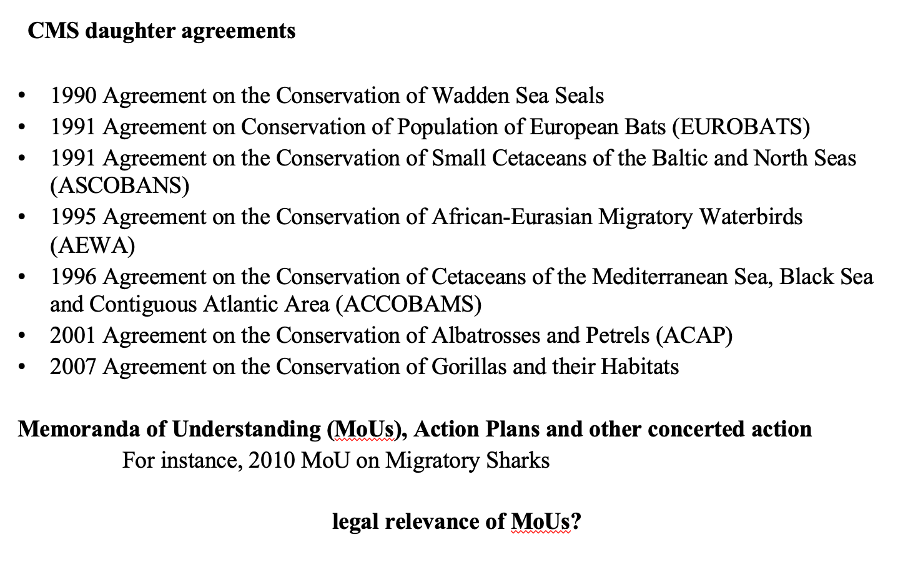
CMS daughter agreements
CMS daughter agreements, not that much for Appendix II species
Political agreements, no binding effects
Parties to CMS
Not nearly universal participation (133 parties, including the EU)
Conservation of migratory species is a matter of concern of the international community and for future generations, but NO international mechanism for their conservation.
Broad discretion of State Parties, duty to cooperate and coordinate measures
CITES - Generally 1
Entered into force in 1975, widely ratified (185 State parties, incl EU)
Objectives: regulates international trade of wild animals and plants (terrestrial and marine) – about 40.000 species!
Regulatory approach: the list technique
Obligation according to the lists in three Appendices
Export/import permits
CITES - appendix
Appendix I: trade is prohibited with a few exceptions
Article II(I): Appendix I shall include all species threatened with extinction which are or may be affected by trade. Trade in specimens of these species must be subject to particularly strict regulation in order not to endanger further their survival and must only be authorised in exceptional circumstances.
Permit (Art III)
Only in exceptional circumstances
Requires permit from both import and export States
Import and export permits: administrative (management authority) and ecological considerations (scientific authority)
Appendix II: trade is permitted but subject to control
Article II(2): (a) all species which although not necessarily now threatened with extinction may become so unless trade in specimens of such species is subject to strict regulation in order to avoid utilisation incompatible with their survival; (b) other species which must be subject to regulation in order that trade in specimens of certain species referred to in subparagraph (a) of this paragraph may be brought under effective control
Permit (Art IV)
Permit required only from export States
Export permits: administrative + ecological considerations
Appendix III: species subject of national trade restrictions requiring international cooperation
Article II(3): All species which any Party identifies as being subject to regulation within its jurisdiction, for the purpose of preventing or restricting exploitation and as needing the co-operation of other Parties in the control of trade
Permit (Art V)
Restrictions limited to specimens from State listing species
Only export permit needed from State listing species
Export permits: administrative considerations
> subject to national measures
CITES - Generally 2
Amendments
App I & II: 2/3 majority of states present and voting (Art XV)
App III: communications to Secretariat (Art XVI)
Reservations (Art XIII)
App I & II: when concluding Convention or within 90 days of amendments
App III: anytime to amendments
Effect:
non-party status re species reserved
(recommendation): species moved to App I treated as species in App II for the States that opted out
Enforcement
Take measures to prohibit trade in species in violation of CITES (Art VIII)
Establish Management Authority + Scientific Authority (Art IX)
Can adopt stricter measures re conditions for trade (Art XIV)
Exemptions: Art VII
Trade with non-parties? Equivalent documentation (Art. X)
The 1992 Convention on Biological Diversity - Generally 1
Conservation of Biological Diversity
Fair and equitable sharing of benefits arising from the utilisation of biological diversity
Sustainable use of biological diversity
Last two is more of controversial elements
The conservation of biological diversity as “a common concern of the humankind”
Reaffirmation of principle of permanent sovereignty over natural resources
Responsibility for conserving and sustainably using biological resources
NOT common heritage NOR common property
What is the legal content of the concept of common concern, if any?
Main normative features of the CBD
Overarching duty to develop national strategies, plans and programmes for the conservation and sustainable use of biodiversity (art 6) – integration into sectoral policies
Duty to identify and monitor components of biodiversity, processes and categories of activities with adverse impact (art 7)
No listing of protected areas or species: States are responsible to identify, monitor and conserve components of biological diversity (Annex I indicative criteria)
In situ conservation measures (art 8)
Each party is obliged, as far as possible and as appropriate, to establish a system of protected areas or areas where special measures are needed
Ex situ conservation measures (art 9)
Parties are required to regulate and manage biological resources important for the conservation and sustainable use of biological diversity, promote the protection of ecosystems, natural habitats and the maintenance of viable populations, and regulate/ control risks from biotechnology and alien species that threaten biodiversity
Protecting biodiversity outside its natural habitat, control risks (e.g. invasive species), manage resources sustainably
Procedural obligations under the CBD
Integration of biodiversity consideration in EIAs (art 14a)
States shall as far as possible and as appropriate “introduce appropriate procedures requiring environmental impact assessment in its proposed projects that are likely to have significant adverse impacts on biological diversity with a view to avoiding or minimising such effects and, where appropriate, allow for public participation in such processes
Does it create a concrete duty to conduct EIA prior to projects?
Notification, exchange of information and consultation regarding likely significantly damaging activities (art 14c)
Notification and emergency responses in cases of grave danger or damage (14d)
General duty to cooperate for the conservation and sustainable use of biodiversity in areas beyond national jurisdiction and matters of mutual interest and other matters of mutual interest for the conservation and sustainable use of biodiversity (art 5)
Procedures for environmental assessment – just to have the procedures in place
Costarica v Nicaragua
Not under this article, but customary law, customary law provides this
Role of the CBD CoP
Evolution of the CBD over time
Decisions and Resolutions (binding and non-binding): EIAs and SEAs (strategic environmental assessment), Marine Spatial Planning, Ocean Noise, implementation of the ecosystem approach
CoP develops guidance, some decisions are binding, some are not
> develop guidance and decisions
Adoption of Protocols: The CoP has overseen the development of additional agreements
2000 Cartagena Protocol on Biosafety: Biosafety, especially risks from living modified organisms
2010 Nagoya Protocol on Access to Genetic Resources: Fair sharing of benefits from using genetic resources
> creating additional agreements
From Aichi to Kunming- Montreal (2022) – Global Biodiversity Framework 2030
The global biodiversity framework sets targets for protecting biodiversity by 2030
> setting global targets
Reviewing the Convention’s implementation
States report implementation measures, CoP can overview and comment upon them
Creating subsidiary bodies and promoting forms of cooperation with other biodiversity related conventions
Biodiversity Liaison Group + Memoranda of Understanding, Joint Work Programmes, Exchange of Information
These help conventions exchange information, coordinate activities and work together
Limitations of CBD
> Soft “nature” of obligations
> Qualification of obligations: “as far as possible and as appropriate” “in accordance with particular conditions and capabilities”
> Domestic implementation
> Lack of reference to the precautionary principle and intergenerational equity in the operative part of the Convention
BBNJ Agreement - General 1
The High Seas Treaty or the Agreement on Marine Biological Diversity of Areas beyond National Jurisdiction
‘ensure the conservation and sustainable use of marine biological diversity of areas beyond national jurisdiction, for the present and in the long term, through effective implementation of the relevant provisions of the Convention and further international cooperation and coordination’ (art. 2)
4 issue-areas
MGRs: Marine Genetic Resources (e.g. genetic material from marine organisms)
ABMTs: Area-Based Management Tools (measures to manage and protect specific ocean areas, including marine protected areas)
EIAs: Environmental Impact Assessments (assessing the potential environmental impacts of planned activities)
CB&TT: Capacity-Building and the Transfer of Marine Technology (helping countries develop the skills, knowledge and technology needed to protect the ocean)
+ cross-cutting issues: are topics that affect all four areas, such as funding, institutional arrangements and cooperation
Not undermining (art. 5(2)): means the treaty should not undermine existing relevant legal frameworks and bodies, or the authority of those bodies. It aims to complement existing international law, not replace or override it
BBJN - General principles and approaches
Article 7:
The polluter-pays principle
The principle of the common heritage of humankind as set out in UNCLOS
The freedom of marine scientific research, together with other freedoms of the high seas
The principle of equity and the fair and equitable sharing of benefits
The precautionary principle or precautionary approach, as appropriate
An ecosystem approach
An integrated approach to ocean management
Ecosystem resilience to tackle climate change and ocean acidification
Use of best available science and relevant traditional knownledge (Indigenous and local communities)
The Circular Economy definition
Kirchherr/Reike/Hekkert: Conceptualising the circular economy: An analysis of 114 definitions Resources, Conservation and Recycling Volume 127, December 2017, Pages 221-232
EU Commission (Proposal Regulation on the establishment of a framework to facilitate sustainable investment; COM/2018/353 final):
“maintaining the value of products, materials and resources in the economy for as long as possible, and minimising waste, including through the application of the waste hierarchy as laid down in Article 4 of Directive 2008/98/EC of the European Parliament and of the Council”.
International Legal Framework for CE?
Are there rules of international law relevant for the CE?
Basel Convention (Control of Transboundary Movement of Hazardous Wastes)
Hong Kong Convention (Ship Recycling)
Protests against ‘toxic colonialism
calls for a total ban vs conflicting economic considerations
Future perspective: Intergovernmental Negotiating Committee on Plastic Pollution
Nations agreed to negotiate a treaty on plastic pollution:
175 nations
binding agreement on plastic pollution
On production, use and disposal – whole life-cycle.
Guiding questions for studying:
Why has biodiversity conservation become a matter of international concern, and why is it regulated through international law?
Which are the principal global agreements governing biodiversity conservation, and what are their respective objectives?
Which are the main regulatory approaches / legal mechanisms employed by these instruments?
Can you explain the main international obligations of states under the major biodiversity conventions?
What are their main strengths and limitations? How does it differ from the EU legal framework in terms of legal obligations, implementation and enforcement?
How does the concept of the circular economy seek to address unsustainable resource use, and are there relevant rules of international law in this field?
Pierre-Marie Dupuy, Jorge Viñuales (2018, 2nd edition) International Environmental Law, CUP: Chapter 6 ‘Species, Ecosystems and Biodiversity’, 202-247.
Adoption of a World Charter for Nature – non-binding instrument, turned out to be an obstacle rather than an advantage
Convention on Biological Diversity (CBD), not technical a framework convention, but aligned some work of other major treaties and conventions in the biodiversity cluster
Regulatory Approaches
- The regulation of resource exploitation
o Targets resources shared by two or more countries or located in common law areas, it is concerned with the distribution of a particular resource and/or the protection of an endangered resource; it usually intervenes at a stage where exploitation is already on-going; often superficial understanding of resource management, not taking into account interactions between resource and its ecosystem
o Legal techniques: setting quotas, regulating the methods and technologies allowed for resource exploitation, limiting the time-periods and the areas where these activities can be conducted
- The protection of spaces
o A site can be protected as such, regardless of its value for one or more plant or animal species,
o Habitat is a difficult concept to define, may refer to the conditions necessary or for the protection of a particular population of a species with a specific geographical location
o Ecosystem seeks to capture a broader functional unit, a set of interactions among plant, animals and micro-organisms as well as their non-living environmental
o Legal techniques: creation of protected areas, establishing buffer zones, conducting environmental impact assessments and monitoring, bottom-up approach
- The regulation of trade in certain species
o Reducing exploitation, namely restrictions on the export and or import of specimens of regulated species or of certain types of organisms
Regulation of exploitation:
Fisheries: UNCLOS, Straddling Fish Stocks Agreement, Whaling Convention
Systems of access: BBNJ, CBD
Protection of spaces:
Wetlands: Ramsar
World Heritage
In situ: CBD
Regulation of trade:
CITES
Genetic resources: Nagoya Protocol, CBD
Regulation of exploitation: Fisheries
- Main instruments: UNCLOS, UN Straddling Fish Stocks Agreement, instruments under FAO
- UNCLOS
o 61(1) UNCLOS: shall determine the allowable catch of the living resources in its EEZ
§ Main components: (1) a limitation on unilateral action; (2) some minimum content; (3) the availability of non-adverbial dispute settlement mechanism
o Does not release other States (flag States) from their obligations in this regard
§ Due diligence, the duty to preserve applies to all States, States have an obligation to cooperate
- The Straddling Fish Stocks Agreement
o The essence is the cooperation and implementation mechanisms it establishes, first by encouraging cooperation between coastal States and flag States through RFMOs, and cooperation does not materialise, by providing a subsidiary cooperation and implementation
§ Join the relevant RFMO
§ Apply the conservation management measures adopted by that organisation
§ Subsidiary mechanism: obligation to cooperate in order to create an organisation or similar arrangements with a certain minimum content
o Implementation – Article 21(1) any State party to the RFMO may board an inspect on the high seas a ship flying the flag of another State party to the Agreement, even the latter State is not itself party to the RFMO in question
o NAFO: States that have issued an objection to provide an explanation and to set out alternative measures they intend to apply for the conservation and management of the fishery resources in question
o Whaling Convention: The conservation of whaling to the conservation of whales
Regulation of Trade: CITES
- Structure - List technique:
o Obligations apply to certain species and or spaces, which are usually listed in an appendix to the agreement
o The list modification system allows for the updating the list to reflect the evolving understanding and or circumstances of a particular problem
- Permit System – five main components
o (1) The stringency of the requirement: Appendix I is only authorised in exceptional circumstances; Appendix II only requires an export permit based on administrative and ecological considerations; Appendix III permit based on administrative considerations
o (2) Permit system can be extended by domestic law
o (3) Minimum content, Article VI lists a number of requirements to the standardise the content of permits and ensure the reliability f the system
o (4) Institutional structure, implement and manage the permit system by setting up a Management Authority, a Scientific Authority and a Rescue Centre
o (5) System governing the listing of species, to be amended Appendices I and II require majority of two-thirds of the parties present and voting, Appendix III any State party may list a species by a simple communication to the Secretariat
Protection of Spaces (Sites, Habitats, Ecosystems)
- Top-Down Approach: The Creation of Protected Areas
o States undertake treaty obligations that they must fulfil by adopting domestic laws and regulations
o The Ramsar Convention
§ Regulatory object: Article 1(1) broad definition of Wetlands, both natural and artificial wetlands; reference to the services they provide
· Distinction between wetlands having ‘international significance in terms of ecology, botany, zoology, limnology or hydrology’ and other wetlands
· Convention urges States to cooperate, however the territorial status of these sites remains subject to the sovereignty of the relevant States with a number of obligations deriving from the law of international watercourses and transboundary aquifers
§ List technique, three levels can be identified
· 1st level applies to all wetlands whether listed or not
· 2nd level sites that qualify as wetlands of international importance
· 3rd level sites on the Montreux Record have priority regime
· Modification of the List, pertains to each State individually, but justify decisions, compensatory measures
o The World Heritage Convention
§ The object protected by WHC has three components: cultural heritage, natural heritage and the outstanding universal value that elevates parts of this heritage to the level of natural heritage
· Outstanding universal value: (1) the interest of the site; (2) integrity and or authenticity; (3) existence of a system of protection of the site
· While Article 6(1) affirms State sovereignty over listed sites, States accept domestic ("vertical") duties to identify, protect, and conserve heritage (Arts 4 & 5), alongside international ("horizontal") duties to cooperate and refrain from deliberate measures that directly or indirectly damage heritage on other States' territories (Art 6(3))
§ Follows the list technique: (Art 11(2)): Includes over 1,000 sites (approximately one-fifth are natural heritage)
§ Establishes a system of nominations
o Protection of the Antarctic Environment: The Madrid Protocol
§ Covers the entire Antarctic environment as an ecosystem and makes it a natural reserve
§ Part of the Antarctic Treaty System, the 1991 Madrid Protocol designates Antarctica as a "natural reserve" devoted to peace and science, creating the first truly international protected area
§ Mining Ban: Articles 7 and 25 impose a 50-year moratorium on all mineral resource activities (mining)
§ Environmental Impact Assessment (EIA): All non-mining activities (such as scientific research or tourism) are subject to a three-tiered EIA process based on impact severity:
· Less than minor or transitory impact: No formal EIA required
· Minor or transitory impact: Requires an Initial Environmental Evaluation
· More than minor or transitory impact: Requires a Comprehensive Environmental Evaluation (CEE) subject to public consultation and review
- Bottom-up Approach:
o Situating the elaboration of strategies at the level of different groups of stakeholders likely to be affected by the problem at hand
o The Convention to Combat Desertification
§ Adopted in 1994, the UNCCD addresses land degradation in drylands (arid, semi-arid, and dry sub-humid areas), which cover 40% of global land and house 2 billion people. Its core driver is mitigating socio-economic impacts (poverty resulting from lost land productivity) rather than land conservation in isolation
§ Employs a decentralized "bottom-up" approach via National Action Programmes (NAPs) developed with local stakeholders, supported by five regional annexes (Annex I for Africa being the most detailed)
The Protection of Biodiversity
- Convention on Biological Diversity (CBD)
o Three Levels of Biodiversity: The 1992 CBD (Article 2) provides an umbrella framework protecting biodiversity across three levels: genetic diversity within species, species diversity, and ecosystem diversity
o Dual Pillars: Balances the conservation of biological diversity (treated as a "common concern of humankind") with the sustainable use of biological resources under State sovereignty (subject to access and benefit-sharing
o Structure & Implementation: Operates through thematic work programmes for specific biomes (e.g. marine, forestry, mountains), cross-cutting initiatives (such as Article 8(j) traditional knowledge), and monitoring frameworks like the 2011–2020 Aichi Biodiversity Targets
The Regulation of GMOs
- The Cartagena Protocol on Biosafety
o Concluded in 2000 under CBD Articles 8(g) and 19(3), it regulates the transboundary movement of Living Modified Organisms (LMOs) intended for intentional introduction into the environment, as well as LMOs for food, feed, or processing (LMOs-FFP)
o Advance Informed Agreement (AIA) Procedure: Requires exporters to notify importing States, who must issue written consent before transboundary movement. Importing States may prohibit or condition entry based on the precautionary principle (even in the absence of full scientific certainty), and silence does not constitute consent
o Liability & Redress: Complemented by the 2010 Kuala Lumpur Supplementary Protocol, which defers specific compensatory mechanisms primarily to domestic law
Access to Genetic Resources and Benefit Sharing (ABS)
- CBD Article 15 & The Nagoya Protocol (2010): Reaffirms State sovereignty over genetic resources. Access requires Prior Informed Consent (PIC) and Mutually Agreed Terms (MAT) for sharing economic or scientific benefits, extending to traditional knowledge held by indigenous communities under Article 8(j)
- The International Treaty on Plant Genetic Resources for Food and Agriculture creates a Multilateral System of Access and Benefit-Sharing covering 64 key food and forage crops (representing 80% of human plant consumption) to reduce transaction costs
Biodiversity Beyond National Jurisdiction (BBNJ)
- Context: Addresses marine areas beyond national jurisdiction (high seas and the deep seabed Area), where access to marine genetic resources and patent ownership are heavily concentrated among a few developed nations
- The BBNJ Negotiating Package: Developed under UNCLOS to create a legally binding instrument based on four core pillars:
o Marine genetic resources, including access and benefit-sharing
o Area-based management tools, including marine protected areas (MPAs)
o Environmental impact assessments (EIAs)
o Capacity-building and transfer of marine technology
- Core Legal Friction: Centred on whether high seas resources are governed by the freedom of the high seas or the common heritage of mankind, alongside the "savings clause" requirement that the treaty "should not undermine" existing bodies (such as regional fisheries management organizations)
L Kramer (2020) ‘Global environmental challenges and the EU’, ERA Forum, 341-360.
Most important challenges of the present: (1) global warming; (2) the loss of biodiversity; (3) the omnipresence of chemicals; (4) resource management; and (5) the fight against poverty
Fight against poverty
- Poverty has very largely remained in the hands of the MS
Climate Change
- UN Climate Change Convention, Kyoto Protocol
o The Kyoto Protocol allowed several States to comply jointly with their reduction obligations and adopted burden-sharing decision which differentiated the reduction obligations of Member States
- Paris Agreement
o Reduce GHG by 2030 by 40 percent compared to 1990 levels
- TFEU
o Combating climate change (Article 191 TFEU)
o Promote energy saving and the development of new and renewable sources of energy (Article 194 TFEU)
- EU Directives
o 2001 Directive – renewable sources of energy
o 2003 Directive – use of biofuels
o 2009 Directive – reach a share of renewable energies in the gross final energy consumption by 20% by 2020, with binding action plans and annual timetables, biofuels, bioliquids
o 2006, 2005, 2012 Directive – energy efficiency
o 2003 Directive – Emission Allowance Trading – rather generous in their attributions, too many allowances were issued, market is not functioning well
- Other legislative measures regarding the CO2 emissions of cars
- Transfer of financial resources from developed to developing countries is relatively passive
Loss of biodiversity
- Major causes: habitat loss and degradation, climate change, excessive nutritional loads and other forms of pollution, over-exploitation and unsustainable use, invasive species
- Birds Directive
o Conservation of wild birds
- Habitats Directive
o Natural habitats and species of wild fauna and flora
- Biodiversity Action Plan
o Four sections: agriculture, the conservation of natural resources, fisheries and economic development cooperation
- Internationally,
o the EU adhered to the Convention on Biological Diversity, as well as to the Cartagena and the Nagoya Protocol
o CITES Convention were transposed into EU legislation
The omnipresence of chemicals
- EU doesn’t have a consistent, coherent product policy
- The strategy to phase out cadmium failed completely
- Number of pesticides were restricted in use or prohibited as follow-up of the POP Convention on Persistent Organic Pollutants: MS could limit their use of pesticides if they wanted
- EU legislation on generally modified organisms (GMO) is very restrictive on the release of GMOs
o Concentration limits in air and water, which can hardly be monitored and enforced
- Air emission limit values are fixed – Montreal Protocol
- Discharge into water – Directive on urban wastewater
- EU Regulation 1907/2006 limiting or prohibiting the use of dangerous chemicals
- Internationally the EU followed the Rotterdam Convention
- Air emissions for airplanes and ships are fixed by the ICAO and IMO, but are very loose
Resource management
- Directive on eco-design of energy-related products
- Directive on energy labelling and standard product information
- EU waste policy: waste prevention programmes and measures to promote the recycling of waste materials
- Circular economy, until now only cars had to be, up to a certain percentage level, recyclable or recoverable
- Basel ban, which prohibits the export of hazardous waste to non-OECD countries, even when the material is to be recycles. For other hazardous wastes that may be exported under the Basel Convention, and for non-hazardous waste, the EU applied the prior informed consent principles
- Ships – setting up of EU register of dismantling facilities which comply with ILO and basic environmental requirements.
This strong reliance on written, codified law practically excludes recourse to international environmental principles-and at the same time makes EU initiatives at the international scene defending or promoting environmental principles most unlikely
Seminar
Test: try to solve the cases