BCH4024 Douma Exam 4 - Lecture 10
 Call Kai
 Learn
Learn Practice Test
 Spaced Repetition
 Match
Match Flashcards
 Knowt Play
1/32

There's no tags or description
Looks like no tags are added yet.
33 Terms
What does epigenetic regulation mean?
It refers to modifications that change DNA accessibility without changing the DNA sequence itself.
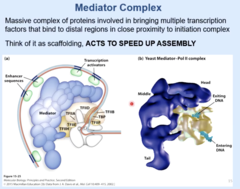
What is the role of mediator in transcription?
Mediator acts as a bridge between activators and RNA Polymerase II, facilitating the initiation of transcription.
What molecule activates the glucocorticoid receptor?
Cortisol or its analog hydrocorticosterone.
What happens after the glucocorticoid receptor binds DNA?
It recruits co-activators like Hic-5, which recruit hats and mediator to promote transcription.
What does a co-activator do?
It binds to activators and mediates their interactions with other transcription machinery components like RNA Polymerase II.
How many subunits make up the mediator complex in humans?
Approximately 30 subunits.
What polymerase is responsible for mRNA synthesis in eukaryotes?
RNA Polymerase II.
What subunit on RNA Polymerase II is critical for initiation and RNA processing?
The C-terminal domain (CTD).
Why can't RNA Polymerase II locate promoters on its own?
It lacks a sigma-like subunit or intrinsic DNA binding domains.
What are general transcription factors?
Proteins required at every RNA Polymerase II promoter to help guide polymerase to the promoter.
How can you recognize general transcription factors?
Their names start with "TFII" (e.g., TFIIA, TFIIB, TFIID, etc.).
Which general transcription factor recognizes promoter sequences?
TFIID.
What does TFIID consist of?
1 TBP (TATA-binding protein) and 13 TAFs (TBP-associated factors).
What sequence is recognized by TBP?
The TATA box.
If the TATA Binding Protein can bind to TATA boxed in eukaryotic promoters, why do we need TBP-associated factors as well?
We need the associated factors as well because TATA boxes are only present in about 10% of promoters.
What is the role of TFIIF?
It 'grabs' RNA polymerase II and bring it to the TFIID complex forming at the promoter.
What is the helicase needed for transcription initiation in eukaryotes?
TFIIH.
What two activities does TFIIH possess?
Helicase activity (to unwind DNA) and kinase activity (to phosphorylate RNA Polymerase II CTD).
What triggers the "green flag" for RNA Polymerase II to start transcription?
Phosphorylation of the C-terminal domain (CTD) of RNA Polymerase II by TFIIH.
What is the role of pioneer transcription factors?
They bind to condensed chromatin and initiate chromatin opening.
What two activities must happen to open chromatin for transcription?
Recruitment of HATs and chromatin remodeling complexes.
What is the chromatin remodeling complex mentioned?
SWI/SNF.
What happens during positive gene regulation?
Activators, co-activators, HATs, mediator, and chromatin remodelers collaborate to stimulate transcription.
Name a way repressors inhibit transcription.
They can block activator binding sites or recruit HDACs to condense chromatin.
What do HDACs do?
Remove acetyl groups from histones, promoting chromatin condensation.
What do HMTs do?
They methylate lysine and arginine residues on histones to promote heterochromatin formation.
What is HP1?
Heterochromatin protein 1, which binds to methylated histones, recruit more histone methyltransferases, and ultimately promote further chromatin compaction.
What modification recruits HP1?
Trimethylation of histone H3 lysine 9 (H3K9me3).
What does hypermethylation of histones lead to?
Heterochromatin formation and transcriptional silencing.
How is heterochromatin spread maintained?
HP1 proteins recruit more histone methyltransferases, leading to further methylation and chromatin condensation.
What is the default state of eukaryotic genes?
OFF; they require activation to be transcribed.
Does the RNA Polymerase mechanism of elongation differ between prokaryotes and eukaryotes?
No, elongation is mechanistically the same.
How do activators help stimulate transcription?
They bind DNA and recruit co-activators, HATs, mediator, and other factors to promote RNA Polymerase II function.