5.3 validity
 Call Kai
 Learn
 Practice Test
 Spaced Repetition
 Match
 Flashcards
 Knowt Play
1/31

There's no tags or description
Looks like no tags are added yet.
32 Terms
Validity
most important concept in psychological measurement
whether the test measures what we think it is measuring
we can have a reliable tool, but
validity might be missing → the tool is measuring other constructs that we think it is measuring
important decisions such as diagnosis or placement in a given group based on
scores from psychometric tests
Validity can be an
elusive, abstract concept
conceptualization of validity has
changed over time & it keeps changing
Validity refers to the degree to which
evidence & theory support the interpretations of the test scores for the proposed uses of tests
Validity does not really refer to the test itself, but also
scores that are derived from the test
Validity analysis should begin with an
explicit statement of the proposed interpretation of test scores
Validity of test scores: an example

Validity is a global judgment based on different types of
evidence
Types of validity
content validity
factorial/structural validity
criterion-related validity
Content validity
does the content of the test reflects the conceptualization of the construct
factorial/structural validity
is the structure of the construct as we had theorized
unidimensional vs multidimensional.
criterion-related validity
validity with respect to other external criteria.
concurrent or predictive
Content Validity refers to
analysis of the relationship between the content of a test & the construct it is intended to measure
Content Validity includes
themes, wording, & format of the items, tasks, or questions on a test
In order to be content validity
content of the items needs to be relevant to the construct
subjects performing tasks must be a good representation of the construct we intend to measure
wording & format of the items must be appropriate (adapted to a certain level & abilities of the test-taker
data must be content-based evidence
The evidence for content validity comes from:
the logical relationships the creator of the test has established between construct & content.
expert judgments of the relationship between different parts of the test & the construct.
Structural/Factorial Validity
analysis of the internal structure of a test
degree to which the relationship among test items & test components (dimensions) conform to the theoretical construct that we are intending to measure

After we analyze the test (using factor analysis), we should
see how items that measure each dimension group together
Evidence for construct validity usually comes from applying
factor analysis to the results of the test
Structural/Factorial Validity: Employee Engagement → example

Criterion Validity
how the scores of the test relate to another established standard of comparison
concurrent validity
predictive validity
Concurrent validity
refers to measures taken at the same time.
We measure subjects (or obtain other type of information related to the construct) at the same time & we expect to see a relationship.

Predictive validity
Refers to obtaining a measure at a later time to compare with our original measurement.
We measure subjects at a later time & we expect to see that their scores in our test predict other indicators of the same construct.

The evidence for criterion related validity comes from
how the scores of our test relate to the results of other tests (or other measures that have been validated) & our measure that is supposed to target the construct.
how the scores of our test relate to the results of other measurements that are taken later in time (& that we believe are related to the target construct)
in practise → we try to correlate the scores of our test with the scores of the criterion
New conceptualization of validity → according to Denny Borsboom & collaborators
Current conceptualization has proven to be useless
Do not believe that a test should be built & checked for validity afterwards
Validity of the measure should start before the measure is even conceptualized
Validity should be a quality that we put in an instrument, & not something to be discovered afterwards
According to Borsboom → a test is valid for measuring an attribute if
the attribute exists & variations in the attribute causally produce variation in the measurement outcomes
he proposed to start test development by thinking about how a process that would lead to difference in test scores would look like
we should build a test based on this, how differences would manifest on the sample
We should focus on how differences manifest in people & not so much in theoretical definitions.
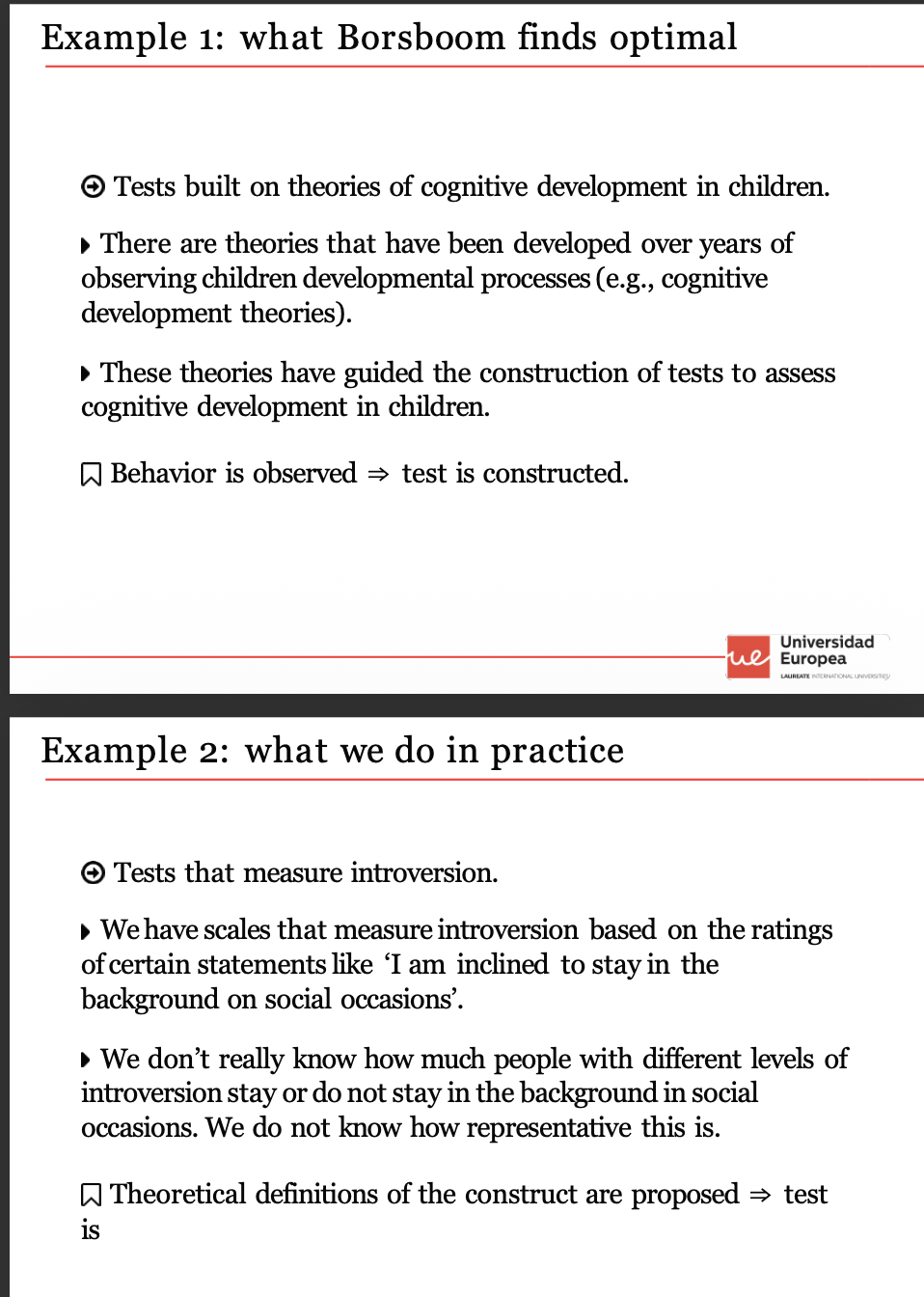
counterargument for Borsboom explanation of a test
Theories exists only in some areas
We cannot always build a test based on how different levels of the trait are manifested in different situations.
Sometimes we can only build a test based on the available theory, administer it, & look for correlations with other measures etc.
Validity refers to the
extent to which a particular test score interpretation (or use) is justified
The prevailing approach to validity analysis considers
content
structural
criterion-related validity
There is some opposition to this approach that claims that validity should precede
test constructions