ochem reactions flashcards
 Call Kai
 Learn
 Practice Test
 Spaced Repetition
 Match
 Flashcards
 Knowt Play
1/10

There's no tags or description
Looks like no tags are added yet.
11 Terms
naming alkenes
double carbon bond always starts with 1
Count based on the lowest starting numbers for significant substituents (priority based on atomic number)
end -ene
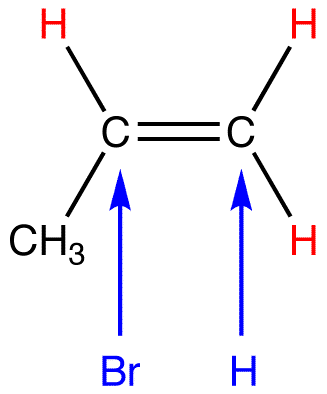
regiochemistry (markovnikov’s rule)
the non-h group adds to the more substituted carbon in the alkene
syn addition (stereospecific)
2 atoms or groups are added to the same side

anti addition (stereospecific)
2 new atoms/groups added to opposite side

Elimination reactions with alcohols (rehydration reaction)
forms a water molecule, secondary and tertiary molecules may contain rearrangements (and thus, contain carbocations in mechanism)
usually H2SO4 or [H+] reactants
removal of alcohols with acids to make alkenes

Direct elimination of alcohols using POCl3
(1, 2, 3 alcohols) this will ALWAYS be E2 NO CARBOCATION INTERMEDIATE
POCl3 reactant, and Py (pyridine) is usually a solvent
Zaitsev products used, can have multiple major products
removal of alcohol with E2

Hydrohalogenation
adding H and X (Cl, Br, I)
regioselective! X adds to more substituted carbon based upon the Markovnikov’s rule
watch for H- or CH3- shifts to most stable rearrangement
product is nonstereoselective, making a racemic mixture with diastereomers/enantiomers

acid catalyzed hydration
adding H and OH, OPPOSITE of dehydration reactions
uses dilute H2SO4 in H2O, or H3O+, or the addition of an [H+] catalyst, use alcohols to make ethers
H+ and methyl shifts!! creates a carbocation intermediate
regioselective, according to Markovnikov’s rule (more substituted c)
nonspecific racemic mixture

oxymercuration-demercuration
mechanism is NOT on the exam
two step, with stereoisomers
adds H and OH, with an end result of alcohol with water
does NOT form a carbocation; no methyl or hydride shifts
Markovnikov’s rule even though no h/ch3 shifts

hydroboration oxidation
mechanism NOT on exam
ANTImarkovnikov reaction of OH/alcohol, to less substituted carbon
2 step with NO C+ intermediate, and NO shifts
NONstereospecific

halogenation
adds 2X (x= Cl, Br, I)
NO C+ intermediates; no shifts
No markovnikov addition; anti addition and stereospecific (X will add opposite to each other, bc more room behind the X bc halogens are big/bulky)
