Art History Exam 1
 Call Kai
 Learn
Learn Practice Test
 Spaced Repetition
 Match
Match Flashcards
 Knowt Play
1/65

There's no tags or description
Looks like no tags are added yet.
Name | Mastery | Learn | Test | Matching | Spaced | Call with Kai | Chat |
|---|
No analytics yet
Send a link to your students to track their progress
66 Terms

Temple of Anu at Urak
3,300 BCE
Mesopotamian Era
A temple that was built high up on a ziggurat for importance and emphasis. Dedicated to the God of Anu. Would’ve been used for trade or religious practice and to hold the city’s stats and numbers. Take note that people have to walk up lots of stairs, then turn to get to the temple.
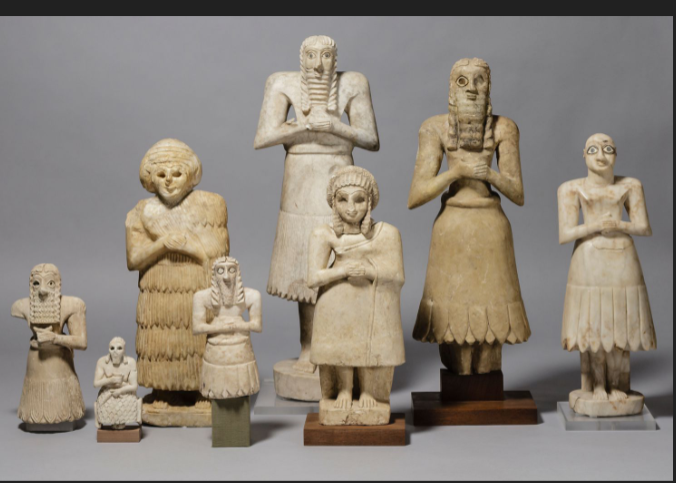
Votive Figures from the Temple of Anu
2750-2600 BCE
Mesopotamian Era
10 small statues, 8 male, 2 female, variation in height, simple carvings, eyes were made of gemstones, these were likely used as offerings for gods and placed in cult rooms, their clasped hands are praying in reverence

Royal Standard of Ur
2550-2440 BCE
Mesopotamian Era
Detailed wooden box inlaid with lapis lazuli, depicting the image of a battle, red stone breaks up the blue lapis, the king is of a larger scale and towers above everyone else to demonstrate his importance. This was buried with royal servants along with other precious objects similar to it

Law Stele of Hammurabi
1760 BCE
Mesopotamian Era
A black slab that depicts a king talking to a regular person, respect is shown because they are looking eye to eye, the scale of the God is showing that they are more powerful than the human, equate of punishment and justice, shows power over people’s daily lives

q
Ishtar Gate of Babylon
605 BCE
Mesopotamian Era
Walls were 23 feet thick with glazed brick paint to look like lapis lazuli, went around the city, 50 ft tall towers for protection, had images of animals all along it to represent the animals outside

Narmer Palette
3,200-3,000 BCE
Egyptian Art
A palette used for makeup, covered in a form of hieroglyphics, likely would’ve been an offering for a god, depicts imagery of slaying enemies for God, the intertwining serpents heads represent unifying of kingdoms, the king’s size shows his militaristic power compared to others, celebrates conquest

Pyramids on the Giza
2589-2503 BCE
Egyptian Art
Huge pyramids that required lots of labor and work, built for someone of incredible importance, had to be completed before death, composed of many chambers and spaces where servants, wives, family and other favorite belongings were stored in the pyramid

The Great Sphinx of Giza
2590-2566 BCE
Egyptian Art
A great statue of a lion with a man’s face that gives protection vibes, faces the nile, appears there should be two of them, another on the other side of the pathway, Napoleon shot the face with a cannon, so it’s unsure whose face is on the lion’s body

Seated Scribe
2450-2325
Egyptian Art
A seated figure that has literacy, scribes are very important because hardly anyone can write during this era, has a very detailed face, but a less detailed body, precious stone eyes

House Alter Depicting Akhenaten, Nefertiti and Three of their Daughters
1350 BCE
Egyptian Art
A private shrine built in a home that was used to honor the sungod, they were often given to royal families by others so they could give them to the gods, figure’s sizes gives hierarchical emphasis on importance

Pectoral Necklace of Sithathoryunet
1887-1878 BCE
Egyptian Art
Necklace with hieroglyphics about king that was worn by the woman to give status to her husband, made of gold, garnet, turquoise, and lapis lazuli, precious artifact symbolized wealth

Temple of Hera
550 BCE
Greek Art
Doric style temple made of limestone covered in plaster to resemble marble, house gods and goddesses, contains cult statues and offerings to gods, well taken care of and kept up with

Euphronios Krater
515 BCE
Greek Art
Was a goblet used to mix wine and water, a type of red-figure pottery (black painted around clay figures), likely given as a gift to someone of importance

Peplos Kore
530 BCE
Greek Art
A 47 inch tall marble statue that was originally painted vibrant colors, it was likely used as a headstone or a marker for a grave once for someone who had passed

Kritios Boy
480 BCE
Greek Art
Marble statue, softer movements, less rigid and more natural shapes, nudity symbolizes vulnerability and naturalistic elements

Charioteer of Delphi
478-474 BCE
Greek Art
A 6 ft tall statue using a wax molding process to create it, using bronze allows for more movement and dynamic poses, likely some type of monument for something, was cast as 8 pieces then put together

Zeus in Warrior Pose
460-450 BCE
Greek Art
a 7 ft tall statue made of bronze, very difficult to do this dynamic pose using marble, so using bronze is much easier, depicting lots of muscles and how physically fit he is

The Partheon, on the Acropolis, ground plan
447-432 BCE
Greek Art
Balanced, proportional temple, with columns that bow slightly inward, lots of mathematical planning so it looks like the structure is pointing straight up

Temple of Athena Nike
421-415 BCE
Greek Art
A temple dedicated to Athena and Nike, within it lies 2 cult statues of them

Nike Adjusting her Sandal
600-400 BCE
Greek Art
Depicts the god of Nike removing her shoe, humanizes God, shows the removal of shoes and places emphasis on everyday life, made of marble and resides in the temple of Athena and Nike

The Seated Boxer
330-50 BCE
Greek Art
Shows a boxer that is resting after a match, cuts on the skin show he’s been working hard and beaten up, emphasized muscles demonstrate his strength, realistic and emotionally dynamic, the body is seated at rest and damaged, don’t know who the boxer actually is

Capitoline Wolf
500-295 BCE
Ancient Roman Art
Mythological founding wolf of Rome, babes suckling from it to represent reliance, front paw is destroyed because it was supposedly struck by lightning, symbol for Rome

Temple of Jupiter, Pompeii
200 BCE
Ancient Roman Art
Temple to worship gods, consisted of stairs, pronads, and a cella for precious artifacts and offerings

Stabian Baths
250-100 BCE
Ancient Roman Art
Different rooms for men and women to bathe, there was a changing room for each to change, some baths were for nudity, others weren’t

Amphitheater at {Pompeii
80-70 BCE
Ancient Roman Art
A large arena where people gathered for entertainment, lots of death, violence, prisoners fighting gladiators, drunk activity, brawls, arguments, not a very good place to be

House of the Faun plan
200 BCE
Ancient Roman Art
A grand private residence area, covered an entire city block, housed lots of artwork and fancy items, consists of many rooms and gardens, 2 giant courtyards surrounded by living spaces, kitchens, and baths, preserved under the volcanic ash from the eruption of Mount Vesuvius, gives the most insight into what Roman life looked like

Alexander Mosaic from the House of the Faun
200-100 BCE
Ancient Roman Art
A detailed mosaic depicting Alexander the Great riding a hose without a helmet, lots of detail, uses a realistic scale, imagery of defeating the Persian Army

Fresco, Casa della Farnesina
60 BCE
Ancient Roman Art
A painting that uses the third style of architectural paintings, used to make a room look bigger, has more detail than a normal architecture painting, skinny columns are not realistic, lots of detail and color

Bust of Julius Ceasar
46-44 BCE
Ancient Roman Art
Realistic and very lifelike sculpture of Julius Ceasar, lots of details, in charge of military, reflects hyper-realism, successful and powerful, lots of support from the people

Augustus Statue
Early First Century CE
Ancient Roman Art
Holding no weapon but instead gesturing with his hand, idealized image, very muscular, carved breastplate depicting peaceful return, lots of god along the armor detailing religious images, traces of paint shows that it used to be vibrantly colored

Garden Frescos, Villa of Livia (wife of Augustus)
Late first century BCE
Ancient Roman Art

Aqueduct (Point-du-Gard, France)
First Century CE
Ancient Roman Art
Series of aqueducts, made from limestone and no mortar, water flows through it and deposits minerals keeping the structure together, brings water in and out of the city, “self-healing”
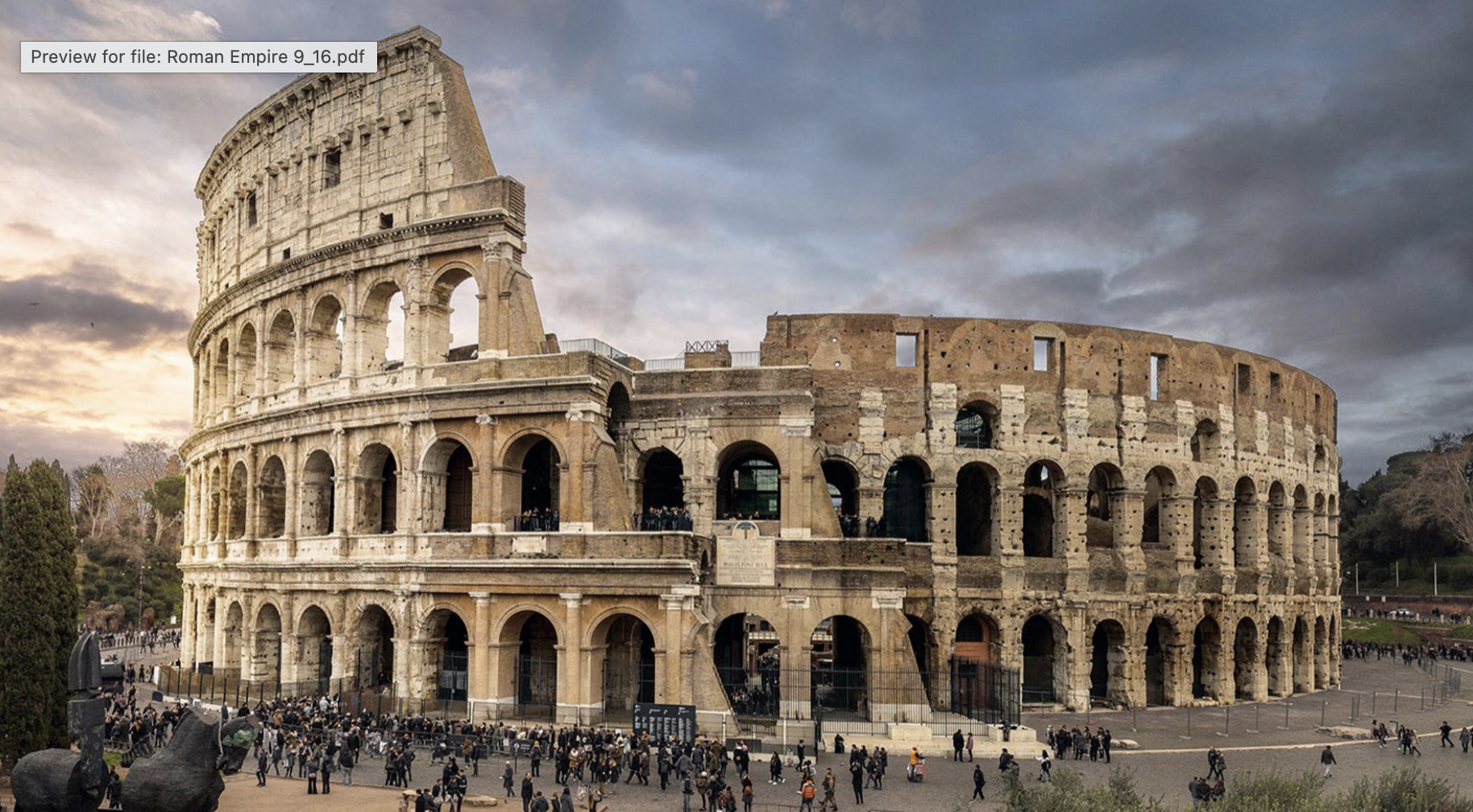
Colosseum
70-80 CE
Ancient Roman Art
The structure is a monumental arena for entertainment, it was the biggest social thing in Rome, used to be very aesthetic and covered in white, so it would reflect a lot of sunlight and catch the eye, used for gladiator battles, ship battles, and other kinds of fighting and entertainment, would never reenact a Roman battle because they don’t want to advertise Romans fighting each other

Pantheon
110-128 CE
Ancient Roman Art
A temple constructed for worship of all the Roman gods, remembered for having the worlds largest unreinforced concrete dome, offerings and worship to ALL gods, interior dome had hollowed out sections to reduce its weight

Commodus as Hercules
192 CE
Ancient Roman Art
Commodus is a reincarnation of the god Hercules, fought and survived the arena over 700 times, portrayal as the god Hercules demonstrates his power over the people, arena, and politics

Bound Chicken Floor Mosaic
100-200 CE
Ancient Roman Art
Located in front of a vineyard, description of what is sold at store, demonstrated wealth, hospitality, and abundance of provisions, illustrates food culture and everyday life

Mithras Slaying the Bull
Early Jewish Art
170 CE
A limestone relief sculpture that depicts a young god killing a bull, which represents chaos and raw nature, shows that the god is killing the chaos of the world, demonstrates his power

House-Church at Dura-Europos
before 256 CE
Early Christian Art
A simple church made for worshiping a diety, offering, and prayer

Sarcophagus of Junius Bassus
390 CE
Early Christian Art
High relief sculpture carved into marble, very labor intensive, depicts many different christian scenes, created for someone important, demonstrates power and wealth

Hagia Sophia
532-37 CE
Byzantine Art
Has the largest dome for nearly 1000 years, took over 5 years to build, originally had white marble covering and gilded domes, would’ve sparkled and been a focal point from the city, has a pendentive dome (round dome set on a square), claristory makes it look like the dome is floating, lots of mosaics and artwork within, demonstrates piety and control

Christ flanked by Constantine IX, Monomachos, and Zoe
1028-1034 CE
Byzantine Art
Found in the Hagia Sophia, gilded mosaic with gold and small tiles, golden halos, scale shows importance of figures

Ka’ba, al-Haram Mosque, Mecca, Saudi Arabia
Islamic Art
A square building covered in black fabric, important mosque/holy site for muslims, pilgrimage site, this is where muslims turn towards 5 times a day to pray

The Prophet’s House (mosque), Saudi Arabia
622 CE
Islamic Art
Drawing of the reconstruction of the Prophet’s House, large courtyard surrounded by living quarters

Dome of the Rock
691-92 CE
Islamic Art
A specific shrine within the mosque, has a giant gilded gold dome and gilded interior, lots of artistic calligraphy.

The Great Mosque of Damascus
715 CE
Islamic Art
Consists of a giant courtyard, fiscades, decorative architecture, minaret towers, structure used for prayer

Mosaics of Landscapes in the Great Mosque of Damascus
715 CE
Islamic Art
Mosaics consist of small pieces of glass, gemstones, gold, gilding, includes few people or animals and is mostly just landscapes in nature

Spiral Minaret of the Great Mosque in Iraq
848-52 CE
Islamic Art
Solid stone stacked upwards, unique non-traditional spiral shape, was a religious focal point for a large city, consists of geometric vegetation looking carvings (not actually plants)

Bowl with Kufic Inscription
ninth century
Islamic Art
Simple bowl covered in blue and white glaze, decorated with calligraphy, geometric shapes along the rim, says happiness twice
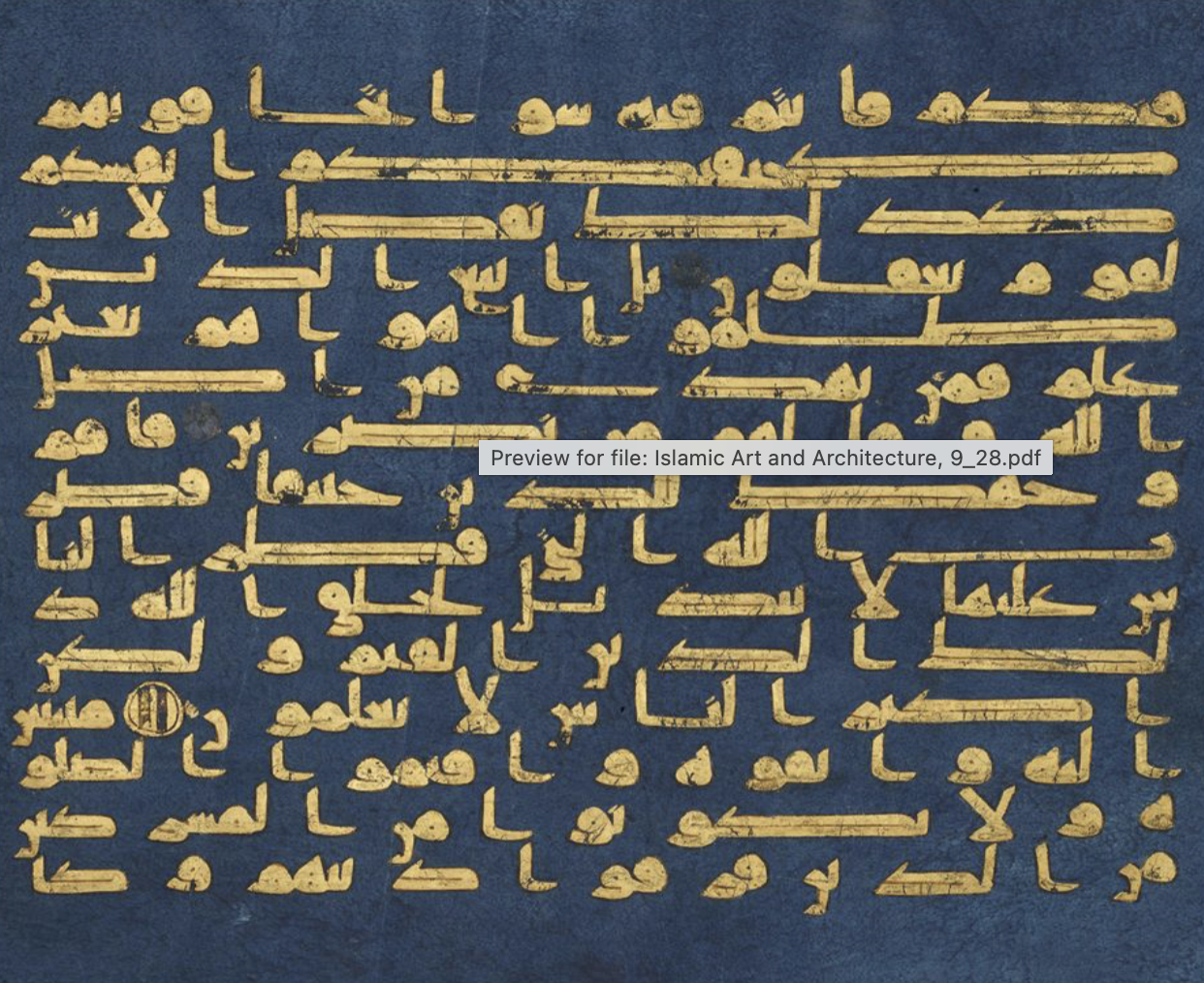
Folio from the Blue Qur’an
850-950 CE
Islamic Art
Page from the Qur’an written in calligraphic style, regular ink embossed with gold leaf to give shiny expensive look, made with very expensive materials, shows religious piety and power

Flame Vessel
2500 BCE
East Asian Art
Chunks of clay were rolled out into think tubes, then squished back together to create flowy lines along the work, very delicate, swirly geometric shapes, named flame vessel for the parts around the top, fragile, luxury objects

Jade Elephant from the tomb of Fu Hao
1200 BCE
East Asian Art
Small, hand carved elephant out of jade, very hard stone so difficult and labor intensive to carve, elephants trunk shaped like a pendant so it was likely on a necklace, exemplifies wealth power and luxury
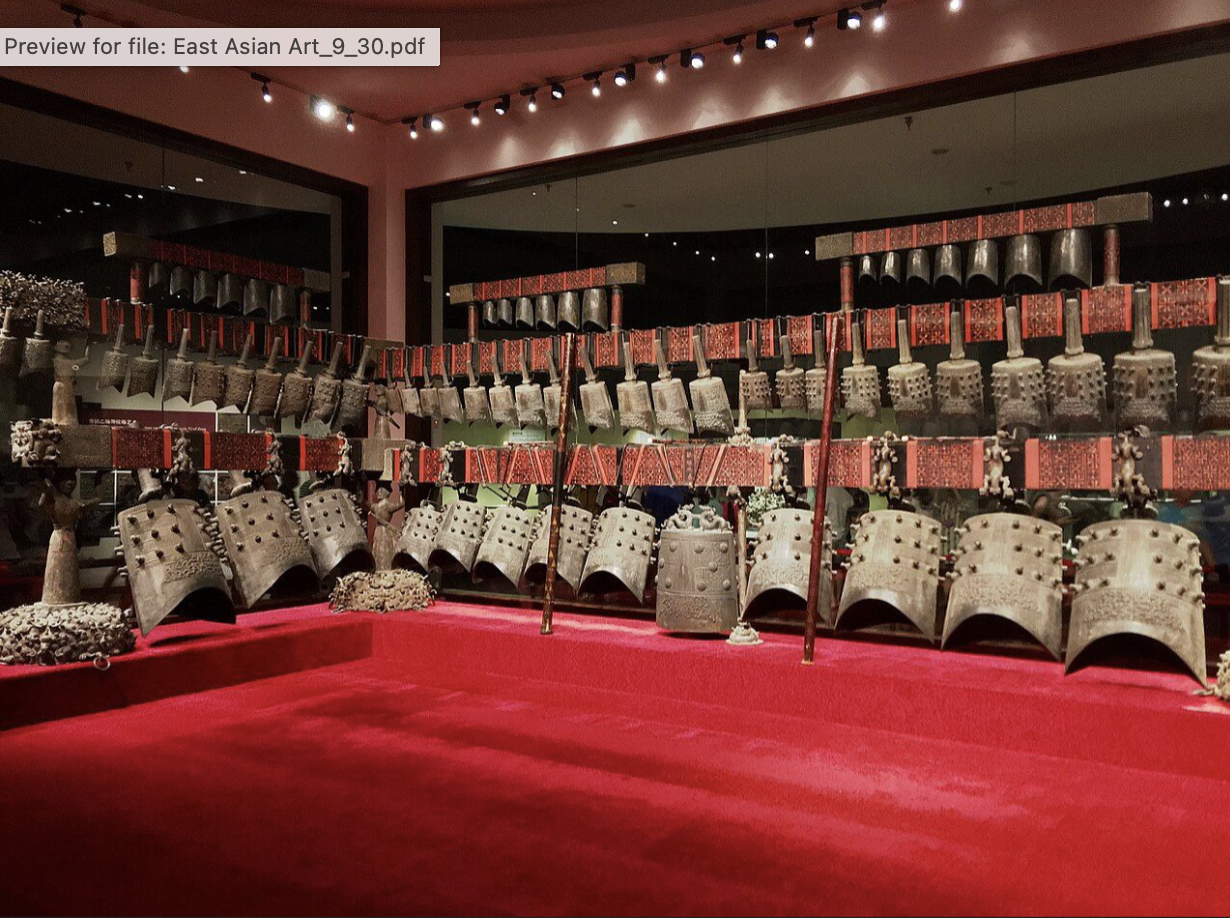
Rack of Bells
East Asian Art
Example of early bronze casting, has lots of details and carvings, very expensive, was probably not actually used for music

Terracotta Army
210 BCE
East Asian Art
Important figures of East Asia were buried with armies of life-sized terracotta soldiers, many held bronze weapons that have since been lost, each has unique faces and expressions, the arms and other parts of the bodies were mass produced by workshops and the heads were carefully personalized and detailed

Funeral Banner of the Lady of Dai
200 BCE
East Asian Art
was found in a water-logged temple, the banner is divided into 3 different registers, each with a different ritual/ journey of the afterlife

Jade Burial Suit
113 BCE
Rising Empires in Japan
Early Japanese believed jade could help preserve a body, aided on the journey in the afterlife, each tile was carefully cut out and shaped then sewn together with a gold thread, extremely expensive material and detailed craftsmanship
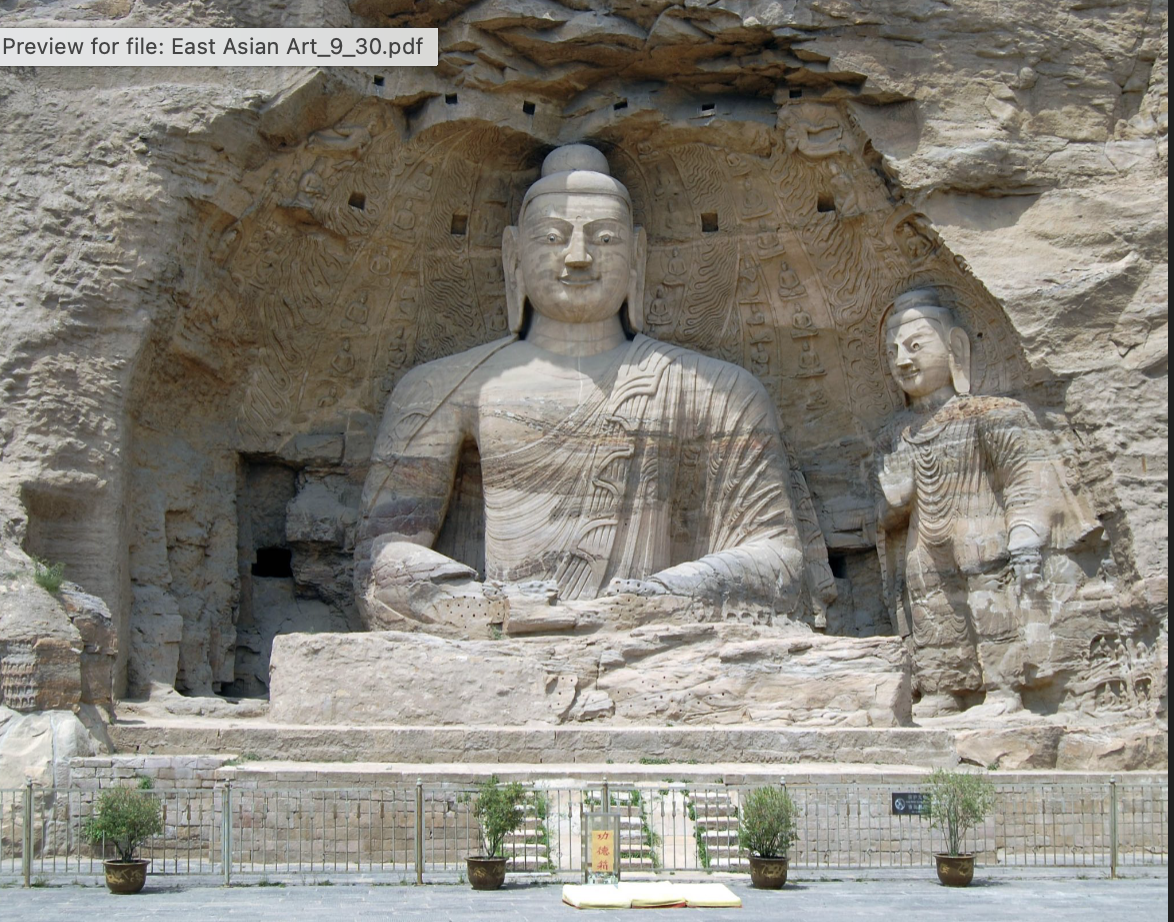
Colossal Seated Buddha
460-465 CE
Rising Empires in Japan
cut out of a cliff, high-relief, made of sandstone which decays quickly, lots of depth and detail, used to be another Buddha on the left, but it has since decayed, said to represent the past, present, and future
Mesopotamian
5,000-400 BCE
Ancient Egyptian
4,000-500 BCE
Ancient Greek
600-400 BCE
Ancient Roman
500 BCE-300 CE
Early Jewish/Christian
150-500 CE
Byzantine
500-1100 CE
Islamic
600-950 CE
Early East Asia
4000-200 BCE
Japan / China
400 BCE- 581 CE