Biochemistry and Cell Biology
 Call Kai
 Learn
Learn Practice Test
 Spaced Repetition
 Match
Match Flashcards
 Knowt Play
1/121

There's no tags or description
Looks like no tags are added yet.
Name | Mastery | Learn | Test | Matching | Spaced | Call with Kai | Chat |
|---|
No analytics yet
Send a link to your students to track their progress
122 Terms
Abu Bakr al-Razi?
A Persian physician, chemist and scholar who lived approximately 865–925 CE. He was a major figure in medieval medicine and chemistry.
What age was Al-Razi in
Islamic golden age
Why is al-Razi relevant to modern biology?
His emphasis on systematic observation and experimentation helped develop the evidence-based approach fundamental to modern science.
Who was Robert Hooke?
An English scientist who lived from 1635–1703 and worked across biology, physics and microscopy.
Hooke
He was the first person to use the term "cell" to describe microscopic structures he observed. 1665
What book did Hooke publish in 1665?
Micrographia, containing detailed observations and drawings made using microscopes.
Hooke
It introduced the concept of cells and helped establish microscopy as an important tool for studying biological structures.
Who was Ross Harrison?
An American embryologist who lived from 1870–1959 and studied development and nervous-system formation.
What major technique did Harrison pioneer?
Tissue culture, allowing living cells or tissues to be maintained and studied outside the organism. 1907
Harrison
Modern cell and tissue culture techniques.
Marie Manyard
An American biochemist, born in 1921 and died in 2003.
What was historically significant about Daly's career?
In 1947, she became the first African-American woman in the United States to earn a PhD in chemistry.
What diseases or health conditions did Daly research?
Her later research included cholesterol and hypertension, particularly their relationship to cardiovascular disease.
Shinya Yamanaka
A Japanese physician and stem-cell researcher, born in 1962.
Yamanaka
He demonstrated that mature, differentiated cells could be reprogrammed into pluripotent stem cells.
Özlem Türeci?
A Turkish-German physician, scientist and entrepreneur, born in 1967.
What is BioNTech known for?
Developing medical technologies including mRNA-based therapies and vaccines, alongside extensive cancer research.
Turechi
Her work demonstrates how understanding mRNA, protein production, cells and the immune system can lead to modern medical applications.
Bohr model
Atoms contain protons neurons and electrons
Elemental isotopes
Different number of neurons, so atomic mass changes but does not drastically change the chemical charaterstics.
Isotopes in Anti-Doping
Used to distinguish steroids that have been naturally produced by the body from steroids that have been externally administrated
Why Can isotopes be used for antidoping
C12/C13 differences in androsterone after testosterones or DHEA administration
What could give a false result
Differences in diet can lead to different endogenous isotope ratios
Breakdown of testosterone or DHEA

What are radioactive isotopes called
Radioisotopes
Fixed half life of 14C
5730

What is tc-99
Tc-99m is a radioisotope used as a radioactive tracer in nuclear medicine.
Why does it say Tc-99 is "tagged" to a pharmaceutical?
Tc-99m on its own doesn't necessarily go exactly where clinicians want to investigate, so Tc-99m can be combined with an appropriate pharmaceutical molecule allowing it to be delivered to target site.
Different types of carbohydrates

Functions of monosaccharides
Cellular energy, Building nucleic acids
General formula of monosacchraides
(CH2O)n
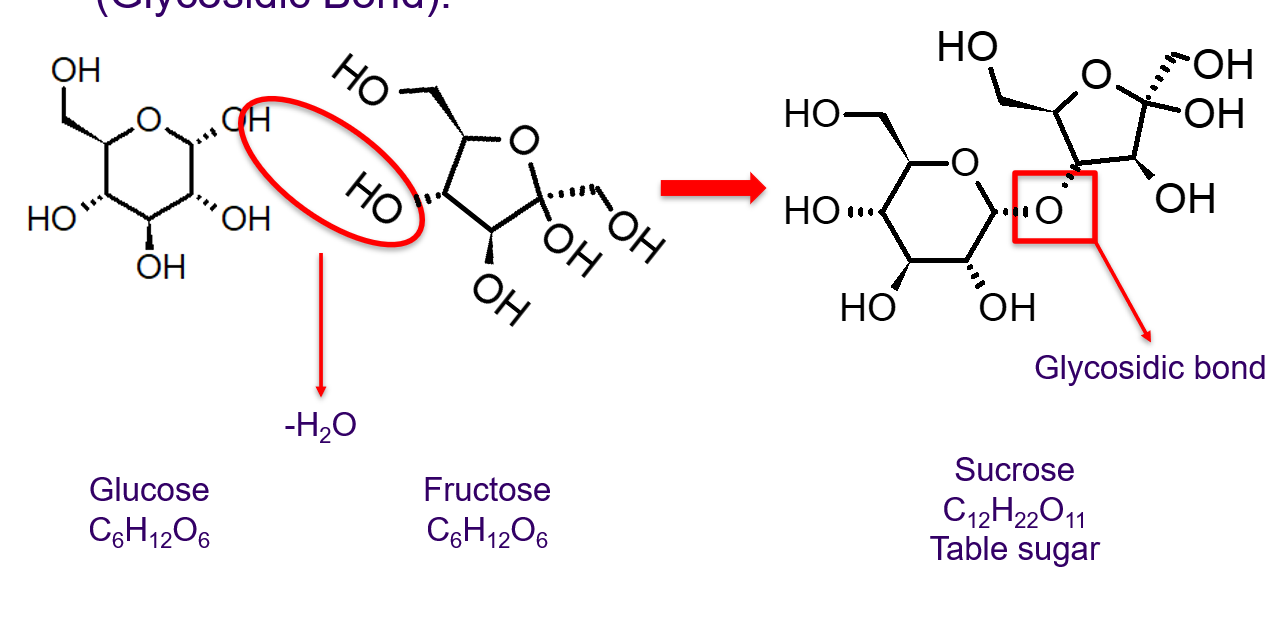
Glycosidic bond
Lipid functions
1)Protection and insulation
2)Neuron myelination
3)Absorption of fat-soluble vitamins
4)Hormone production
5)Cell membranes- lipid bilayers
Lipids

Lipid classifications/sub-groups
1)Triglycerides 2)Phosopholipids 3)Sterols.
Properties of Lipids
Fatty, waxy or oily in compostion
Triglycerides
Main constitute of body fat. Can be Saturated (c-c) or unsaturated. Double bonds can be cis or trans in geomery
Phospholipids

AMPHIPATHIC
has both a hydrophilic and hydrophobic region
Which part of a phospholipid is hydrophilic?
The polar phosphate-containing head.
Sterols
Cyclic organic compounds found in grains, nuts, seeds, fruits and vegetables. A sub-group of steroids
Steroid vs Sterol
Both 4-ring structure but a sterol has a OH- group
What sterol is important in fungi?
Ergosterol
Why is cholesterol described as amphipathic?
Cholesterol has a small polar hydroxyl (-OH) region and a much larger hydrophobic region.
How does Cholesterol affect fluidity
At higher temperatures:
Cholesterol restricts phospholipid movement
→ prevents the membrane becoming too fluid
At lower temperatures:
Cholesterol prevents fatty-acid chains packing too closely
→ prevents the membrane becoming too rigid.
Roles of cholestrol
Role in heart disease.
Synthesis of eg vitamin D, bile, sex hormones
Important part of cell membrane structure
Amino acid

In which direction are protein sequences written?
N-terminus → C-terminus
What is the N-terminus?
The end of a polypeptide containing the free amino group.
What is the C-terminus?
The end containing the free carboxyl group.
What are proteinogenic amino acids?
Amino acids that are incorporated into proteins.
Amino acids encoded in human DNA
Only 20 are genetically encoded in human DNA, these are known as the proteinogenic amino acids
Peptide bond
Formed via a condensation reaction between the carboxyl and amine group
Peptide bond formation

20 proteinogenic amino acids

Angiotensin I
Peptide hormone
Vasoconstriction
Increases blood pressure

Primary structure
The amino acid sequence from N- to C- terminus
Secondary strcture
Logical structural features- number of commonly observedmotifs
Tertiary structure
The overall protein conformation caused by side chain interactions- folding of a polypeptide into a particular 3D shape
What are electrostatic interactions in proteins?
Attractions or repulsions involving charged or polar groups in a protein. Oppositely charged side chains can attract and form ion pairs/salt bridges
What is π-π (pi-pi) stacking?
A non-covalent interaction involving π systems, commonly associated with aromatic groups positioned close to one another. π-π contacts contribute to protein folding and structure.
aromatic ring ⇄ aromatic ring
hydrophobic interactions in proteins?
In an aqueous environment, non-polar/hydrophobic groups tend to associate away from water. The hydrophobic effect contributes importantly to protein folding.
What’s the main bond in secondary structure
Hydrogen bonding
Alpha helix

What holds an alpha helix together
The α-helix is stabilised by hydrogen bonds within the polypeptide backbone.
C=O of one peptide group acts as a hydrogen-bond acceptor.
N-H of another peptide group acts as a hydrogen-bond donor
What does "residue" mean?
An amino-acid residue is an amino acid once incorporated into a peptide/protein chain.
What does i+4 mean?
Four residues further along the amino-acid sequence.
Is an α-helix right- or left-handed?
Right handed
How many residues are there per turn of an α-helix?
Approximately 3.6 residues per turn
How does alpha helix form
Hydrogen bonds formed between carboxyl and amino groups. Then the helix turns right-handed (clockwise when vweid from the N-Terminus). The upper and lower ends of the ploypeptide are not involved in this bonding
Beta plated sheet

Build of beta plated sheet
A β-strand is an extended section of polypeptide backbone.
Multiple β-strands positioned alongside each other and connected by hydrogen bonds form a β-sheet, also called a β-pleated sheet
Shape of beta plated sheet
Zig-zag. The angular conformation of the peptide chain causes the zig-zag shape.
What bonds hold beta plated sheet togther
Hydrogen bonds in the backbone forms between each segment, as Adjacent β-strands are stabilised by hydrogen bonds between the peptide backbones.
Parallel beta plated sheet
The neighboring β-strands run in the same N → C direction
Antiparallel beta plated sheet
Neighbouring strands run in opposite directions.
Tertiary structure
Consist of many alpha helices and beta sheets twisted around each other. This 3D shape of the protein is influenced by intermolecular forces as well as hydrophobicity.
Restrict the shape of a protein to one or a few conformations
Noncovalent bonds
Under which one of the following conditions is the complete structure of a protein designated as its quaternary structure?
The protein contains more than one protein subunit.
It is estimated that about 30% of the proteins encoded in an animal's genome are membrane proteins that are required for a cell to function and interact with its environment.
True
What is the name of the linkage which bonds monosaccharides to form oligosaccharides and polysaccharides.
Glycosidic linkage
1st Law of Thermodynamics
The total amount of energy within a system and its surroundings is constant OR energy can neither be created nor destroyed, only interconverted between forms.
2nd Law of Thermodynamics
The total entropy (the level of disorder) of a system and its surroundings always increases.
3rd law of thermodynamics
The entropy of a system approaches a constant value when its temperature approaches absolute zero.
Closed system
cannot exchange matter across boundaries.
Open system
can pass matter back and forth across boundaries.
systems

Enthalpy
Heat Storage Capacity of A System
Formula for enthalpy
Enthalpy = Internal Energy + (Pressure x Volume)
H (J (or J/mol)) = E (J) + (P (Pa) x V (m3))
Similarities in enthalpy
∆H (enthalpy) and ∆E (energy) are very similar in liquids and solids because there is little change in volume
entopy
refers to the level of disorder in a system (e.g. how energy is distributed in a system)
Key rule of entropy
Entropy increases spontaneously
Gibbs free energy
∆G = ∆H - T∆S
∆G = Change in Gibbs Free Energy (kJ/mol)
∆H = Change in Enthalpy (J)
T = Temperature (K)
∆S = Change in Entropy (J/K)
∆G < 0
Reaction occurs spontaneously
∆G > 0
Reaction does not occur spontaneously
∆G°
Under Standard Conditions (298K or 25°C), 1 bar pressure, all reactants and products at 1M.
∆G°’
37°C i.e. 310K, and pH of 7 = 10-7M [H+]
∆H < 0 and ∆S > 0
-∆G
Spontaneous
Exergonic
Energetically Favourable
Loss of available energy
∆H < 0 and ∆S < 0
∆G
Spontaneous
At low temperatures
∆H > 0 and ∆S < 0
∆G
Non-Spontaneous
Endergonic
Energetically unfavourable
Gain in available energy