Physics review uncertainty
 Call Kai
 Learn
 Practice Test
 Spaced Repetition
 Match
 Flashcards
 Knowt Play
1/13

There's no tags or description
Looks like no tags are added yet.
14 Terms
Notes

Physics Lab: Determining the Acceleration of a Freely Falling Object
Lab Results Summary
The purpose of this lab was to experimentally determine the acceleration due to gravity g by measuring the time it takes a dropped object to fall from different heights. Our group performed three trials at each of five different heights, for a total of 15 drops. We used slow-motion video analysis and stopwatch timing to measure the falling time.
As the drop height increased, the object took longer to reach the ground. The collected position and time measurements will be used to create graphs and calculate the object's acceleration due to gravity. The results are expected to demonstrate that a freely falling object accelerates downward at a nearly constant rate of approximately 9.8 m/s^2, assuming air resistance is negligible.

Uncertainty in Addition and Subtraction
What is the largest and smallest value I can get when adding 23.5 ± 0.1 m and 1.43 ± 0.02 m?
If the numbers have the uncertainty in different place values, the uncertainty of the result is the uncertainty in the highest place value
(2.34 ± 0.03 s) + (4.212 ± 0.002 s) = 6.55 ± 0.03 s
If the numbers have the uncertainty in the same place value, then the uncertainty needs to be larger than any of the individual uncertainties, with the largest possible uncertainty being the sum of all the uncertainties
(5.28 ± 0.02 s) - (4.84 ± 0.03 s) = 0.44 ± 0.04 s or worst case 0.44 ± 0.05
Uncertainty of multiplication and division
What are the largest and smallest values I can get when multiplying 12.1 ± 0.2 m/s by 8.3 ± 0.3 s?
You can’t have more known and estimated digits in our answer than any of our original numbers
For the value of the plus/minus, determine the percent uncertainty (uncertainty divided by actual value) for all values, add them together, then take that percent of you final answer
(0.122 ± 0.003 m)(0.15 ± 0.01 m) = 0.018 ± 0.002 m2
Physics Lab: Horizontal Projectile Motion
1. Data Interpretation
The average time of flight for the slow speed was 0.46 seconds, the medium speed was 0.37 seconds, and the high speed was 0.42 seconds. Although there were slight differences between the results, increasing the horizontal speed did not significantly change the time it took the ball to hit the ground. This suggests that horizontal speed has little to no effect on the time of flight.
2. Physics Explanation
The results demonstrate that horizontal and vertical motion are independent of each other in projectile motion. Horizontal velocity does not affect the vertical acceleration of the ball because gravity acts downward regardless of its horizontal speed. Therefore, the ball takes approximately the same amount of time to reach the ground regardless of its horizontal launch speed.
3. Landing Distance
The high-speed ball lands farther away from the table because it has a greater horizontal velocity than the slow-speed ball. Since both balls spend approximately the same amount of time in the air, the high-speed ball travels a greater horizontal distance during that time. This is because horizontal distance depends on horizontal velocity multiplied by time.
4. Experimental Error
Two possible sources of experimental error are camera angle parallax and frame rate limitations.
- Camera angle parallax: If the camera is not positioned correctly, it may be difficult to identify the exact moments when the ball leaves the table and touches the floor. For example, recording the launch time too early would make the measured time of flight too long, while recording it too late would make it too short.
- Frame rate limitations: The camera may not capture enough frames to identify the exact moments of launch and impact. If the first frame showing the ball hitting the floor occurs after the actual impact, the measured time of flight will be too long. Similarly, identifying the launch moment too late would make the measured time too short.
5. Prediction
If the experiment were repeated using a table twice as high, the time of flight would increase for all three speeds. The ball would take longer to reach the floor because it would have a greater vertical distance to fall. However, the slow, medium, and high-speed balls would still have approximately the same time of flight as one another because horizontal velocity does not affect vertical motion.
Important physics concept to remember: The main purpose of this experiment is to demonstrate that horizontal and vertical motion are independent. Changing the horizontal launch speed changes how far the ball travels, but not how long it takes to fall from the same height.


Horizontal Projectile Lab Discussion and the Return of Vectors
Page 5: Vectors – River Scenario
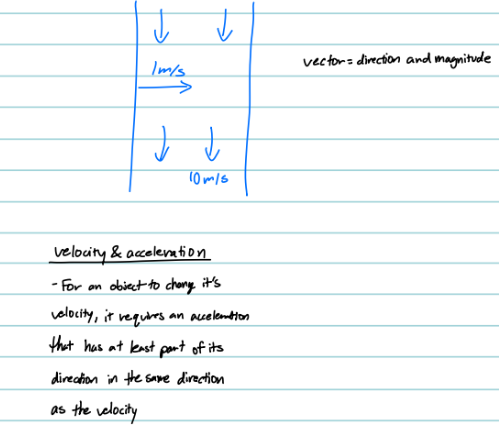
1. Does the downstream current help you reach the other side of the river any faster?
No. The downstream current does not affect the time it takes to cross the river because the cross-river swimming speed remains 1 m/s. It only affects the swimmer's horizontal position downstream.
2. How far downstream would you end up?
d = vt
d = (10 m/s)(50s)
d = 500
You would end up 500 meters downstream.
Perpendicular vectors do not affect each other
Page 7–9: Physics Concepts and Lab Analysis
1. What does it mean that perpendicular vectors do not affect each other?
Perpendicular vectors act independently in their respective directions. Changing an object's horizontal velocity does not change its vertical motion, and vice versa.
2. What direction was the initial velocity in our lab?
The initial velocity was horizontal because the ball left the edge of the table moving horizontally.
3. What direction was the acceleration?
The acceleration was vertically downward because gravity pulls the ball toward the ground.
4. What does this tell us about vertical motion?
The time it takes an object to fall depends exclusively on its vertical displacement, vertical initial velocity, and vertical acceleration. Horizontal velocity does not affect the time of flight.
5. How do we solve a two-dimensional motion problem?
We separate the motion into two independent one-dimensional problems:
Horizontal motion (x-direction).
Vertical motion (y-direction).
We solve each direction separately and combine the results when necessary.
Your ball left the ramp horizontally at a velocity of 1.33 m/s ± 2% and the height of the ramp off the ground is 0.882 m ± 0.2%. How far away, horizontally, would the ball land from the ramp?
0.564m ± 2.1%

Your ball left the ramp horizontally and landed 1.34 m ± 2% away. If the height of the ramp was 0.954 m ± 0.2%, what speed did it leave the ramp at?
3.04m ± 2.1%
Turd the target

Absolute Uncertainty, Percent Uncertainty, and more
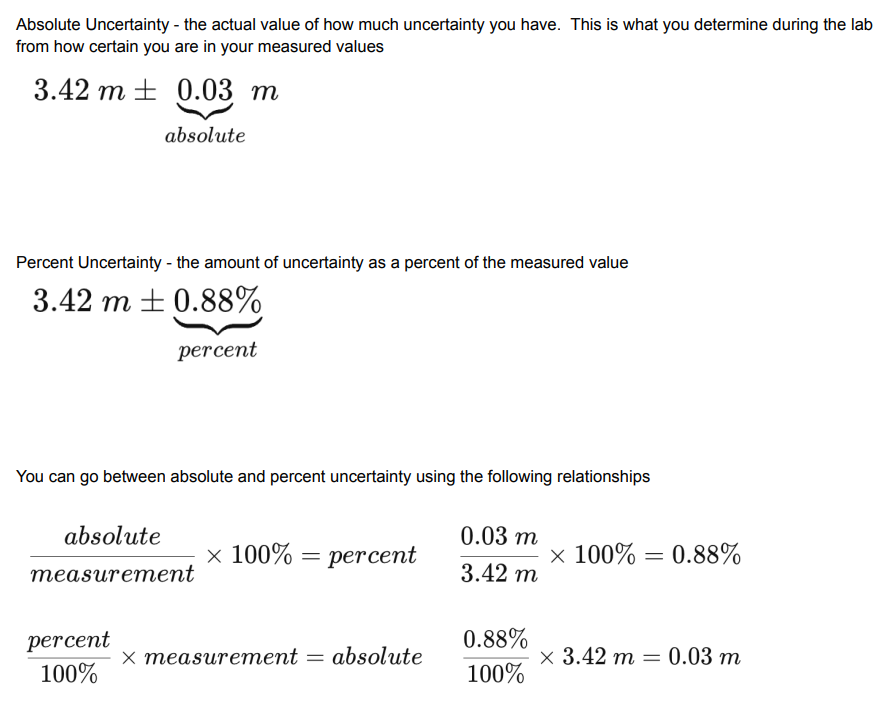
Absolute Uncertainty - the actual value of how much uncertainty you have. This is what you determine during the lab from how certain you are in your measured values
Percent Uncertainty - the amount of uncertainty as a percent of the measured value
You can go between absolute and percent uncertainty using the following relationships
Addition/Subtraction
When adding and subtracting, you can’t be more certain about your answer than you are about any of the numbers used. You will round your answer to the same decimal place as the measurement used with the estimated digit in the largest decimal place.
The absolute uncertainty of the answer is the sum of all the absolute uncertainties of the measurements used, rounded to the place that matches the decimal place of the estimated digit of your answer

Multiplication/Division
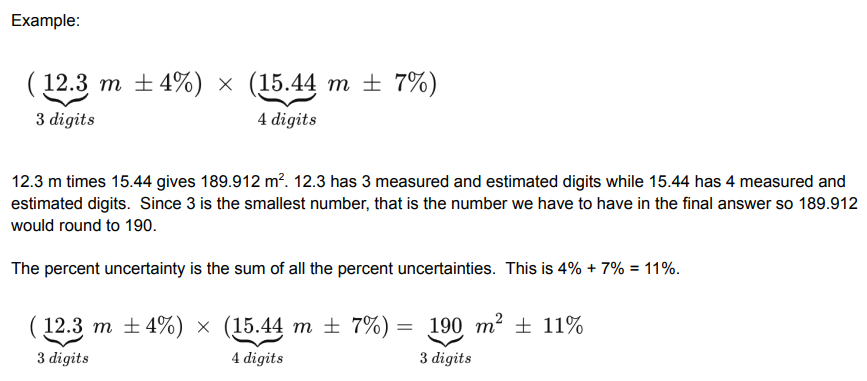
When multiplying and dividing, your answer can not have more measured and estimated digits than any of the numbers used. You will round your answer to have the same number of measured and estimated digits as the number used with the least amount of measured and estimated digits
The percent uncertainty of the answer is the sum of all the percent uncertainties of the measurements used.
More notes
Squares and Square roots
When you square a number, you double the percent uncertainty together
When you square root a number, you cut the percent uncertainty in half
Averages
Use the highest absolute uncertainty of all the numbers used
Desmos
Use the highest percent uncertainty of all the numbers used