APUSH Political Cartoons
 Call Kai
 Learn
 Practice Test
 Spaced Repetition
 Match
 Flashcards
 Knowt Play
1/28

There's no tags or description
Looks like no tags are added yet.
29 Terms
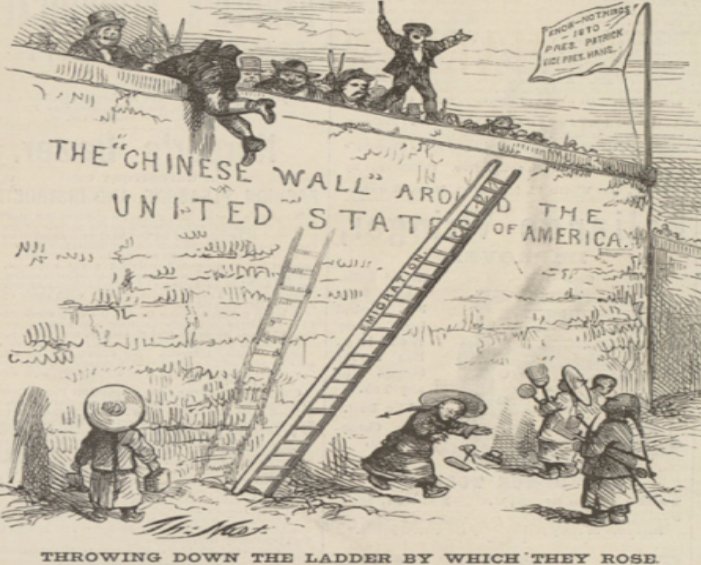
critiques the hypocrisy of nativists who benefited from open immigration to enter the United States but sought to pull up the ladder—symbolized by anti-immigrant barriers—to exclude new Chinese immigrants.

depicts various American working-class groups using blocks labeled with grievances like "Prejudice," "Jealousy," and "Fear" to build a wall excluding Chinese immigrants, while ironically showing China tearing down its own wall to open trade with the United States in the background.

highlights the injustice of the Chinese Exclusion Act by portraying a peaceful, hardworking Chinese immigrant barred from entering the "Golden Gate of Liberty" despite bringing attributes like "Industry," "Order," "Peace," and "Sobriety," while a notice ironicly welcomes radicals and lawbreakers.

lampoons the Statue of Liberty by depicting a stereotyped Chinese immigrant in San Francisco harbor emitting rays labeled with xenophobic tropes like "Filth," "Immorality," "Diseases," and "Ruin to White Labor" to promote anti-Chinese exclusion sentiment.

criticizes how political factions across the 47th Congress—including Republicans, Democrats, Independents, and Readjusters—united to attack non-voting Chinese immigrants, using them as an easy political target because they lacked political power and representation.

depicts an agitated Irishman disturbing the peace in a shared bunkhouse of quiet, sleeping immigrants from around the world, criticizing Irish immigrants as uniquely disruptive agitators in American society.
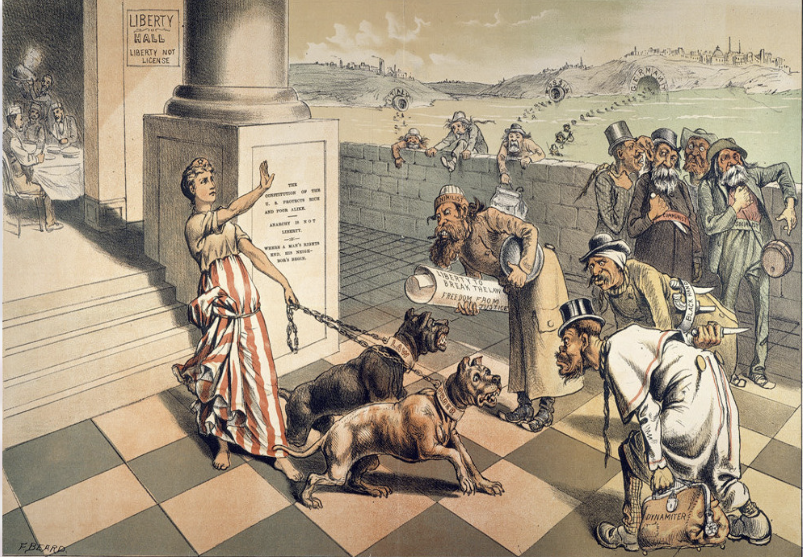
depicts Columbia guarding the entrance to "Liberty Hall" with watchdogs labeled "Law" and "Order" to restrain incoming European anarchists, social radicals, and violent agitators carrying weapons and explosives.

reflects Gilded Age nativist anxieties by portraying an incoming immigrant laden with burdens labeled "Poverty," "Disease," "Superstition," "Anarchy," and "Sabbath Desecration" while Uncle Sam reluctantly admits him because no law existed to turn him away.
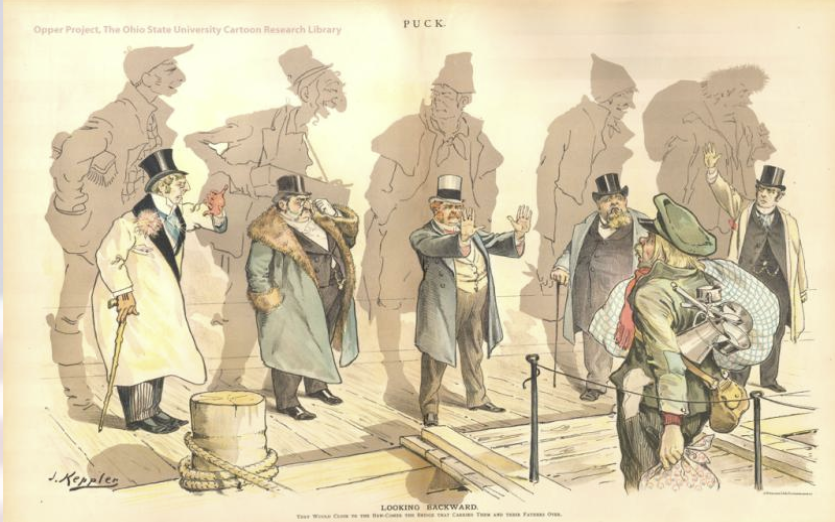
criticizes wealthy, established Americans who attempt to block a new immigrant, while their own shadows loom behind them revealing their impoverished, newly arrived immigrant origins.

nativist fears by depicting the Roman Catholic Church as a predatory octopus extending its tentacles around key United States government institutions in Washington, D.C., including the Capitol, White House, and Bureau of Engraving.
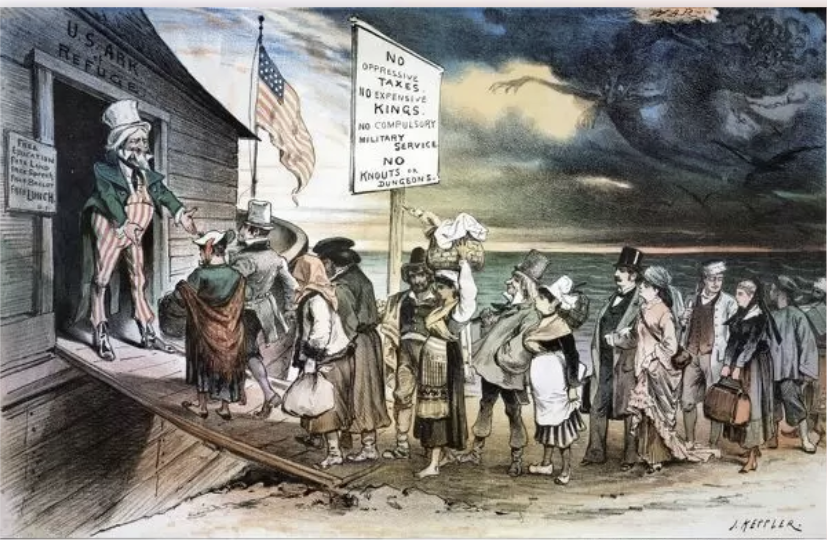
portrays the United States as a welcoming asylum ("U.S. Ark of Refuge") where Uncle Sam greets European immigrants escaping war, tyrannical monarchs, oppressive taxes, and compulsory military service.
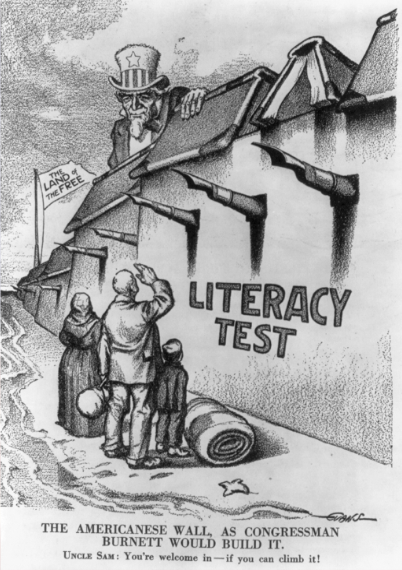
criticizes proposed literacy test legislation by depicting it as a towering, pen-topped wall of books designed to block immigrant families from entering "The Land of the Free."

reflects xenophobic anxieties about Southern and Eastern European immigration by depicting Uncle Sam standing by as rat-like figures carrying knives and headbands labeled "Anarchist," "Mafia," and "Socialist" are dumped directly from the slums of Europe onto American shores.

the divided American perspectives on turn-of-the-century immigration by surrounding a giant immigrant figure with various societal figures holding signs with competing views—ranging from cheap labor and political votes to economic menace and disease.

portrays President Theodore Roosevelt advocating for environmental conservation by pointing to a posted declaration urging the protection and preservation of public forests from destruction and depletion.

illustrates the moral and physical ruin caused by alcohol through a nine-step staircase that leads from casual social drinking to crime, poverty, and ultimate destruction.

depicts President Theodore Roosevelt (as "Jack the Giant Killer" holding a sword labeled "Public Service") confronting towering Wall Street monopolists—such as J.P. Morgan and James J. Hill—to highlight his Progressive Era "trust-busting" campaign against corporate monopolies.
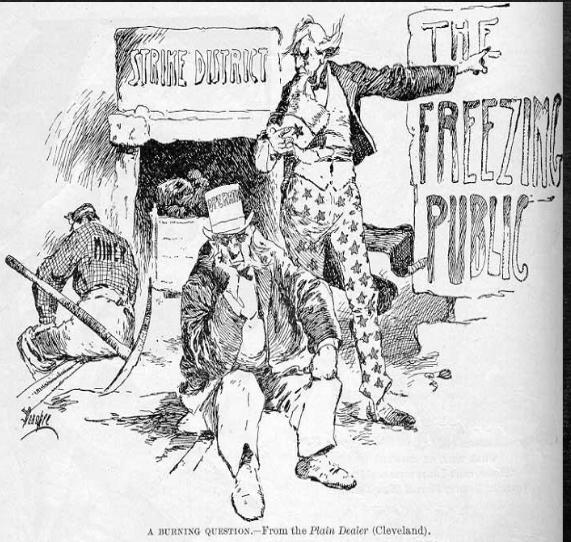
depicts Uncle Sam intervening during the Anthracite Coal Strike of 1902 to demand that stubborn mine operators and striking miners resolve their standoff before winter for the sake of the "Freezing Public."

illustrates President Theodore Roosevelt's policy of distinguishing between corporate monopolies, showing him killing "Bad Trusts" that abused their power while restraining and regulating "Good Trusts" on a leash.

depicts President Theodore Roosevelt tightening a vise around a bloated, money-spilling figure labeled "The Trusts" to symbolize his Progressive Era regulatory policies.

depicts Uncle Sam holding his nose while using a rake labeled "Investigation" to churn through a foul-smelling fire labeled "Meat Scandal," symbolizing the federal government's necessary exposure and cleanup of the corrupt and unsanitary meatpacking industry following public outrage.

depicts outgoing President Theodore Roosevelt handing over his infant "My Policies" to his handpicked successor, William Howard Trust-busting successor William Howard Taft, who is dressed as a nursemaid to care for the administration's legacy.

depicts President Theodore Roosevelt dressed in royal robes as a monarch while holding up his handpicked successor, William Howard Taft, wearing a crown to satirize executive overreach and dynastic succession.

depicts an overwhelmed President William Howard Taft hopelessly tangled in yarn while kittens representing various political factions create chaos around him, all as an unamused Theodore Roosevelt looks on through the window.
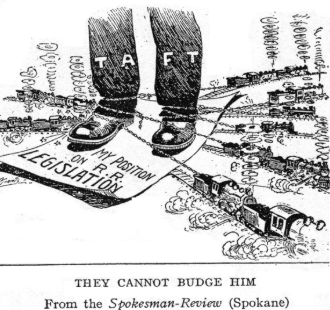
depicts President William Howard Taft standing firm on a platform labeled "My Position on R.R. Legislation" as railroad interests attempt to move him.

depicts the Ballinger-Pinchot affair, showing President William Howard Taft wielding a big stick to defend Interior Secretary Richard Ballinger from Chief Forester Gifford Pinchot, while Theodore Roosevelt watches from behind a tree labeled "My Policies."

depicts Theodore Roosevelt submerged in the waters of "Teddyism" surrounded by a third-party Progressive choir, extending a hand to rescue the hesitant Republican elephant as President William Howard Taft and party conservatives pull it back toward the shore.

depicts the ghost of George Washington accosting Theodore Roosevelt with a stern finger labeled "Anti-Third-Term Principle" as Roosevelt, carrying a paper marked "My Policies, My Platforms, My Issues," recoils in dismay.
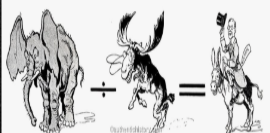
illustrates a simple mathematical equation of the presidential election, showing how the division between the Republican elephant and Theodore Roosevelt's Bull Moose party ultimately equaled victory for Woodrow Wilson riding the Democratic donkey.