Chapter 4 - Three Major Classes of Chemical Reactions
 Call Kai
 Learn
Learn Practice Test
 Spaced Repetition
 Match
Match Flashcards
 Knowt Play
1/29

There's no tags or description
Looks like no tags are added yet.
Name | Mastery | Learn | Test | Matching | Spaced | Call with Kai | Chat |
|---|
No analytics yet
Send a link to your students to track their progress
30 Terms
Is concentration an intensive or extensive property?
It’s intensive, meaning it’s independent of the amount of substance present.
What does molarity (M) represent? How is it calculated?
It represents the concentration of a solution.
You calculate it by doing (moles of solute) / (liters of solution)
What is the molarity of a solution that contains 53.7 g of glycine dissolved in 495 mL of solution?
glycine AMU: 75.07
53.7/75.07 = 0.715 mol Glycine
495 mL / 1000 mL = 0.495 L
0.715 / 0.495 = 1.44 M glycine
How many grams of solute are in 1.75 L of 0.460 M sodium hydrogen phosphate? First, write out what sodium hydrogen phosphate is:
sodium hydrogen phosphate: 141.96 g
Na2HPO4
0.460 M = mol / 1.75
mol = 0.805 mol Na2HPO4
0.805 × 141.96 = 114 g Na2PO4
When we’re calculating molarity, we know the formula is mol/volume.
Is the volume the solution volume or the solvent volume?
It’s the SOLUTION volume, so it already considers what’s in the entire solution (solute + solvent).
this means you cannot just dissolve 1 mol of a solute in 1 L to get 1 M solution.
Isotonic saline is 0.15 M aqueous NaCl. How would you prepare 0.80 L of isotonic saline from a 6.0 M stock solution?
Get this into mol of NaCl by doing (0.80 L soln) * (0.15 mol NaCl) / (1 L soln) = 0.12 mol NaCl
Now take our mol of NaCl in 0.15 M and find the volume needed in the second solution: (0.12 mol NaCl) * (1 L soln / 6.0 mol NaCl) = 0.020 L soln
Answer: Put 0.020 L of 6.0 M NaCl in a 1.0 L graduated cylinder and add 0.8 L of water.
A chemist dilutes 60.0 mL of 4.50 M potassium permanganate to make 1.25 M solution. What is the final volume of the diluted solution?
Use M1V1 = M2V2 here.
0.060 L * 4.50 = (1.25)(x)
x = 0.216 L

Answer this question:
FOR B: The solvent needs to either be boiled off or more mols of the solute need to be added.
FOR C: More solvent needs to be added or the solute needs to be removed through chemical-change processes.

Answer question (is MCQ)
The answer is B.
Think about it. We now have 400 mL of solution and 12 mols. The solution just got four times larger, so there’s four fewer moles 12/4 = 3

Answer problem:
A: Beaker C (just think about how KSO4 dissociates
B. We have nine particles and if each one is 0.1 mol, then we have 0.9 mol of particles. To get this answer in particles, times by avogadro’s:
0.9 mol x 6.022 × 1023 = 5.420 × 10²³ particles
C: We have 6 K+ particles and if each one is 0.1 mol, then we have 0.6 mol. The entire solutoin is 500. mL so 0.6/0.500 L = 1.20 M

Answer question BUT SKIP LETTER B
A: This dissolves into Fe3+ and SO32-. We need to then write out the equation for this: Fe2(SO4)3 —> 2Fe3+ + 3SO2-4
Then we use mol ratios here: 5 mol Fe2(SO4)3 × 2 mol Fe / 1 mol Fe2(SO4)3 = 10 mol Fe3+
And then do the other in your head cuz it’s a lot of work: 15 mol SO42-
C: 0.80 M Cu(NO3)2 = x . 0.035 L therefore x = 0.028 mol of entire compound.
Then write out equation: Cu(NO3)2 —> Cu2+ + 2NO31-
And you can do these ratios in your head. It’ll be 0.028 mol Cu2+ and 0.056 mol NO3-
What does a precipitate reaction involve?
It involves two soluble ionic compounds reacting to form a precipitate (wow, who would have thought?)
In a precipitation reaction, there’s such thing as writing out the molecular equation and the total ionic equation. What’s the difference in them?
The molecular equation writes out the ENTIRE equation as if the compounds didn’t separate into cations and anions. The biggest thing to pay attention to here is the state of matter (liquid, solid, gas, aqueous).
The total ionic equatoin shows all the souble ionic substnaces that actually exist WITHIN a solution. It shows the ions and the precipiate easily.
Look at image (top one is molecular)

What is the net ionic equation telling us?
This tell us exactly what ions interact to form the precipitate. It completely eliminates the spectator ions (ions that don’t react to form a precipitate).
Look at image showing all three equations:

There’s a big list of solubility rules you unfortunately have to memorize. What are they (only say soluble ones here)?
All Halogens (F, Cl, Br, etc) in Group 17
Anything with SO42-
NO3, C2H3O2, HCO3, ClO3, NH4 (ammonium)
Any Group 1 metals
(You’ll be given if something has an exception)
What is a metathesis reaction?
This is a reaction when two ionic compounds exchange ions (swap partners) to form two new compounds.
This is literally just describing what happens in a precipitation reaction. It tells us that two ionic compounds will swap ions with each other

Answer the problem: (skip D)
A: It’s Na2SO4 because it’s soluble in water.
B: Ba(NO3)2 because Fluoride cannot dissolve in water based on its super duper strong bond.
C: We know that both Na2SO4 and Ba(NO3)2 are dissolved. The ions here are swapped to get NaNO3 and BaSO4. Based on solubility rules, NaNO3 is soluble (group 1), so BaSO4 is the precipitate formed.
MOLECULAR, TOTAL IONIC, and NET IONIC in picture (remember states)

What mass of magnesium hydroxide is formed when 0.180 L of 0.0155 M magnesium chloride reacts with excess calcium hydroxide?
Magnesium hydroxide is 58.32 AMU
Write the balanced equation: MgCl2 (aq) + Ca(OH)2 (aq) —> Mg(OH)2 (s)+ CaCl2 (aq)
Find moles of magnesium chloride: 0.180 L * 0.0155 mol / 1 L = 0.00279 mol MgCl2
Use molar ratio to turn this into magnesium hydroxide (it’s 1 to 1): 0.00279 Mg(OH)2
Turn this into grams by multiplying my 58.32 to get 0.163 g Mg(OH)2

Answer the question: and dont do B
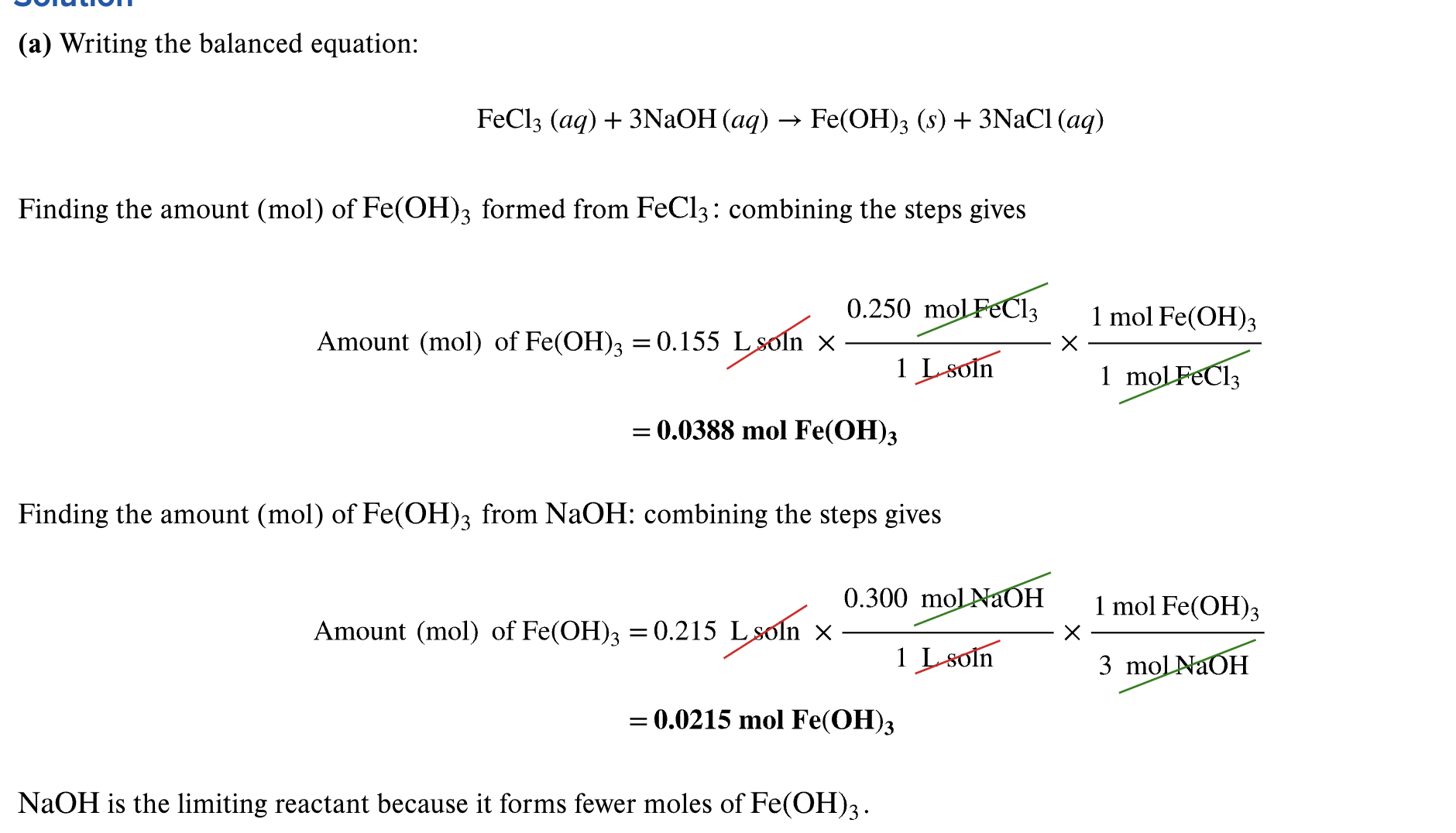
Fe(OH)3 amu is 106.87 g
A: Write out the balanced equation: FeCl3 (aq) + 3NaOH (aq) —> Fe(OH)3 (s) + 3 NaCl (aq)
Look at screenshot
After you find the limiting reactant, use AMU in the flashcard to get 2.30 g Fe(OH)3
At the core, what is an acid-base reaction? Also remember what’s CRITICAL to have this reaction!
An acid-base reaction involves an acid reacting with a base. It will always involve water as a reactant/product.
Strong bases have either ____ or ____ as part of their structure. It’s how we know they’re strong.
OH- or O2-
There are three things that can indicate a strong electrolyte:
Strong acids
Strong bases
Ionic compounds
Nitric acid is a major chemical in the fertilizer and explosives industry. How many H+ ions are in 25.3 mL of 1.4 M nitric acid?
Find the moles of HNO3 (nitric acid): 25.3 mL / 1000 = 0.0253 L.
x/0.0253 = 1.4, so x (or mols) is 0.035We know nitric acid completely dissociates (cuz if it didnt this problem wouldnt exist), so write out equation
HNO3 —> H+ + NO3-Find the mols of H+ which is just 1:1 ratio: 0.035 mol H+
To find the number of ions, we multiply by avogadro’s number to get 2.1 × 10²² H+ ions
In the screenshot, pay attention to the written equation—it’ll be an exam question!

Write the molecular, total ionic, and net ionic equation for the reaction of the strong acid HCl with the strong base NaOH:
MOLECULAR: HCl (aq) + NaOH (aq) —> NaCl (aq) + H2O (l)
TOTAL IONIC: H+ (aq) + Cl- (aq) + Na+ (aq) + OH- (aq) —> Na+ (aq) + Cl- (aq) + H2O (l)
NET IONIC: H+ (aq) + OH- (aq) —> H2O (l)
A good tip for writing the total ionic is to rememebr what would dissociate in water. Here, everything does!

Answer the question:
Write the balanced equation: 2NaOH (aq) + H2SO4 (aq) —> Na2SO4 (aq) + 2H2O (l)
To find the volume of NaOH, we need to do 33.87 - 0.55 then turn it into liters (divide by 1000) to get 0.03332 L soln
Now we can find the mol of NaOH added: 0.1524 mol NaOH / 0.03332 L = 5.078 × 10⁻³ mol NaOH
Now based on our equation, we can find the moles of H2SO4 and based on the ratio, we’re dividing by 2 so: 2.539 × 10⁻³ mol H2SO4
Now we have enough for the molarity: 2.539 × 10⁻³ / 0.050 mL = 0.05078 M H2SO4
Consider the two following equations. In each one, identify which molecule is oxidized/reduced:
2Mg (s) + O2 (g) — 2MgO (s)
H2 (g) + Cl2 (g) —> 2HCl (g)
In first equation, Mg is oxidized and O2 is reduced. Remember that lone elements get a number of 0, so we have 0 and 0. After Mg reacts with O, it has +2 charge and O has -2 charge.
Mg went from 0 to 2+ so it oxidized. O went from 0 to -2, so it was reduced.
In the second equation, both of them have 0. Then H reacts with Cl and goes from 0 to +1. Cl goes from 0 to -1.
H2 is oxidized, Cl2 is reduced. (don’t say H is oxidized and Cl is reduced)

Answer this question: (dont do the fourth one—dichromate ion)
Start by writing everything in its chemical part: ZnCl2, SO3, HNO3
For ZnCl2, calculate the charge on each one. Zn is +2, Cl2 is 2-
For SO3, we know O3 is -6, so S must be +6.
For HNO3, we know H is +1, O3 is -6, so then N has to be +5.

Answer the question: Also, just say which one is oxidized.
To test the thing it wants, tell me in letter A which one is the reducing agent and which one is the oxidizing agent.
You simply apply oxidation numbers to each element and see if it changes from reactants to products.
For A
Al goes from 0 to +3 and H2 goes from +1 to 0. Al is oxidized, H2SO4 is reduced. Therefore, Al is the reducing agent dn H2SO4 is the oxidizing agent.
For B
We see the formation of water, and all O.N. stay the same! This is an acid-base reaction!
For C
We see PbO go from +2 to 0, meaning it’s reduced. We see C go from +2 to +4, so CO is oxidized.

Answer the question
Fe = 55.845 amu
(first question)
You can just do MV = MV, BUT you need to pay attention to the coefficients. We want to know the M of 6FeSO4 to titrate 30.0 mL of FeSO4 solution
6(0.02185)(0.250) = (0.030)(x) then x = 1.09 M
We get the 6 here because we have 6 mol of the iron stuff per 1 mol of K2Cr2O7
Question 2
Take the molarity in first quesiton (1.09) and do 1.09 = x / 0.030 so x = 0.0327 mol Fe2+
Turn this moles into grams by multiplying by AMU of iron so 0.0327×55.845 = 1.83 g
Then do 1.83 g / 2.58 = 0.709 or 70.9%
A metal and nonmetal form a(n) ____ compound…
ionic