Defence
 Call Kai
 Learn
 Practice Test
 Spaced Repetition
 Match
 Flashcards
 Knowt Play
1/8

There's no tags or description
Looks like no tags are added yet.
9 Terms
What are a plants defences?
Reaction a plant has agaisnt pathogen attack
Can be constitutive (passive) or induced (active) by the pathogen
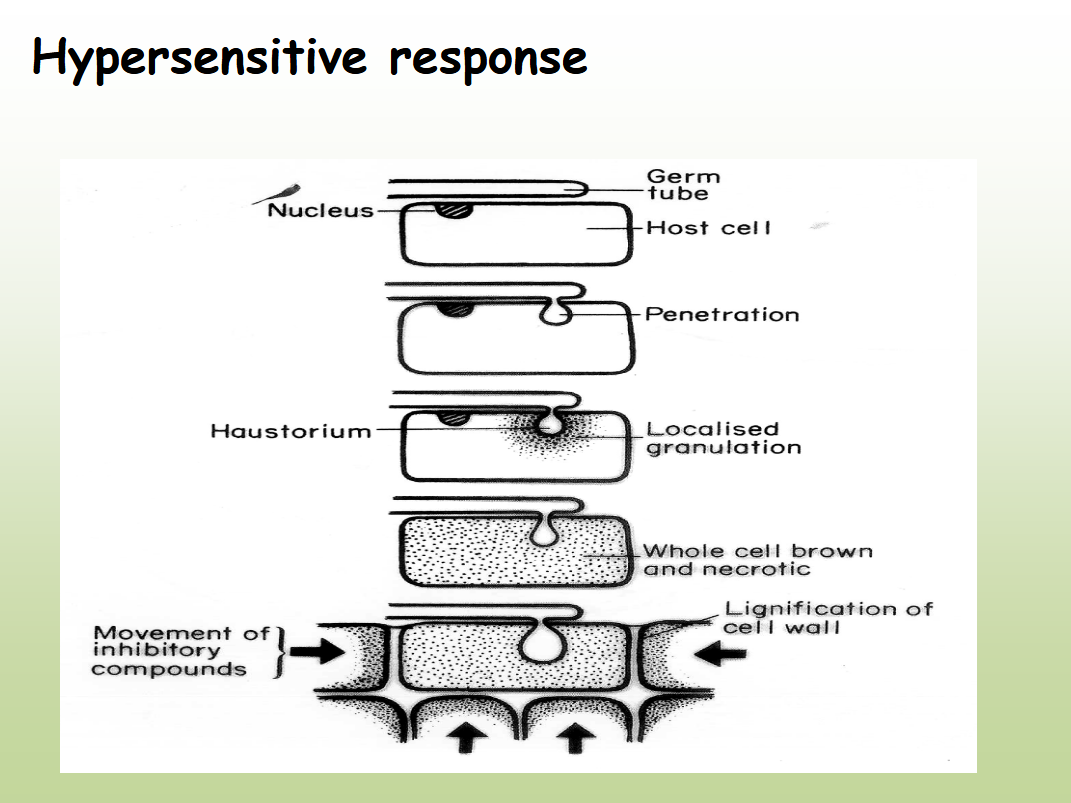
What is Induced hypersensitive defence agaisnt biotrophs?
Hypersensitive response leads to a very rapid cell death around the site of the attack.
This seals off the wounded tissue to prevent the pathogen or pest from moving into the rest of the plant.
What is systemic acquired resistance?
Systemic acquired resistance (SAR) is a whole-plant defence response that develops following an initial localised pathogen infection.
The initial infection activates systemic signalling, allowing uninfected parts of the plant to respond more rapidly and effectively to subsequent pathogen attacks.
SAR involves:
Accumulation of salicylic acid (SA), which activates defence signalling pathways.
Increased expression of pathogenesis-related (PR) genes, producing proteins involved in defence.
Development of broad-spectrum resistance against a wide range of pathogens.
SAR therefore provides enhanced protection throughout the plant following an earlier infection.
How does basal resistance by PAMP recognition work?
Basal resistance is an evolutionarily ancient defence mechanism that protects plants against many potential pathogens.
Pathogen-associated molecular patterns (PAMPs), also called microbe-associated molecular patterns (MAMPs), are conserved microbial molecules such as bacterial flagellin, elongation factor Tu (EF-Tu) and lipopolysaccharides (LPS).
These molecules are recognised by pattern-recognition receptors (PRRs) located on the plant cell surface.
Recognition activates intracellular signalling pathways, triggering PAMP-triggered immunity (PTI), also called MAMP-triggered immunity (MTI).
Defence responses include:
Production of reactive oxygen species (ROS).
Reinforcement of cell walls through lignin and callose deposition.
Production of antimicrobial compounds.
Activation of defence-related genes.
These responses help prevent pathogen penetration and colonisation.
How do pathogen effectors neutralise basal resistance?
Pathogens produce and inject effector proteins into plant cells to suppress basal resistance, also known as MAMP-triggered immunity (MTI).
These effectors interfere with specific components of the plant's immune signalling pathways, preventing the activation of defence responses such as reactive oxygen species (ROS) production and cell wall reinforcement.
By suppressing MTI, effectors allow the pathogen to infect, grow and colonise the host, resulting in disease.
How do R gene products recognise pathogen effectors?
Plant resistance genes (R genes) encode proteins that recognise specific pathogen effector proteins or their effects on host cells.
Recognition occurs through two main mechanisms:
Direct recognition: The R protein physically interacts with the corresponding pathogen effector, triggering a defence response.
Indirect recognition (guard hypothesis): The R protein monitors a host protein, known as a guardee, which is targeted by the pathogen effector. When the effector modifies the guardee, the R protein detects this change and activates immunity.
Recognition activates effector-triggered immunity (ETI), producing a rapid and intense defence response that can include the hypersensitive response (HR), oxidative burst and antimicrobial production.
Describe R-gene resistance and the gene-for-gene model of resistance?
R-gene resistance: Plant R proteins recognise pathogen effectors, activating effector-triggered immunity (ETI).
ETI: Triggers rapid defence responses, including ROS production, antimicrobial compounds and the hypersensitive response (HR).
Gene-for-gene model: Resistance occurs when a plant R gene recognises the product of a corresponding pathogen avirulence (Avr) gene.
Matching R + Avr: Resistance occurs.
No matching R + Avr: Pathogen may infect, causing disease.
Resistance breakdown: Mutations in pathogen Avr genes can prevent recognition, allowing infection.
What is ROS (reactive oxygen speicies)?
Toxic Hydrogen Peroxide produced by plant cells, triggering the HR strengthening cell walls and enhancing lignin formation.
What do ROS (reactive oxygen species) do?
Affect cellular membrane function, in part by inducing lipid peroxidation and by causing lipid damage.
Alteration of ion components in the cell and the breakdown of cellular components in the presence of ROS results in the death of affected cells and the formation of local lesions.