D3 OSCE (kinda DONE)
 Call Kai
 Learn
 Practice Test
 Spaced Repetition
 Match
 Flashcards
 Knowt Play
1/147

There's no tags or description
Looks like no tags are added yet.
148 Terms
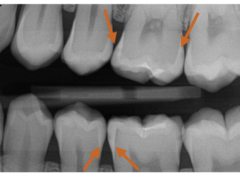
What are all these arrows pointing to?
Caries
How to calculate bone loss?
-Find long axis of the root
-Subtract 1.5-2m from CEJ
-Divide root into thirds
-Calculate percentage of RBL
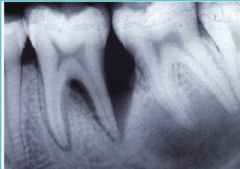
What is this showing?
Vertical bone loss
What is vertical bone loss?
One sided bone resorption of interdental marginal bone has an angulation towards either of mesial and distal aspect of the root

What is this showing?
Horizontal bone loss
What is horizontal bone loss?
Bone loss occurs in a plane parallel to CEJs of adjacent teeth
Describe the caries process in laymans terms?
Your teeth are very strong, but sugary or acidic foods and drinks, like soda, candy, and juice can still hurt them. The bacteria (germs) in your mouth love to eat sugar. When they do, they make acid, kind of like the acid in a sour lemon. This acid starts to eat away at your teeth.
Brushing and flossing help remove the bacteria and leftover food so they can't make as much acid. If you don't clean your teeth well, the germs keep damaging the tooth, and that's how a cavity forms.
You can help prevent cavities by brushing and flossing every day and choosing healthier foods and drinks, like water, fruits, and vegetables. OR
The caries process, or tooth decay, begins when bacteria in the mouth feed on sugars from food, producing acids that eat away at the tooth. Over time, this can lead to cavities as the bacteria progress deeper into the tooth structure.
You determine your patient is high caries risk.. What are your options for how you treat them?
Restorative plan
Non-restorative caries management
-->Diet change, improving OH, fluoride toothpaste→ tackle ETIOLOGY
Prescription
--> Prevident toothpaste
What is the Rx for Prevident for an ADULT?
1.1% Sodium Fluoride paste. Apply a pea sized amount to the toothbrush, brush for 2 minutes before bed, spit, and do not rinse. Do not eat or drink for at least 30 minutes.
What is the Rx for Prevident for a CHILD?
1.1% Sodium Fluoride paste. Apply a pea sized amount to the toothbrush, brush for 2 minutes before bed, spit, and rinse mouth thoroughly
If your patient has manual dexterity problems, you can prescribe them fluoride mouthwash/toothpaste
mouthwash
What is the purpose of CAMBRA?
Aims to prevent, arrest, or reverse dental caries by evaluating a patient's risk factors and providing tailored preventive strategies.
It focuses on understanding the causes of tooth decay rather than just treating the symptom
Preventative approach to categorize patients based on their risk of developing cavities
CAMBRA focuses on 3 things to help categorize its patients. What are they?
Caries risk factors
Caries protective factors
Clinical exam findings
According to CAMBRA...
What does "Caries Risk Factors" include in its assessment?
Visible plaque,
frequent snacking
Irregular saliva flow due to medications
abnormal tooth morphology like deep grooves and fissures
exposed root surfaces, orthodontic appliances like braces.
According to CAMBRA...
What does "Caries Protective Factors" include in its assessment?
The use of fluoride (systemic like water and topical like toothpaste) and salivary function
According to CAMBRA...
What does "Clinical exam findings" include in its assessment?
white spot lesions, demineralized areas, restorations, and plaque accumulation
Overall.. Caries management needs to be... (3 things)
1. Patient specific
2. Should identify and target etiology
3. Usually a balance of both restorative and non-restorable tx options like change in diet, improving OH, and using Fl2 toothpaste.
On a radiograph, your low caries risk patient has an E1/E2 carious lesion
What is the tx recommendation?
Monitor at next POE
On a radiograph, if your carious lesion is a D1 on a high risk patient..
What is the tx recommendation?
Restoration with either resin composite or RMGI or amalgam
On a radiograph, if your carious lesion is a D1 on a low risk patient..
What is the tx recommendation?
Lesion arrest with remineralization or proximal sealant.
Re-evaluate risk status
On a radiograph, if your carious lesion is D2/D3
What is the tx recommendation?
Restoration with either resin composite or RMGI or amalgam
What are the ADA guidelines for treating a moderate carious lesion on permanent teeth?
Selective caries removal
Remove INFECTED dentin, leave behind some AFFECTED dentin to remineralize to reparative dentin, less likely to expose pulp
IF you can't do this, choose non-selective carious removal
take away all caries, including affective dentin, more likely to expose pulp
What are the ADA guidelines for treating a advanced carious lesion on permanent teeth?
Selective caries removal
IF you can't do that, STEP-WISE caries removal
-->Remove infected dentin in TWO stages. Remove most soft dentin, and leave some behind, TEMPORIZE. 2nd visit: go back and remove more soft dentin, FINALIZE restoration
OR non-selective caries removal
How should you begin talking about oral hygiene instruction with your patient?
Use a plaque disclosing tablet, calculate PI score, give the patient a mirror and explain.
-->New plaque vs old plaque
Red: newer plaque
Purple/Blue: older plaque
What are the two ways to provide OHI to your patient? (2 options)
Option 1:
Give pt a toothbrush and ask them to demonstrate how they brush their teeth.
You can SUGGEST a better way for the pt to reach the gumline (tilting the toothbrush like this to brush the gums), Repeat this same technique with floss→
You can SUGGEST a better way for flossing, wrapping it around two fingers, shaping it like a "C" on one side of the tooth, and wrapping around the other tooth instead of going up and down.
Option 2:
Obtain a tooth model
Demonstrate how to properly brush and floss
Have the patient demonstrate BACK - this is very important
Then have the patient demonstrate to YOU
When you're asking your patient about their diet, what should you ask them?
If they snack/drink soda
Ask how much (if they sip on it, ask if they cut down, ask if you can provide suggestions, and tell them that it eats away at the enamel (the hardest part of the tooth), and cause cavity, and then say have the soda and sip on it and drink it in once sitting than not throughout the day and then swishing it out with some water
Ask if they like chewing gum, ask what brand, orbit and trident are the best
T/F: You can NOT do anything to your patient without INDICATION
True
You apply fluoride varnish to your patients teeth.. What are the after care instructions?
Do not brush/floss your teeth for at least 4 hours
You may eat and drink immediately after application
Eat soft foods during the treatment period; don't eat anything crunchy that could take off the fluoride treatment
Don't consume hot drinks or alcohol mouth rinses
How do you check the general fit of a crown when you receive it back from the lab?
check to see if its secure on the CAST, does it rock or shake?
The die has a die spacer on it. The 3D model tend to be a little more wiggly. Check this on the CAST, place your finger on it and try to move it.
How do you check interproximal contacts of your crown when you receive it back from the lab?
Dont floss it!!!
Just hold it into the light, are the contacts closed? It shouldnt be broad, or tall, or there should not be light through it.
Just look for the slightest contact.
You can place the stimstock on one side of the prep, place the crown in the mouth and hold down. Drag the shimstock through and it should show a nice crease across the shimstock, if it flies through it then it'll be a food trap
if contacts are open, this is the LABS FAULT
How do you check the margin/framework of your crown when you receive it back from the lab?
check this on the DIE!!
1. Look for open margin, this is a vertical opening
2. Over contoured: check if its bulky. if its bulky its probably because YOU underprepped the tooth
3. Under contoured: Use your finger nail to feel from the crown to the die
-->Is it confined to enamel or is it into dentin? Assume 0.5-1mm of enamel, if its confined to enamel then its okay, if its dentin its more prone to decay
If the patient can keep it clean? (if its on buccal/lingual, then it should be ok, interproximal then no)
T/F: An over contoured crown is worse than an under contoured crown
True
How do you check the embrasures of your crown when you receive it back from the lab?
Look down at the model, and place your finger on one side so it casts a shadow on it. It needs to be self-cleansing
How do you check the anatomical form/contour of your crown when you receive it back from the lab?
Ask yourself, "does this look like the tooth its supposed to be?"
How do you check the occlusion of your crown when you receive it back from the lab?
Find where your shimstock holds without your crown in, put pressure on the model and pull it. It should stay. Put your crown back in, and place the shimstock back where you originally checked it.
When adjusting the occlusion on a crown, what instrument should you use to ensure youre maintaining adequate thickness of the crown?
Caliper
Dental triage...Clue or key?
COLD is the only symptom that is a _____, its meaning that this tooth is still ALIVE, the rest hot, sweet, sour, biting, are all _____
Key, Clue
Dental triage...Clue or key?
Have you had a fever, bleeding, where is the pain, when did the pain start, is anything helping the pain like OTC medications?
The answer to this is a _____
Clue
Dental triage...Clue or key?
Is the pain constant or does it come and go
The answer to this is a _____
Key
Dental triage...Clue or key?
Does the pain occur on its own (spontaneous) or does it start when exposed to something (like only drinking or eating)
The answer to this is a _____
Key
What is considered a dental emergency?
Uncontrolled Bleeding, airway construction
When dental triaging, reversible pulpitis can be your preliminary pulpal diagnosis if your patient has what?
Symptoms in response to STIMULUS only
When dental triaging, Symptomatic irreversible pulpitis can be your preliminary pulpal diagnosis if your patient has what?
Spontaneous pain, increased response to thermal stimulus
When dental triaging, acute apical abscess can be your preliminary periapical diagnosis if your patient has what?
swelling, spontaneous pain, extreme tenderness to biting,
When dental triaging, chronic apical abscess can be your preliminary periapical diagnosis if your patient has what?
Sinus tract
If NSAIDS are contraindicated in your patients, what is the first line of therapy for them in pain management?
Acetaminophen 1000 mg every 4-6 hours
Do not exceed 4000 mg of Acetaminophen
What are the contraindications for prescribing Acetaminophen?
Allergy
Liver Impairment
If your patient has systemic effects and is indicated for an antibiotic, what is the first line?
(no PCN allergy)
Amoxicillin 500mg.
Dispense 21 tablets.
Take 1 500mg tablet by mouth every 8 hours for 7 days
If your patient has systemic effects and is indicated for an antibiotic, what is the first line?
(PCN allergy)
Azithromycin
Loading dose 500mg on day 1, 250mg for 4 days
OR
clindamycin 300mg every 6 hours 4x a day for 3-7 days
What are examples of posterior space maintainers?
Nance
Lower Lingual holding arch
Band and loop
distal shoe

What space maintainer is this?
Nance
What is the purpose of a Nance?
Acrylic button utilizes tissue support to maintain molar position

What space maintainer is this?
Lower Lingual Holding Arch
What is the purpose of a lower lingual holding arch?
Wire soldered to molar bands wraps around the lingual surface of mandibular dentition
-->Contacts as many mandibular teeth as possible

What space maintainer is this?
Band and Loop
what is the purpose of band and loop?
Wire soldered to molar band or stainless steel crown extends across edentulous space and contacts the next available tooth
--> The molar band is typically placed on either the permanent 1st molar (if available), or the primary 2nd molar

What space maintainer is this?
Distal Shoe
What is the purpose of a distal shoe?
Molar band or stainless steel crown is soldered to a post
Post is inserted into the alveolar bone mesial to the first molar.
Primarily used prior to the eruption of the 1st molar
*used to make sure the 1st permanent molar doesnt drift into the empty spot if the 2nd primary molar is lost prematurely. makes sure that premolars have space to come in.
What are the ABCDE's of risk assessment?
Antibiotics: prophylactically, therapeutically? (possible for diabetic patients)
Anesthesia: problems with vasoconstrictors or local anesthetic
Anxiety: sedative needed?
Allergy: drugs or materials?
Bleeding: hemostasis a problem? How big of a wound am i making
Chair position: can you tolerate supine position
Drugs: interactions?
Devices: AV fistula, pacemkaker
Equipment: X-ray units
Emergencies: likelihood of patient having a medical emergency in your chair
What lab values do we care about as dentists?
INR; 2-3
PT: 11/13 sec
aPTT: 25-35:
Platelet count: 150,000-450,000 (these values are all bleeding values/clotting values)
WBC
Neutrophil count
CD4 count
Viral load (all about infection)
Ejection fracture (percentage of blood pushed out from the heart)
Creatinine (kidneys)
BUN (kidneys)
its important to remember that these values are changing all the time!
If your patient has a hx of atrial fibrillation, what is the management (meds/therapy) you would expect them to be on?
Blood thinners/anti-coagulants
→ Warfarin/Coumadin
→Xarelto, Eliquis, Plavix
If your patient has a hx of atrial fibrillation, what are things you need to consider? (lab values/meds/special tx)
Pts on Warfarin-->INR within 24 hours is IDEAL, 72 hours may be OK if the patient is stable. No recent dose change, stable INR over time
-Drug Holiday? →For Xarelto/plavix
If your patient has a hx of stroke what is the management (meds/therapy) you would expect them to be on?
Blood thinner/anti-coagulants
Stent
→(no pre-med needed for stents)
If your patient has a hx of stroke, what are things you need to consider? (lab values/meds/special tx)
On average, these patients are taking Plavix and Aspirin for a MINIMUM of 6-12 months after stent placement
If your patient had a stroke, you cant do treatment for how long?
NO TREATMENT for 3-6 months after stroke.
→ ask for a med consult to decide this!
If your patient has a hx of heart attack/MI what is the management (meds/therapy) you would expect them to be on?
Pacemaker
Blood thinner
Stent
If your patient has a hx of heart attack/MI, what are things you need to consider? (lab values/meds/special tx)
Possible effects ultrasonic or electronic devices could have on dental patients or staff who have implantable cardiac devices
→ Apex locator, electrosurge, piezo
If your patient had a heart attack/MI, you cant do treatment for how long?
NO TREATMENT for 6 weeks to 1 year after MI (this is depending on the type of stent placed)
→ some of these patients might need a premed
If your patient has a Hx of pulmonary embolism or
Hx of DVT, what is the management (meds/therapy) you would expect them to be on?
Blood thinner and anti-coagulants
If your patient has a hx of cancer or currently has cancer, what is the management (meds/therapy) you would expect them to be on?
Medications
--> immunosupresed
Radiation
Chemo
If your patient has a hx of cancer or currently has cancer, what are things you need to consider in regards to medications? (lab values/meds/special tx)
Bisphosphonates!
→ most common in breast cancer
Med consult request: dose, route, duration
IV bis: high risk
Oral bis: low risk
Highest risk for MRONJ
IV bisphosphonates for >1 year
Tooth extractions
Ill-fitting dentures
If your patient has a hx of cancer or currently has cancer, what are things you need to consider in regards to radiation? (lab values/meds/special tx)
Osteoradionecrosis (ORN)
-fields, ports, dose,
Risk increases with doses about 60 grays
-the radiation closes off and shrinks the blood vessels
Consider referral to OMFS
ABX for pre/post operative for avg. 7 days
→ this is to help create a therapeutic dose in the blood to prevent infection
Hyperbaric O2 before/after
→ causes angiogenesis
Triggers for ORN:
Trauma to irradiated bone
Denture irritation
Spontaneous (less common)
If your patient has a hx of cancer or currently has cancer, what are things you need to consider in regards to chemotherapy? (lab values/meds/special tx)
Chemo:
→ immunosuppression
Premedication?
Emergency tx only during chemo- work with physician
*need WBC count prior to any invasive tx
Absolute neutrophil count (ANC): should be about 1500
your patient has heart failure, what 2 questions should you ask them?
If your heart failure stable? unstable?
What is your ejection fracture?
--> (50-70% is normal EF)
What characteristics would an UNSTABLE heart failure patient show?
-dyspnea at rest or lying flat
Peripheral edema
Uncontrolled hypertension
Recent heart failure
New or worsening fatigue
What characteristics would an STABLE heart failure patient show?
-no resting dyspnea
-can climb a flight of stairs without symptoms
-no recent hospitalization
-controlled on medications
t/f: if your heart failure pt had a EF of less than 40%, you should get a med consult?
true
If your patient has diabetes, what is the management (meds/therapy) you would expect them to be on?
Medications
--> ex: Metformin
-Insulin
If your patient has diabetes, what should you consider before treating them?
They will have poor wound healing/increase chance of infection
what is their HbA1c?
At UNE, what is the "green light" HbA1c value?
6.0-6.9
At UNE, what is the "yellow light" HbA1c value?
7.0-8.9
At UNE, what is the "red light" HbA1c value?
>9.0
STOP~ do not proceed
Your patient has diabetes and you need a med consult for their HbA1C. What are you writing?
"Please provide patients most recent HbA1C within the last 3 months"*
If your patient has a hx of organ transplant, what is the management (meds/therapy) you would expect them to be on?
Medications
--> Immunosuppression
If your patient had an organ transplant, how long do you have to wait before you can do treatment on them?
3-6 months after
preferably, tx is done before transplant
If your patient has osteoporosis, what meds would you expect them to be on?
Bisphosphonates
if your patient has liver disease, what therapy would you expect them to be on?
Anti-viral therapy if its hepatitis induced
*liver disease patients have BLEEDING TENDENCIES!
If your pt has liver disease, what lab values and/or considerations should you have before treating them?
Are they on coumadin?
--> INR w/in 24-72 hrs
Altered drug metabolism
-status of liver function
Infection risk: immunocompromised with advanced liver disease
Premed?
→ ALOT of the stuff we use is metabolized in the liver, so make sure you get a med consult to make sure they are safe to treat!
If your patient has HIV/AIDS, what meds would you expect them to be on?
an anti-viral
if your patient has HIV/AIDS, what lab values should you ask for?
Ask for CD4 count (immune status) and viral load (how actively the virus is spreading)
Undetectable
If your pt has a bleeding disorder like hemophilia, liver disease, or von Willebrand disease, what should you do?
Refer to a specialist
→ VIII factor replacement may be necessary depending on the disease and recommendations
→ possible antifibrinolytics
NO dental procedures without consult first
if your pt has renal disease, what question should you make sure you ask them?
Are you on hemodialysis?
What days do you receive hemodialysis
if your patient has renal disease, what considerations should you have before you start tx?
Med consult requesting
—> dialysis schedule (usually day after)
Do tx 4 hours after dialysis if needed
Lab values: 24-48 values
-creatinine: muscle metabolism
-platelet count
-PT or INR
-PTT
-[CBC]
-[BUN]
-[electrolytes]
For all lab values, when is the best time for your patient to get them checked?
always check lab values 24-72 hours before invasive procedures
your pt is on warfarin and you need a med consult.
what are you writing?
"I am extracting XYZ teeth, please provide the patients INR values from the previous 24-72 hours"
if your pt is on Plavix/Eliquis/Xarelto and you need a med consult, what are you asking?
you ask for a drug holiday, DO NOT ASK FOR AN INR!
Physicians might say "No drug holiday needed" or "Stop taking 3 days before the procedure and take it immediately after the procedure."
The drug holiday is determined by the physician, NOT YOU!
→ "Im extracting XYZ teeth, does this patient need a drug holiday?"
consult vs referral.
when is a consult indicated?
its needed for very specific questions,
"pt presents with coumadin, please provide INR within the next 72 hours prior to their appointment on XX/XX/XX"
consult vs referral.
when is a referral indicated?
You want the patient evaluated for something- more vague
Pt came in for an intake exam, blood pressure was 180/100, please evaluate patients blood pressure and treat as indicated.'
if your patient has angina and takes nitroglycerin, what do you need to be aware of?
beware of the effects of nitroglycerin because it causes HYPOtension and the systolic number needs to be above 90. If the pt is also on ED drugs, you need to know!
What are the most common calls after hours?
Post op extractions, swelling, bleeding
Non extraction pain or swelling
Fracture of tooth/restoration, loss restoration
Temp or definitive crown came out
Alveolar osteitis (dry socket)