Exam 2: Chapter 3, 4, 5
 Call Kai
 Learn
 Practice Test
 Spaced Repetition
 Match
 Flashcards
 Knowt Play
1/28

There's no tags or description
Looks like no tags are added yet.
29 Terms

alcohol formula
R-OH
Alkyl halide
R-X
Example of alcohol
Anything with OH like CH3CH2OH
example of alkyl halide
CH3CH2CI
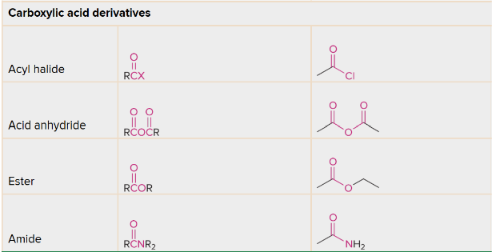
Examples of Carboxylic acid derivatives- all have a double bonded O
Acyl halide (like alkyl halide just with C in between R and X, and O double bonded on the C), acid anhydride, ester, amide
Mechanism
How the reaction happens, the pathway of reactants turning into products
Heterolysis
water leaves?
Carbocation
positively charged carbon
Protonation
smt add an H+ to smt
Electrophile
chemical species that accepts a pair of electrons from a nucleophile to form a new covalent bond; Lewis Acid
Nucleophile
electron rich species that donates a pair of electrons to form a new covalent bond. It attacks carbon attacks an electron-poor/positive carbon. Strong ones have a negative charge (*MOre negative= more nucleophilic) and lone pairs (bc has extra lone pair wants to get rid of it)
Leaving group; good and bad
a species that takes the bonding electrons and leaves the carbon; a good leaving group is a weak base because it will be stable after it leaves. A bad leaving group is a strong base because it doesn’t want to exist on its own
First-order/unimolecular
unimolecular= step in a rxn mechanism where only one osrticle undergoes chemical change at the transition state
Intermediate
formed in between initial reactants and final products. It is formed in one elementary step then consumed in another
Transition state- early and late
state where bonds are being broken and made
isomer
diff compounds with the same molecular formula
constitutional isomer
isomers with different connectivity of atoms (like different order of what atoms connectected to what, or like certain atoms being bonded to different atoms). Ex: in one molecule an OH is bonded to the second carbon, in the second molecule and OH is bonded to the third carbon so the molecules have different connectivities
stereoisomer
isomers with the same connectivity (atoms are connected in the same order, and to the same atoms. So like in both molecules the OH is bonded to the second carbon) but have different arrangements (3D) of their atoms in space (so like cis/trans- groups facing the same direction/groups facing different direction in reference to same structure; sometimes you don’t look at wedge and dash, you look at if two groups are on the same or opposite sides of a reference structure. Wedge/dash gives you 3D information to determine R/S configuration) (and also R/S- different configurations of groups around a chiral center if the strutures have one)
Summary: same order of how atoms connected + could be facing diff ways
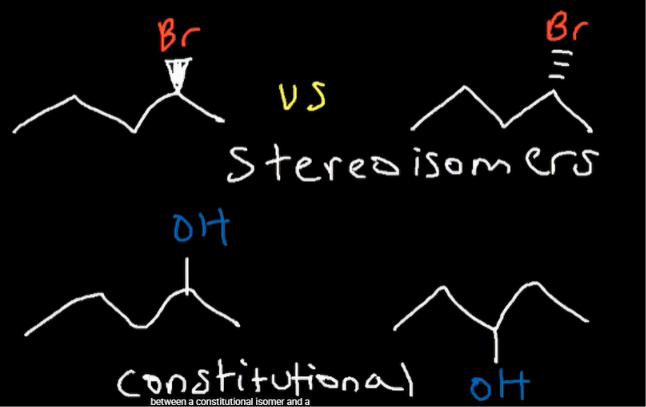
what is the difference between constitutional isomer and stereoisomer?
Constitutional isomers have different connectivity, while stereoisomers have the same connectivity of atoms. Stereoisomers also have different 3D arrangements of atoms, so like one structure could be cis and the other could be trans (
what are two types of stereoisomers
enantiomers and diast

Enantiomers
Stereoisomers that are non-superimposable mirror images of each other. You know if enantiomers if all the chiral centers have different configurations. This particular image has stereoisomers, but more specifically, they are enantiomers because one chiral center has a Br facing towards you while the other molecule has a chiral center with a Br facing away from you. Therefore these mirror images are non-superimposable because the Br groups wouldn’t line up with each other
A trick is if configuration at all chiral centers are different
If asked to draw one:
Given wedge and dash= change 2 groups

Diasteriomers
Stereoisomers that are not mirror images of each other at all. (can be due to diff 3D arrangement of atoms??) This can be due to
easy trick to tell is if the configuration at one of the chiral centers in both molecules are the same, but at another spot it is different; basically just not all configurations at chiral centers is the same
Difference between enantiomer and diasteriomer
Enantiomers are mirror images of each other while diastereomers are not. Enantiomers also must be superimposable upon each other due to having
Meso compounds
Molecules that have 2 or more chirality centers, but the overall molecule is ACHIRAL because it has an internal symmetry somewhere, most commonly plane of symmetry
have 2 chirality centers/all chirality center configurations change and have a plane/center of symmetry (achiral)
Checklist for problems to decide isomer, constitutional isomer, stereoisomer, enantiomer, diastiomer
Chirality centers?
no= identical molecules
yes= continue
Same Molecular formula for diff structures? Isomer
Connectivity betw atoms
diff= Constitutional isomer
same=stereoisomer (but more specifically enantiomer or diastereomer)
Plane of symmetry? =Achiral= meso compound
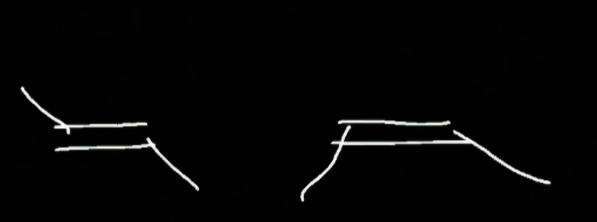
cis trans geometric isomers
One way to tell if structures are isomers or stereoisomers. The left is trans and the right is cis

Relationship betw these structures?
1) Are they identical? Yes bc not only is connectivity the same in each, they are both symmetric/have a plan of symmetry down the middle due to each path next to the OH are identical to each other in one structure so both structures= achiral
They are identical molecules. Basically C at the CH is not chiral/achiral molecule so the wedge/dash orientation isnt needed. They are the same molecule

Relationship betw these structures?
Connectivity is diff as the Br’s are not attached to the same carbons. These are constitutional isomers
Do meso compounds have opticala activity
NO bc you need chirality to rotate light