Perceptual Motor Learning - KINE 216 - Quiz 5
 Call Kai
 Learn
Learn Practice Test
 Spaced Repetition
 Match
Match Flashcards
 Knowt Play
1/73

There's no tags or description
Looks like no tags are added yet.
Name | Mastery | Learn | Test | Matching | Spaced | Call with Kai | Chat |
|---|
No analytics yet
Send a link to your students to track their progress
74 Terms
Neuron Plasticity - def and other name for
brain's ability to reorganize itself by forming new neuronal connections in response to injury, learning and practice throughout the lifespan
- "cortical remapping"
Ten Principles of experience dependent plasticity
1. use it or lose it
2. use it and improve it
3. specificity
4. repetition matters
5. intensity matters
6. time matters
7. salience matters
8. age matters
9. transference
10. interference
Salience
to add meaningful engagement to something
Transference
one activity can pos affect another
Interference
one activity can neg affect another
What part of the brain is focused on memory?
all fur lobes, the diencephalon, and the limbic system
- ALL PARTS OF THE BRAIN ARE INVOLVED
3 main memory functions
1. storage of info
2. retrieval of info
3. system specific functions
Model of Memory
input -> sensory memory --selective attention--> working memory --rehearsal-->
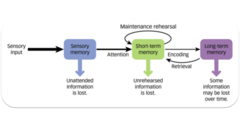
How does a memory go from sensory to working memory?
selective attention
Sensory Memory - capacity and duration
fades in milliseconds but unlimited capacity
Working Memory - capacity and duration
7 +/- 2 items (5-9 items) at a time and 20-30 seconds
3 parts to working memory
1. Central Executive
2. Phonological Loop
3. Visuospatial Sketchpad
Another name for working memory is?
short term memory
Central Executive
where decision are made, flow of info is controlled, and pulls form the long term memory
Visuospatial Sketchpad
spatial and visual info for short term
Phonological Loop
spoken and written language is held here for a short time
Long Term Memory - capacity and duration
unlimited capacity and duration
3 types of long term memory
1. procedural
2. declarative: episodic
3. declarative: semantic
Procedural
procedure on how do something; skills, actions, and movements
Episodic
facts to specific events
- THINK: like a flashback
Semantic
general knowledge form experience that is not time related
- THINK: things learnt in school such as bone names and muscle insertions
What are the declarative long term memories? And what type of memory do they hold?
episodic and semantic
- factual memory
Working Memory - def
Memory system associated with sensory, perceptual, attentional, and short-term memory processes
- Involved in all situations requiring temporary use and storage of information
Working Memory - function
enables people to respond to the demands of a right now situation
- Critical role in decision making, problem solving, movement planning and execution
- Interacts with long-term memory (retrieves info & moves info there)
Working memory serves as an ?
interactive workspace
How can you increase the size of working memory?
chunking
2 theories of forgetting
1. decay theory
2. interference theory
Decay Theory
if info is not used then the info will be lost
Interference Theory
old info gets in the way of new info, or new info gets in the way of the retrieval of old info
2 types of interference
1. proactive interference
2. retroactive interference
Proactive Interference
old info gets in the way of new info
Reactive Interference
new info gets in the way of the retrieval of old info
Practical Implication of memory - keep instructions, cues, feedback ? and ?
- keep feedback short and simple
Practical Implication of memory - ? key learning points
- repeat key learning pts
Practical Implication of memory - provide opportunities for ?
- provide opportunities for physical rehearsal
Practical Implication of memory - relate new skill to ?
- relate new skill to a previously learned skill
Practical Implication of memory - use meaningful ? and ?
- use meaningful labels and analogies
Practical Implication of memory - group or ? movements
- group or chunk movements
It (is / is not) normal to lose memory and cognitive function as you age.
is not normal
Healthy Aging sensory decline: taste, hearing, vision, and smell ex
taste - bitter taste stay longest so extra salty in food
hearing - high pitch frequency disappear first
vison - prob need reading glasses
smell - more perfume/cologne bc dec smell
Healthy Aging mild decline in
- memory
- mental felxibility
- ability to recall people name, object, and places
T?F: there is a general slowing of info processing as u age?
true
Aging (is / is not) a disease
is not
Dementia
disease of the brain that causes a decline in memory and intellectual functioning from some previously higher level of functioning severe enough to interfere with everyday life
T/F: Dementia is a syndrome
true
Common signs of dementia
- memory loss (new info vs. old info)
- disorientation to time, place, and people
- language problems
- diminished concentration (distracted easy)
- visual, spatial, perceptual problems (sense of direction; esp in a new environment)
- difficulty with complex task and learning new concepts
- problems with abstract reasoning, problem solving, and judgement
- chgs in personality, mood , and behavior (in the frontal lobe; see a lot of frustration bc of this)
Diagnosed How?
not a single test that can diagnose dementia but you can rule out other diseases
- physical and neurological exams
- neuroimaging
- functional assessments of ADLs and IADLs through OT and PT evaluations
- mental status exam: neurophysiological testing
ADLs and IADLs stand for
- activities of daily living
- instrument of activities of daily living (more like hobbies)
Diff b/t dementia and alzheimers?
Dementia is the syndrome which Alzheimers falls under
5 types of dementia in order of most prevalent least
1. Alzheimer dementia
2. Vascular dementia
3. Lewy body dementia
4. frontotemporal dementia
5. Parkinson's dementia
?% of patients with dementia who have Alzheimers
50-75%
?% of patients with dementia who have vascular dementia
20-30%
?% of patients with dementia who have Lewy body dementia
10-25%
?% of patients with dementia who have frontotemporal dementia
10-15%
? mil of Americans over 65 have Alzheimers Disease (AD)
7 mil
AD has a new case ever ? sec
72 sec
1/? chance of AD if over 65 and 1/? if over 75
1/9 over 65
1/2 over 85
Approx ?% aren't diagnosed with AD
50%
Almost ? mil people in the USA care for people with AD?
11 mil
Healthcare has spent about ? billion dollars for AD?
$360 billion
?/? women get AD
2/3
Is AD more prevalent in men or women?
women
AD is a ?, ?, ? disease of the brain.
a progressive, degenerative, and neurological
Progressive
gets worse
Degenrertive
tears down
Neurological
affect nervous system
AD (is / is not) reversible
is not
AD is related to a ? and ? chg in the brain
chemical and structural chg in the brain
AD def
steady decline in memory and cognitive function severe enough to interfere with everyday life
What does AD look like?
- neurofibrillary tangles cause by tau proteins (tauopathy)
- amyloid plaques
- dec in chemical that facilitate memory
- cell dead bc of tangles
- brain atrophy/shrink
Progression of AD - the three stages and their time
1. early stage - 2-4 yrs
2. middle stage 2-10 yrs
3. late stage 1-3 yrs
Early Stage of AD
- Forgetfulness
- Trouble multi-tasking
- Writes reminders (to compensate) but loses them
- Personality changes (defensive)
- Shows up at the wrong time or day
- Changes in appearance (minor)
- Preference for familiar things
- Often defensive about issues/denies a problem
- May only be noticeable to close family/friends
Middle Stage of AD
- Fluctuating disorientation
- Diminished insight
- Learning new things becomes difficult
- Declining recognition of acquaintances, distant relatives, then more sig. relationships
- Mood and behavioral changes
- Functional declines
- Alterations in sleep and appetite
- Wandering
- Noticeable to everyone
Key symptoms of middle stages
Wandering, bc late stage can't physically wander, and early stage still has enough mental to not to