Natural Biomaterials
 Call Kai
 Learn
 Practice Test
 Spaced Repetition
 Match
 Flashcards
 Knowt Play
1/36

There's no tags or description
Looks like no tags are added yet.
37 Terms
Natural Polymers
proteins, polysaccharides, polynuceotides, polyester made by bacteria
Proteins
a natural polymer
ex. collagen, gelatin (aprtially amorphous collagen), fibrin/fibrinogen (bioactive and resorbable), silk (silkworm or spider)
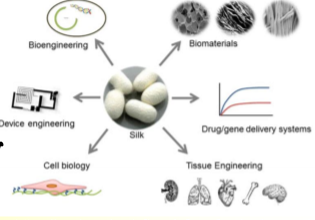
Silk
type of natural polymer protein
silkworm or spider - can be genetically engineered to produce silk for specific purposes
Polysaccharides
a natural polymer
ex.
cellulose, carboxymethylcelluose, methylcellulose
alginate
glycosaminoglycan (GAG) - herparin, hyaluronic acid, chondroitin sulfate
chitin and chitosan
Alginate
type of natural polyer polysaccharide
hydrophilic and easily cross-linked w/ Ca2+ to make hydrogels
Polynucelotides
a natural polymer
DNA and RNA - used for vaccines or templates to grow nano-structures
Polyesters made by Bacteria
a natural polymer
PHB/PHV (polyhydroxybutyrate/polyhydroxyvalerate)
not “natural” - put things into bacteria to make these
Natural Biomaterials
compatibility w/ bio tissue - very good
immunogenicity - maybe
MW - defined
processing choices - few
reproducibility - low
degradation - yes and products are safe
Synthetic Biomaterials
compatibility w/ bio tissue - not as good
immunogenicity - usually no, but may produce haptens
MW - dispersed for many polymers
processing choices - many
reproducibility - high
degradation - maybe
Collagen
nature’s most abundant protein polymer
type I, II, III, IV, and I-III
Collagen in the Body
makes up more than a 1/3 of the body’s protein
at least 10 types in vertebrate that differ in length of nonhelical fraction, length of helx and #, and nature of carbohydrate attached on the helix
Type I - Collagen
skin/tendon/bone
90% of collagen is this
scar tissue
Type II - Collagen
cartilage
Type III - Collagen
major component of blood vessels
in skin and granulation tissue, before type I is formed
Type IV - Collagen
component of basement membrane that separates epithelial tissue from mesodermal tissue
nonhelical
doesn’t form fibrils
Types I through III - Collagen
forms firbrils with distinct triple helix structure
Type I Collagen Structure
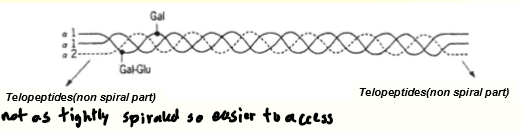
primary - aas: Gly-X-Y (X and Y frequently Pro (proline) and Hyp (hydroxyproline)) and location of inter-chain crosslinks: condensation of lysein and hydroxylysine
secondary - alpha chain
tertiary - triple helix held together by H-bonds
quarternary - several triple helices packed in quasi-hexagonal lattice

Collagen Quaternary Structure (supermolecular unit structure)
microfibrils → lateral end-to-end aggregation → fibril → collagen fiber → bundled fivbers lead to body tissue formation

Importance and Manipulation of Structural Characteristics
2 discrete levels of structural: tertiary (triple helix) and quaternary (lattice of triple helices → D-period, 67 nm)
Tertiary (triple helix) - Importance/Manipulation of Structural Characteristics
helix can be destroyed by heating (70 degrees C) or bromide or thiocynanate and ends up in a random coil (amorphous so now gelatin)
Quaternary (lattice of triple helces = D-period) - Importance/Manipulation of Structural Characteristics
D-period allows for platelet aggregation on it but if use acetic acid (pH < 4.25) the D band disappears and the helix is unchanged
Chemical Modifications - Collagen
degradation
cross-linking
enzymatic treatment
gelantinization
Degradation - Collagen
type of chemical modification
uses collagenases (naturally occurring enzymes that attack the triple helix at a specific location - 2/3 from N end, 1/3 from C end → gelatin)
Cross-linking - Collagen
type of chemical modification
NH2 on lysine residue can be cross-linked w/ di-aldehydes
reduces degradation rate from a few days to several weeks
dereases immunogenicity problems (increase immunogeneicty)
Enzymatic Treatment - Collagen
type of chemical modification
uses to cleave the telopeptide region (not as tightly spiraled) which may reduce immunogencity
Gelatinization - Collagen
type of chemical modification
increases immunogenicity
Applications of Collagen
hemostatic device (gelfoam) - to arrest bleeding
lip augmentation (lip plumpers)
nerve conduit
tendon/ligaments
burn treatment/skin graft
drug delivery
heart valves
Gelfoam
type of hemostatic device (application of collagen)
water-soluble
porous
prepared from pruified pork skin
absorbs and holds within its interstices many times its weight of blood/other fluids
can be applied to bleeding surfaces as a hemostatic device
Fibrin Gels
structure controlled based on the conc. of Ca2+ and fibrinogen
amenable to inclusion of GFs
degraded by plasmin
degradation products digested by inflammatory cells
application - tissue engineering scaffold and a sealant
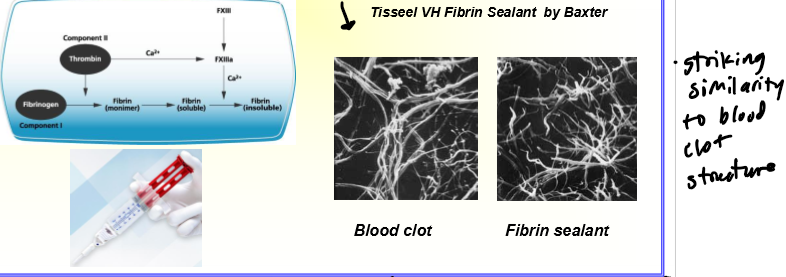
Sealant
a fibrin gel application
a 2 component fibrin mixture that simulates the natural physiological conditions to achieve hemostasis and tissue sealing
syringe - 2 components mix at tip an fribin comes out: fibrogen in 1 compartment and thrombin + Ca2+ in other)
Hyaluronic Acid
ubiquitous native ECM component
high content in epithelial, connective, and neural tissue
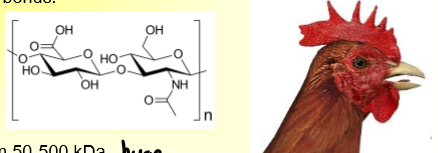
linear polysaccharide composed of repeated disacchardide units of N-acetyl-glucosamine and D-glucuronic acid that are linked together via alternating beta-1,4 and beta-1,3 glycosidic bonds
50-500kDa (huge)
only GAG that isn’t sulfated (still very hydrophilic though)
degraded by hyaluronidases
Hyaluronic Acid Sources
rooster combs - contain polymer at a higher conc. than other animal tissues
microorganisms - through a fermentation process
HyA Applications
hydrophilic, anti-inflammatory, and pro-regeneration (intrinsic bioactivities)
adhesion barrier
opthalmology
soft tissue implants
wound healing - 2 parts of the tissue have been cut and involves a lot of scar tissue which hurts (tissue that shouldn’t be there)
surface coatings
drug delivery
cosmetic application
osteoarthritis knee (lubricating/cushioning the joint and producing an analgesic effect)
Chitin
found in crustaceans (carbs, lobsters, shrimp), insects, worms, fungus, and mushrooms
tough/strong
used as sutures and a wound healing agent
type of natural polymer (polycasscharide)

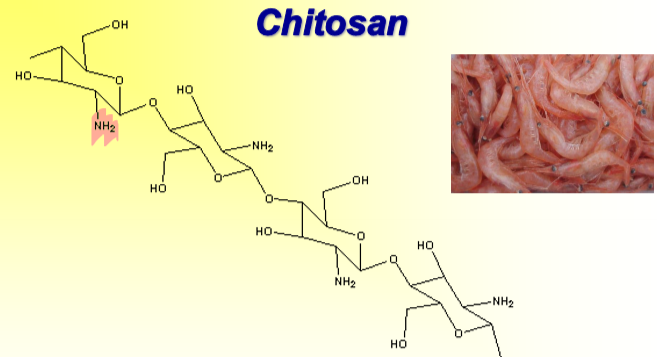
Chitosan
obtained by deacetylation of chitin (remove acetyl group from chitin) → more water soluble (bc more hydrophilic)
used for gene delvery (cationic charge - + charge) and bandage
Bandage - Chitosan
causes rapid clotting, hypoallergenic, and has natural anti-bacterial properties (resists bacteria growth)
Polyhydroxyalkanoates (PHAs)
aliphatic polyesters naturally produced via a mcirobial process on sugar or lipid based medium where they act as C and energy stroage material in bacteria
can be thermoplastic or ealstomeric materials (melting points: 40-180 degrees C)
bioresorbable with no toxic byproducts → soln. for plastic waste issue
currently being examined as biomaterials for bone repair, fixation, suture, tissue egineering sscaffolds
ex. PHB (poly-beta-hydroxybutyrate), PHV (polyhydroxyvalerate), copolymer PHBV
