biochemistry 2 chapter 10
 Call Kai
 Learn
Learn Practice Test
 Spaced Repetition
 Match
Match Flashcards
 Knowt Play
1/72

There's no tags or description
Looks like no tags are added yet.
Name | Mastery | Learn | Test | Matching | Spaced | Call with Kai | Chat |
|---|
No analytics yet
Send a link to your students to track their progress
73 Terms
what are enzymes
biological catalysts that increase reaction rates without being used up or affecting equilibrium
what are most enzymes in proper configuration
proteins, however some rna also catalyze reactions
what do some enzymes require
a cofactor
An ion such as Fe++, Mg++ or Zn++
An organic or organometallic coenzyme (e.g. heme, or NADP)
Holoenzyme is with the cofactor, apoenzyme is without the cofactor
Some cofactors are tightly bound (called prosthetic groups), others are loosely bound
how do enzymes affect equilibrium and thermodynamics
Enzymes do not affect the overall reaction equilibrium (Keq)
Enzymes do not alter the overall standard free energy change (change of G) of the reaction
mechanisms of rate increase by
Enzymes accelerate reactions exclusively by lowering the activation energy barrier for both the forward and reverse reactions

cofactor nature, binding, example, and activity role
inorganic or organic, loosely or tightly, mg2+ for DNA, stabilizes/activates
coenzyme nature, binding, example, and activity role
organic, usually loose, NAD/FAD/CoA, electron/group carriers
apoenzyme nature, binding, example, and activity role
protein only, none, Apo-DNA polymerase, inactive form
prosthetic group nature, binding, example, and activity role
organic or inorganic, tightly or covalently, heme in hemoglobin, permanent catalytic role
cofactor =
helper (metal ion or organic molecule)
coenzyme =
organic helper (vitamin derived)
apoenzyme =
inactive protein part alone
prosthetic group =
permanently bound helper
how do enzymes organize reactive groups
close proximity and proper orientation
uncatalyzed bimolecular reactions
two free reactants → single unrestricted transition state conversion is energetically unfavorable
uncatalyzed unimolecular reactions
flexible reactant → rigid transition state conversion is energetically unfavorable for flexible reactants
catalyzed reactions
the enzyme uses the binding energy of substrates to organize the reactant to a fairly rigid ES complex, the energy cost is paid during binding
What state do enzymes bind best to
transition states
enzyme active sites are complimentary to
the transition state of the reaction
enzymes bind transition states better than
substrates
stronger interactions with the transition state as compared with
the ground state lower the activation barrier
ion Fe2+ or Fe3+
enzymes Cytochrome oxidase, catalase, peroxidase
ion Mg2+
enzymes Hexokinase, glucose 6-phosphatase, pyruvate kinase
important coenzymes
biocytin, coenzyme A, flavin adenine dinucleotide, nicotinamide adenine dinucleotide, tetrahydrofolate
what is chymotrypsin
a serine protease that cleaves peptide bonds adjacent to aromatic amino acids (carboxyl side of Tyrosine, Phenylalanine, and Tryptophan)
what is a hydrophobic pocket
A deep binding pocket near the active site that selectively accommodates the bulky, nonpolar aromatic side chains (Tyr, Phe, Trp) of the substrate, properly positioning the adjacent peptide bond for cleavage.
what is the catalytic triad
Asp 102, His 57, Ser 195
His 57
Acts in general acid-base catalysis. It accepts a proton from Ser 195 to generate a strongly nucleophilic alkoxide ion (O-) and later donates a proton to the leaving group
Ser 195
Acts as a nucleophile. Its deprotonated alkoxide ion attacks the substrate peptide carbonyl carbon, forming a transient covalent acyl-enzyme intermediate
Asp 102
Hydrogen bonds with His 57 to orient and stabilize its positively charged form during catalysis
what is an oxyanion hole
A pocket formed by backbone amide hydrogen atoms (including Gly 193 and Ser 195).
what does an oxyanion hole do
It stabilizes the short-lived, negatively charged oxygen atom (O-) of the tetrahedral intermediates formed during nucleophilic attacks (acylation and deacylation phases).
step 1 of chymotrypsin mechanism
substrate binding to active site of chymotrypsin

step 2 of chymotrypsin mechanism
nucleophilic attack: histidine interacts with serine pulling H from Ser, generating nucleophile, the resulting alcoxide ion attacks peptide C=O of NH-C=O, forming tetrahedral intermediate (TH) with C-O formation

step 3 of chymotrypsin mechanism
substrate cleavage: collapse of TH intermediate reforms the C=O and breaks its bond with NH leaving first product and Acyl Enzyme intermediate

step 4 of chymotrypsin mechanism
water comes in gets deprotonated, forms nucleophile (OH-) and attacks the ester linkage of Acyl enzyme intermediate

step 5 of chymotrypsin mechanism
collapse of TH intermediate forms COOH on substrate breaking off from the enzyme giving the second product and serine

step 6 of chymotrypsin mechanism
break off from the enzyme

step 7 of chymotrypsin mechanism
product dissociates

Basic (histidine) and acidic (serine) functional groups on the enzyme act in
general acid base catalysis
Transient covalent bonds are formed between
the substrate and the enzyme
Chymotrypsin cleaves peptides on the carboxyl side of
tyrosine, phenylalanine and tryptophan because they contain aromatic rings, which fit into the hydrophobic pocket of the enzyme
kinetics definition
the study of the rate at which molecules react
what is the rate of enzymatic reaction affected by
enzyme, substrate, effectors, and temperature
competitive inhibitor mechanism
competes directly with the substrate for binding at the active site
competitive inhibitor kinetic impact
increases Km, while Vmax remains unchanged
uncompetitive inhibitor mechanism
binds only to the enzyme substrate complex, preventing the reaction from completing
uncompetitive inhibitor kinetic impact
decreases both Vmax and Km by the same factor
Noncompetitive inhibitor mechanism
binds to either the free enzyme or the enzyme substrate complex at a site distinct from the active site
Noncompetitive inhibitor kinetic impact
decrease Vmax, Km remains unchanged
total enzyme concentration is
constant
E+S→←
ES
ES→←
E+P
C is what in equation
E+S
U is what in equation
ES
Km
the substrate concentration at which the initial reaction velocity reaches half of the maximum velocity (1/2Vmax)
Why does Vmax changes affect Km
Km is anchored to the value of 1/2Vmax, so changes in Vmax directly influence the corresponding Km on the velocity curves
nonlinear michaelis menten plot should be used to
calculate parameters of Km and Vmax
a linearized double reciprocal plot is good for analysis of
two substrate data or inhibition
saturation kinetics
high S, velocity is NOT proportional to S
regulation can be
non covalent modification, covalent modification, irreversible, reversible
noncovalent modification
allosteric regulators are small chemicals that can be positive (improve) or negative (reduce)

what is ATCases primary role
to initiate the de novo pathway for pyrimidine nucleotide biosynthesis
what does ATCasae do
catalyzes the condensation of aspartate and carbamoyl phosphate to form N-carbamoylaspartate, in pyrimidine
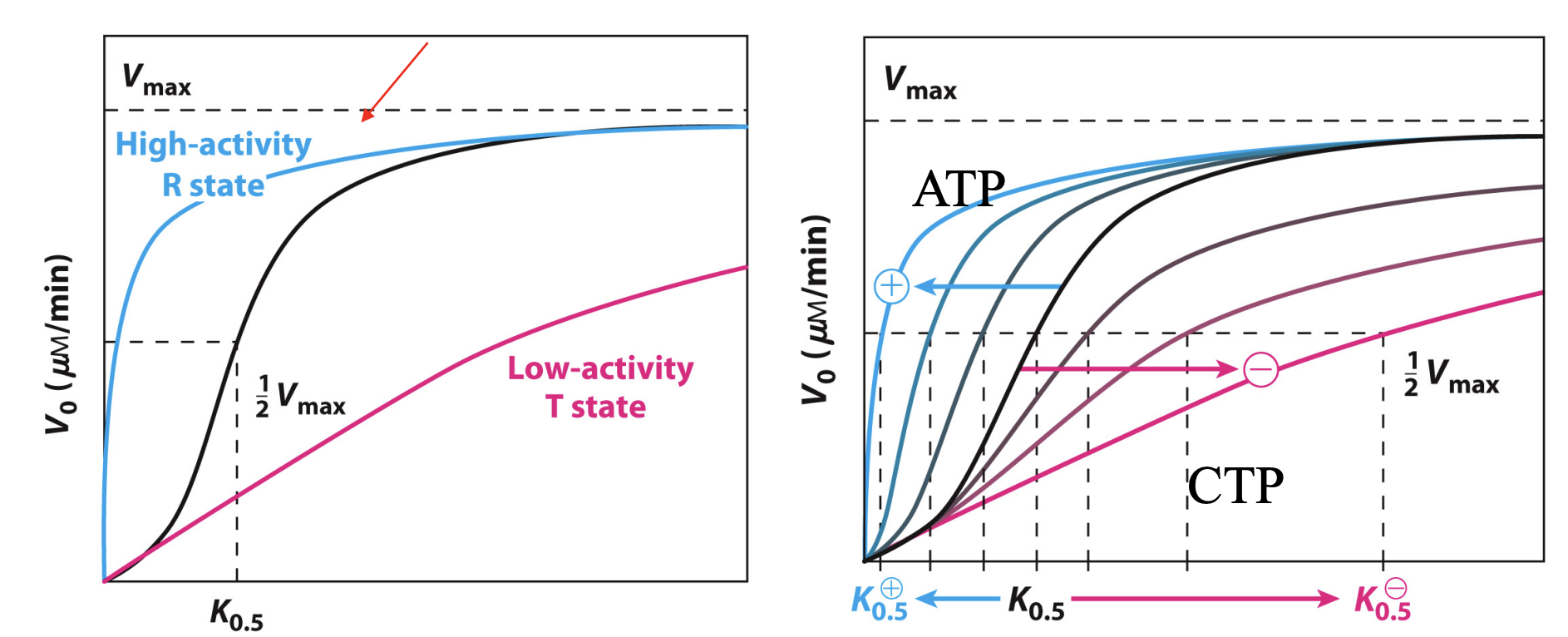
allosteric behavior
It exhibits sigmoidal kinetics (saturation curve) rather than hyperbolic Michaelis-Menten kinetics, transitioning between two structural states
T state
low activity state
R state
high activity state
Allosteric regulators
ATP and CTP
ATP
positive modulator, allosteric activator.
Binds to ATCase and stabilizes the high-activity R state, shifting the curve to the left and lowering K
CTP
negative modulator, allosteric inhibitor.
Product of the pyrimidine pathway that acts as a feedback inhibitor. Binds to ATCase and stabilizes the low-activity T state, shifting the curve to the right and increasing
Methanol Poisoning
an application of competitive enzyme inhibition, where competitive inhibitors are used medically to block the active site of alcohol dehydrogenase to prevent the conversion of methanol into toxic metabolites
Aspirin
Highlighted as a key example of irreversible covalent modification (and suicide/irreversible inhibition), where the active site of the target enzyme is permanently modified to inhibit activity