Kidney Structure (M5)
 Call Kai
 Learn
 Practice Test
 Spaced Repetition
 Match
 Flashcards
 Knowt Play
1/50

There's no tags or description
Looks like no tags are added yet.
51 Terms
Three distinct internal regions of the mammalian kidney
- Cortex (outer layer)
- Medulla (inner layer)
- Pelvis (central cavity leading into the ureter)

Nephron
The structural and functional unit of the kidney, responsible for filtering blood and forming urine.
Pathway of blood flow through the microscopic vasculature of the nephron
Renal artery → afferent arteriole → glomerulus → efferent arteriole → convoluted tubules → renal vein.
Components of the nephron located specifically within the renal cortex
- Bowman's capsule
- Glomerulus
- Proximal convoluted tubule (PCT)
- Distal convoluted tubule (DCT)

Components of the nephron and collecting system located in the renal medulla
- Loop of Henle (descending and ascending limbs)
- Collecting duct
Ultrafiltration
The non-specific filtration of blood under high hydrostatic pressure at a molecular level across the glomerular filtration barrier into the Bowman's capsule.
Mechanism generating high hydrostatic pressure in the glomerulus
The afferent arteriole has a significantly wider lumen diameter than the efferent arteriole, creating high resistance to outflow and elevating hydrostatic pressure within the glomerular capillaries.
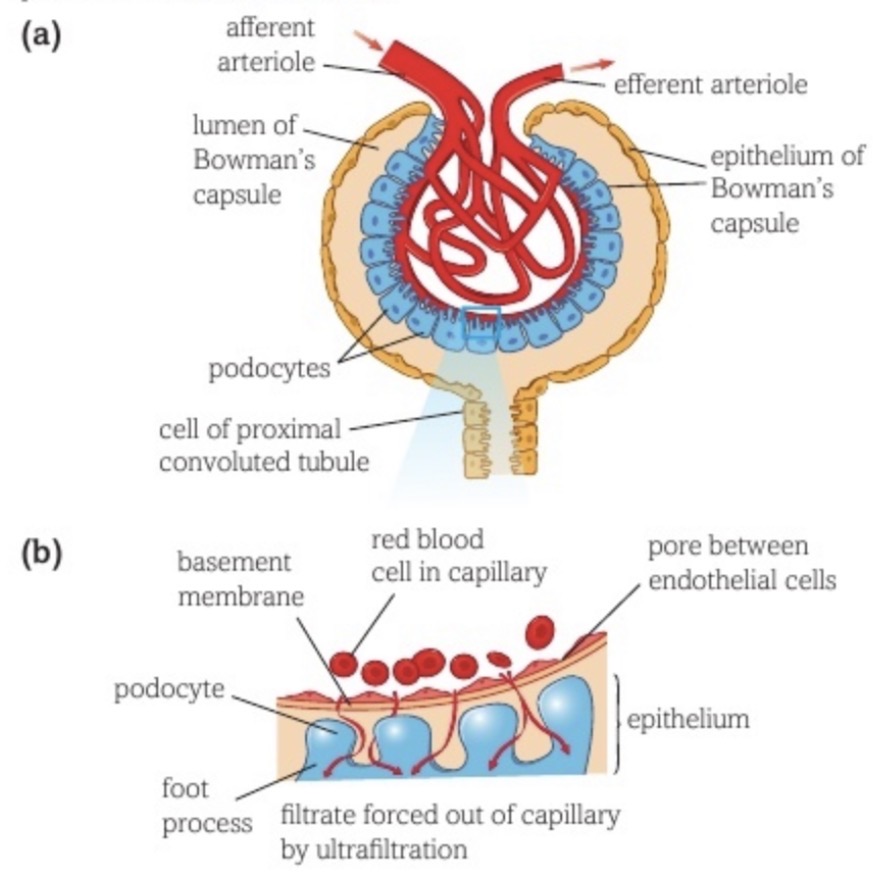
Three layers of the glomerular filtration barrier in order from blood to lumen
- Vascular endothelium of the capillary (fenestrated)
- Basement membrane (meshwork of collagen and glycoproteins)
- Epithelium of Bowman's capsule (podocytes with filtration slits)

Structural role of fenestrations in the capillary endothelium during ultrafiltration
Pores allow blood plasma and dissolved solutes to pass freely through while retaining cellular components (red blood cells, white blood cells, platelets) in the capillary lumen.
Basement membrane (renal function)
A meshwork of collagen fibres and glycoproteins acting as a selective molecular sieve; prevents molecules with a relative molecular mass (Mr) greater than 69,000 (such as large plasma proteins) from entering the filtrate.
Cut-off relative molecular mass (Mr) excluded by the glomerular basement membrane
Mr>69,000 (e.g., serum albumin and other large plasma proteins).
Podocytes
Specialised epithelial cells of the inner wall of Bowman's capsule with major processes and interdigitating foot processes (pedicels) that form narrow filtration slits to allow filtrate into the capsule lumen.
Major solutes filtered out of blood plasma into the glomerular filtrate
- Water
- Glucose
- Amino acids
- Urea
- Inorganic mineral ions (Na+, K+, Cl−)
Key components retained within the glomerular capillaries during ultrafiltration
- Blood cells (erythrocytes, leukocytes, thrombocytes)
- Large plasma proteins (Mr>69,000)
Significance of retained plasma proteins for blood water potential in the efferent arteriole
They confer a very low (highly negative) solute potential and oncotic pressure to the capillary blood, generating an osmotic gradient that aids the reabsorption of water downstream.
Primary site of selective reabsorption in the nephron and substances reabsorbed there
The proximal convoluted tubule (PCT); reabsorbs 100% of glucose and amino acids, most mineral ions, and approximately 85% of water.
Four structural adaptations of proximal convoluted tubule (PCT) epithelial cells
- Microvilli (brush border): greatly increases surface area for transport proteins.
- Many mitochondria: provide ATP for active transport (Na+/K+ pumps).
- Cotransporter proteins: facilitate secondary active transport of glucose/amino acids with Na+.
- Basal invaginations: increase surface area adjacent to capillaries.

Mechanism establishing the sodium ion (Na+) gradient across the PCT cell membrane
Na+/K+ ATPase pumps in the basal and lateral membranes actively transport Na+ out of the cell into the tissue fluid/blood, lowering intracellular Na+ concentration.
Mechanism by which glucose and amino acids enter PCT cells from the tubule lumen
Enter by secondary active transport (cotransport) via symport proteins, moving down the Na+ concentration gradient established by basal active transport.
How glucose and amino acids exit PCT cells into the interstitial fluid
Exit across the basal membrane by facilitated diffusion down their concentration gradients before diffusing into surrounding blood capillaries.
Mechanism of water reabsorption along the proximal convoluted tubule (PCT)
Reabsorption of solutes (glucose, ions, amino acids) lowers the water potential inside the cell and adjacent blood, driving water uptake from the lumen by osmosis down a water potential gradient.

Mechanism for reabsorbing small proteins that enter the PCT lumen
Reabsorbed into PCT epithelial cells via endocytosis, digested in lysosomes, and returned as amino acids to the blood.
Rate of glomerular filtrate formation vs final urine production rate
- Glomerular filtrate formed: ≈125cm3min−1
- Fluid leaving PCT: ≈45cm3min−1
- Urine entering bladder: ≈1.5cm3min−1 (1.5−2.0dm3day−1)
Function of the loop of Henle as a hairpin countercurrent multiplier
Flow of tubule fluid in opposite directions multiplies the concentration of mineral ions in the medullary tissue fluid, generating a steep water potential gradient from cortex to deep medulla.

Permeability and transport characteristics of the descending limb of the loop of Henle
- Permeable to water (water leaves by osmosis into hypertonic interstitial fluid).
- Relatively impermeable to ions (some Na+ and Cl− diffuse in).
- Fluid becomes progressively concentrated (water potential decreases toward hairpin).

Permeability and transport characteristics of the ascending limb of the loop of Henle
- Impermeable to water.
- Lower thin segment: Na+ and Cl− diffuse out passively.
- Upper thick segment: Na+ and Cl− are actively transported out into medullary tissue fluid.
- Fluid becomes progressively dilute (water potential increases toward DCT).
Osmolality trend along the nephron loop from top of descending limb to top of ascending limb
Increases (becomes most concentrated / lowest water potential) at the hairpin apex, then decreases (becomes dilute / higher water potential) at the top of the ascending limb.
Ecological adaptation of loop of Henle length in desert mammals
Have exceptionally long loops of Henle extending deep into the medulla; creates a steeper solute gradient in the medulla, allowing greater osmotic reabsorption of water and production of hypertonic, concentrated urine.
Mechanism allowing continuous water reabsorption along the collecting duct
The collecting duct descends through the medulla alongside an increasingly negative tissue fluid water potential gradient; a water potential gradient is maintained across its entire length, enabling continuous water efflux by osmosis.
Osmoregulation
The homeostatic control of the water potential of body fluids (blood and tissue fluid) by maintaining the balance between water and dissolved solute concentrations.
Osmoreceptors
Sensory receptors located in the hypothalamus that detect changes in the water potential of circulating blood.
Response of osmoreceptors to a decrease in blood water potential
Water exits osmoreceptor cells by osmosis down a water potential gradient; cells shrink, stimulating neurosecretory cells in the hypothalamus to generate action potentials.

Sites of synthesis, storage, and release of antidiuretic hormone (ADH)
- Synthesised: in cell bodies of neurosecretory cells in the hypothalamus.
- Stored and released: in terminal axon endings located in the posterior pituitary gland via exocytosis.
Cellular mechanism of action of ADH on collecting duct epithelial cells
- ADH binds to specific complementary receptors on the basal membrane.
- Initiates an enzyme cascade (cell signaling) activating intracellular phosphorylase.
- Vesicles containing aquaporins fuse with the luminal cell surface membrane.
- Permeability to water increases; water moves into cells and blood by osmosis.

Aquaporins
Intrinsic membrane channel proteins that selectively facilitate the rapid passage of water molecules across cell membranes.
Physiological effect of alcohol consumption on ADH secretion
Inhibits ADH release from the posterior pituitary; collecting ducts remain impermeable to water, leading to excessive excretion of dilute urine (diuresis) and dehydration.
Glomerular filtration rate (GFR)
The total volume of fluid filtered into Bowman's capsules from the glomerular capillaries per unit time (cm3min−1).
Diagnostic GFR values for normal function, chronic kidney disease, and kidney failure
- Normal GFR: 90−120cm3min−1
- Chronic kidney disease: <60cm3min−1
- Kidney failure (urgent medical intervention needed): <15cm3min−1
Four major causes of kidney failure
- Diabetes mellitus (Type 1 and Type 2)
- Hypertension (high blood pressure)
- Heart disease
- Severe renal infections
Clinical significance of finding large plasma proteins (e.g. albumin) or erythrocytes in urine
Indicates structural damage to the glomerular filtration barrier (specifically the capillary endothelium, basement membrane, or podocytes).
Haemodialysis
A medical procedure where patient blood from an artery or vein is pumped through an artificial dialyser containing partially permeable cellulose fibres surrounded by countercurrently flowing dialysis fluid.
Function of adding heparin to blood during haemodialysis
Acts as an anticoagulant to prevent blood clotting within the artificial tubing and dialysis machine.
Role of countercurrent flow of blood and dialysis fluid in haemodialysis
Maintains a steep concentration gradient for waste products (e.g., urea) along the entire length of the dialysis membrane, maximising diffusion efficiency into the dialysis fluid.
Composition of renal dialysis fluid relative to normal blood plasma
- Same glucose and amino acid concentration as healthy plasma (prevents net loss).
- Identical mineral ion concentrations to correct imbalance.
- Zero urea concentration (maximises diffusion of urea out of blood).
- Formulated to regulate water removal osmotically.
Two advantages of kidney transplant over long-term haemodialysis
- Freedom from time-consuming dialysis sessions (greater lifestyle freedom and quality of life).
- Fewer dietary restrictions and feeling physically fitter with improved self-image.
Two disadvantages of kidney transplant compared to dialysis
- Risks associated with major surgery and general anaesthesia.
- Need for lifelong immunosuppressant therapy, leading to fluid retention, high blood pressure, and increased vulnerability to infections.
Human chorionic gonadotrophin (hCG)
A peptide glycoprotein hormone produced by the blastocyst/implanted embryo with an Mr of approximately 36,700, small enough to filter into urine and act as a biomarker for pregnancy.
Function of the reaction zone in a pregnancy test strip
Contains mobile monoclonal antibodies complementary to hCG, conjugated to colored blue dye particles/beads; form mobile hCG-antibody-dye complexes if hCG is present.
Function of the test zone in a pregnancy test strip
Contains immobilised monoclonal antibodies complementary to the hCG-antibody complex; traps complexes to create a visible colored line indicating pregnancy.
Function of the control zone in a pregnancy test strip
Contains immobilised antibodies specific to the mobile antibodies; binds excess unbound mobile dye-conjugated antibodies to form a line confirming the test functioned correctly.
Analytical method used to detect anabolic steroids in urine samples
Gas chromatography combined with mass spectrometry (GC-MS), which vaporises the sample, separates substances based on relative mobility, and identifies them via mass-to-charge fragmentation patterns.