03 training specificity
 Call Kai
 Learn
 Practice Test
 Spaced Repetition
 Match
 Flashcards
 Knowt Play
1/6

There's no tags or description
Looks like no tags are added yet.
7 Terms
[A]What does the SAID principle stand for and how is it defined by Godfrey & Whyte (2006)?
SAID: Specific Adaptation to Imposed Demands.
Definition: "A specific stimulus results in specific adaptation. If the stimulus is reduced or removed, reversibility or detraining begins." (Godfrey & Whyte, 2006, p. 25). Detraining begins within 2–6 weeks after the stimulus stops
[A]What are the 3 components of Specificity and what repetition ranges dictate strength adaptations?
Skill: Movement pattern, velocity, and joint angles (gains highest at trained joint angles; Speed-accuracy trade-off (Fitts' law): learn slow, then speed up); weighted → normal implements
Muscle group: Only activated muscles adapt (e.g., cycling → quadriceps; running → plantar flexors; heavy loads target fast-twitch fibers); strength ^ mainly in activated muscles
Energy system: Intensity & duration decide adaptations; no single intensity prepares for everything; weight VO2max, LT, economy by event demands
Repetitions per Set (Table 2.1):
Strength: 4–8 reps
Strength-endurance: 8–12 reps
Local muscular endurance: 14–25 reps
Endurance: 30–40 reps
[A]What is the overarching scientific rule regarding the effectiveness of Cross-training?
„Cross-training effects never exceed those induced by specific training." (Godfrey & Whyte, 2006, p. 33)]. Cross-training cannot replace sport-specific training for peak adaptation
![<p><span><em>„Cross-training effects never exceed those induced by specific training."</em> (Godfrey & Whyte, 2006, p. 33)<sup>]</sup>. Cross-training cannot replace sport-specific training for peak adaptation</span></p><p></p>](https://assets.knowt.com/user-attachments/897f98a3-0f07-4453-84d8-5469689196dc.png)
[B]What are the three meanings according to Tanaka (1994) of Cross-training and why use it?
3 Definitions (Tanaka, 1994): (1) Training for several sports simultaneously (e.g., triathlon); (2) Transfer from one sport to another; (3) Transfer from one limb to another
Legitimate Applications: Rehabilitation (maintaining fitness during injury without joint stress), reducing overuse injuries & monotony and compliance, as well as general preparation during the off-season
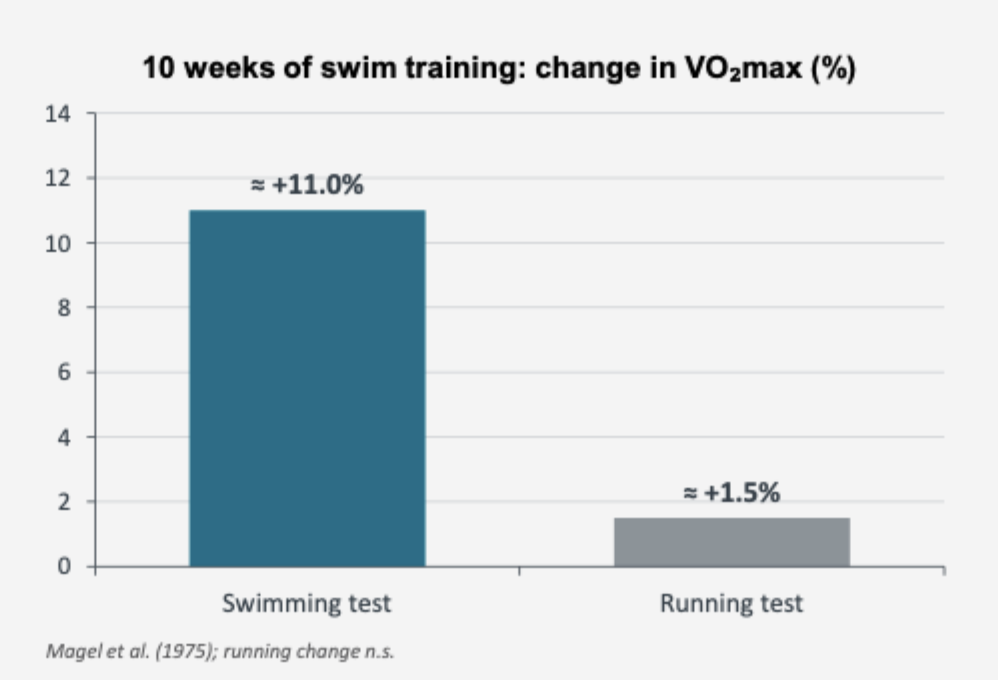
[B]What did the swim study by Magel et al. (1975) and the XC runner study by Paavolainen et al. (1999) prove regarding specificity?
Magel et al. (1975): 10 weeks of swim training increased swim VO₂max by +11.0%, but running treadmill VO₂max by only +1.5% (non-significant), proving adaptations are muscle-group and movement-specific
Paavolainen et al. (1999): Replacing 32% of endurance volume with explosive-strength training for 9 weeks → result = improved 5 km time and running economy, proving training must match the demand/power requirement (stretch-shortening cycle), not just visual appearance
Specific to the demand, not to how the exercise looks: running needs power and stiffness in the stretch-shortening cycle
[B]What are the 4 steps of systematic training prescription for a sport?
Analyse the sport: Which determinants limit performance?; Identify performance-limiting factors (e.g., VO₂max, LT, economy, power)
Profile the athlete: Conduct lab & field tests to determine strengths and weaknesses
Prescribe: Allocate training proportionally to key performance determinants
Monitor & re-test: Is the athlete adapting?; Assess adaptation and adjust the plan accordingly
Example: Triathlon 'brick' sessions (switching swim → bike → run) specifically train discipline transitions
[C]What exact VO₂max values are used to illustrate reversibility and detraining?
An untrained genotype baseline of 60 mL·kg⁻¹·min⁻¹ increases by +20% to 72 mL·kg⁻¹·min⁻¹ with training, but drops completely back to 60 mL·kg⁻¹·min⁻¹ when training is stopped (Wallis & Logan, 1964; Mujika & Padilla, 2000)
