3: Income Statement
 Call Kai
 Learn
 Practice Test
 Spaced Repetition
 Match
 Flashcards
 Knowt Play
1/32

There's no tags or description
Looks like no tags are added yet.
33 Terms
What does the income statement show
The statement explains how revenue and expenses combine to produce profit or loss
reports profitability over a specific period
shows profit or loss for the period
Profit or Loss= revenue - expenses
What can profit support in the future
Profit may support dividends or be retained earnings for future growth
Why are income statements useful
Past- evaluate performance
Future- supports forecasts
Risk- assess uncertainty of future cash flows
Efficiency- understand how resources were used
Examples of revenue
sales of goods
fees for service
interest and subscription
→ e.g. Real estate business: revenue is rent (sales of goods)
→ e.g. bank: revenue is interest
→ e.g. accountancy firm: revenue is fees for their service
Examples of expenses
cost of sales
selling and administration
interest and tax
What is the business year divided into
Reporting periods
→ an accounting year does not have to match the calendar year
What reporting periods is the business life divided into and what is each for
Month → Quarter → Year
→ month and quarter is for decision making/ own use
→ year is for legal reasons when submitting accounts to Companies House
How long do plc and ltd get to prepare financial statements
Private (ltd):
They have 9 months from end of own accounting year to prepare financial statements and submit accounts (a regulation)
Public (plc):
They have 6 months to prepare, audit and submit to companies house
Accrual versus cash basis
The timing of recognition can differ from the timing of cash
Accrual basis
revenue when earned (good leaves business or service is provided)
expenses when incurred
Cash basis
revenue when cash is received
Expenses when cash is paid
The two types of accounting
Accrual basis accounting
Cash basis accounting
Accrual-basis Accounting
Record transactions in the periods in which economic events occur
→ recognition is driven by earning and incurrence, not by cash collection or payment
→ *Accrual is a liability (incurred expense)
Economic event → revenue earned/expense incurred → recognise in profit
Cash-basis Accounting
Recognition occurs only when cash changes hands
cash received → recognise revenue
cash paid → recognise expense
*cash basis accounting is not compliant with IFRS (International Financial Recording Services)= use accrual-basis accounting unless small business/ practice
→ prepayment is an asset
What are the main elements of equity
retained earnings
revenue - expenses - dividends
Components in an income statement

Cost of sales
= direct costs of the goods or services sold during the period
costs must relate to the goods or services sold in the period
unsold goods remain in closing inventory (= opening stock following year)
cost of sales is deducted from revenue to calculate gross profit (GP= rev - cost of sales)
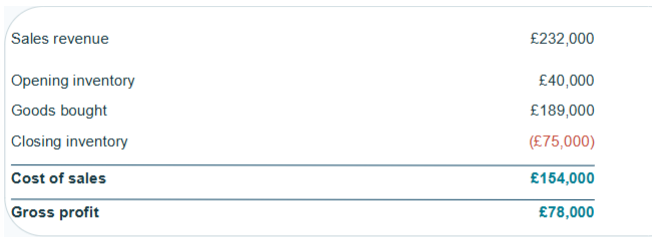
Opening inventory + purchases - closing inventory = cost of sales
Operating Expenses
= other costs incurred in carrying out trading activities
→ operating expenses are deducted from GP to calculate OP (OP= GP- operating expenses)
Examples:
salaries and wages
rent and rates
utilities
transport costs
telephone and postage
insurance
Detailed income statement
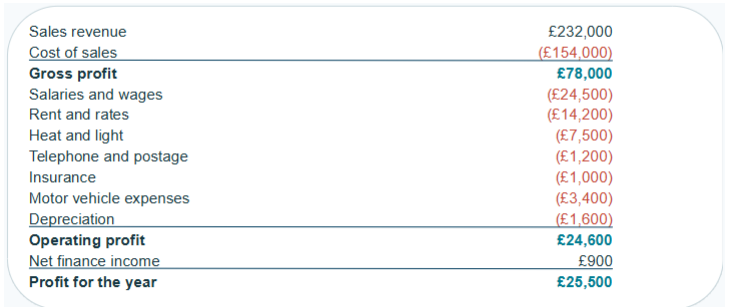
zoom in on cost of sales
Why do assets lose accounting value
Depreciation allocates the depreciable amount over an asset’s useful life
→ focus on fixed assets
wear and tear
lower resale value
obsolescence and ageing
systematic allocation rather than marketing valuation
What is depreciation
= represents the loss in value of this asset over time
→ depreciation is an expense
Depreciation when purchasing a new asset
When purchasing an asset (e.g. motor vehicle or computer), you should expect its value to not stay the same over the years
wear and tear
having a lower resale value
becoming outdated/ obsolete
etc.
What are the 2 methods of depreciation
Straight line
Reducing Balance
What are the 4 inputs to the calculating depreciation
*The method determines the pattern of allocation
asset cost= initial recorded amount
useful life= expected period of use
residual value= expected value at disposal
method= straight line or reducing balance
What is the straight line method
The same depreciation charge is recognised each year

Reducing balance method
apply a fixed percentage to the carrying amount brought forward
the depreciation charge reduces because the carrying amount reduces each year

What is the accounting value
Accounting value is the value left after depreciation and this figure then becomes the opening value for the next year
Comparing the two methods of depreciation

What is it known as when a receivable becomes unrecoverable
Bad debt
Bad debt
= recognised as an expense when a customer balance cannot be collected
→ e.g. someone declares bankruptcy
credit sales create trade receivables
a later cash receipts reduces the receivables
an unrecoverable balance is removed from receivables
the same amount is recognised as bad-debt expense
Credit sale to a partial payment
→ sale on credit period= increases accounts receivable by same amount
→ cash increases= account receivables decrease by same amount

What happens to the remaining balance (bad debt)
It gets written off
→ after the write-off, no amount remains recoverable from the customer
Income Statement:
bad debt expense increases by amount unrecovered
Statement of Financial position:
trade receivables decrease by amount unrecovered