English Study Material: Endotherms, Homeotherms, and Climate Adaptations
 Call Kai
 Learn
 Practice Test
 Spaced Repetition
 Match
 Flashcards
 Knowt Play
1/40

There's no tags or description
Looks like no tags are added yet.
41 Terms
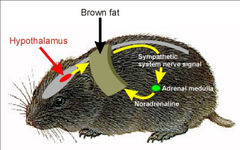
Non-shivering thermogenesis helps _______________________ animals warm up.
Non-shivering thermogenesis helps hibernating animals warm up.

Non-shivering thermogenesis helps hibernating animals warm up by metabolizing _____________________.
Non-shivering thermogenesis helps hibernating animals warm up by metabolizing Brown Adipose Tissue (BAT).
True or False:
A Hairless Dog has a larger boundary layer than a Shitzu.
False.
A Hairless Dog has a smaller boundary layer than a Shitzu.
True or False
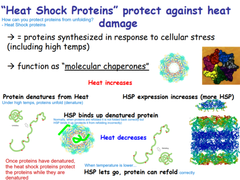
Heat Shock Proteins block protein denaturation in hot situations.
False
Heat Shock Proteins bind to proteins during extreme heat to keep them from refolding incorrectly. When it cools down, they let go and let the protein fold correctly.
True or False
In Camels, countercurrent heat exchange occurs in the nasal turbinate.
False.
In Camels, countercurrent heat exchange occurs in the rete mirabile.
Evaporative cooling happens in the Nasal Turbinate of camels (wet nose).
Countercurrents can be utilized to retain heat (like in Ungulate legs) or be bypassed to lose heat (duck legs in cold temps). It is also used in cooling the brain of camels by running hot blood next to cold blood.

True or False
Evaporation causes greater heat loss through Convection
False.
Convection causes greater heat loss through Conduction
Why does convection accelerate the heat transfer (loss)? - It pushes the hot air away and cools the area and bc heat transfer is increased when there is a larger temperature differential (when there is cold air touching the hot air)

Convection causes greater heat loss through ________________ .
Convection causes greater heat loss through Conduction.
True or False
Poikilotherms are more likley to have multiple isozymes for an enzyme than homeotherms.
True
Poikilotherms are more likley to have multiple isozymes for an enzyme than homeotherms.
This is because Poikilotherms vary more than Homeotherms
Explain how the Rete Mirabile Allows a Camel to Save up to 5L of water a day...
The rete mirabile helps camels brains keep cool by using cool blood (which is cooled in the nose) and running it next to warm blood heading towards the brain, ultimately cooling the brain. With cooled brain temperatures, the camel does not have to produce a lot of sweat (which would cause it to loose water).
Additionally, evaporative cooling that occurs in the nose of camels happens when the air they exhale is condensated into water droplets on their nose (preventing water loss).

Explain what similarity between snowshoe hares and pied flycatchers make them both vulnerable to climate change?
Snowshoe hares and Pied Flycatchers both rely on daylength for cues. But as climates change, and their environment advances along with it, daylength stays the same.
Pied Flycatchers rely on daylength to know when to migrate to their breeding grounds, but climate change advances the phenology of their breeding sites, so birds arrive at the breeding grounds later than would be optimal for raising young.
Snoeshoe hares rely on daylength to know when to begin to change the color of their fur. But as climate change changes their environment before daylength tells them to change color, they are left sticking out. They become an easy target fro prey.
(In reference to the paper) Why are long distance migrants more vulnerable to climate change than non-migratory species?
Long distance migrants use daylength as the primary cue to time Spring migration towards the breeding grounds. Climate change is advancing the phenology of the breeding site, but there is no corresponding change in daylength, so birds are arriving at the breeding grounds later than would be optimal for raising young.

What is the overall question in the paper?
Can a long-distance migrant respond to increasing temperatures with adjustments in egg lay and arrival?
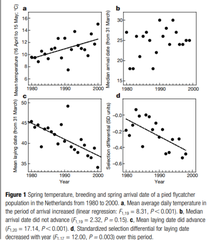
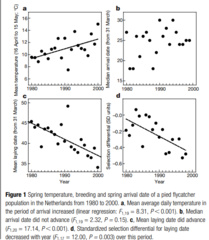
Draw the graph that represents the date of egg lay period of flycatchers at their breeding grounds:
Remember that as years went on, the mean egg laying date became earlier in the year (hence the decrease in the egg laying date)

Draw the graph that represents the date of arrival date of flycatchers at their breeding grounds:
Remember that the pied flycatchers did not change/advance their arrival date.

How did Figure 2 reflect the overall paper?
Pied flycatchers are using daylength to time departure for spring migration. This means that they cannot arrive sooner when conditions are advanced at the breeding site. However they can advance lay date once they've arrived.

Explain Figure 2:
Question:
Does temperature at the breeding site predict date of egg lay and arrival dates?
Explanation: It appears that pied flycatchers cannot advance the date of arrival given local conditions at the breeding site; however, once there, females can advance the date of egg lay to more closely match environmental conditions. (answers for 3d, 3e and 4 may overlap a bit, that's fine)

Explain Figure 1:
The Question: How has the selection differential changed over the 20 years of data analysis? (or, is there a change in the effect of lay date on recruitment of young into the breeding population the next year?)
Explanation:
As years progress, there is greater and greater benefit to laying eggs earlier in the year, in that a greater proportion of earlier laid young recruited into the next years' population.
Define the term Heat:
The amount of energy present.
Define the term Temperature:
The measure of the intensity of the heat present.
______________ is the amount of energy present.
Heat is the amount of energy present.
_________________ is the measure of the intensity of the heat present.
Temperature is the measure of the intensity of the heat present.
Name the three rules of heat transfer:
1. Heat flows from warmer to cooler places
2. The greater the difference in temperature (temp gradient), the greater the transfer of heat (flux)
3. Physical Properties Matter (animals with a lot of blubber lose less heat)
Write out what PUFA stands for:
PUFA = Polly-Unsaturated Fatty Acid
Would a desert animal choose a diet higher or lower in Poly-unsaturated fatty acids (PUFA)?
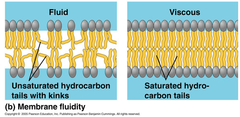
A desert animal would choose a diet that is lower in Poly-unsaturated fatty acids. This is because in hot temperatures, animals need more saturated fatty acids to reduce the fluidity of their membranes.
If an animal were to instead have more (PUFA) in a hot enviornment, their membrane would be too fluid.
What is a Poikilotherm?
Poikilotherms body temperatures vary with the environment.
Opposite of Homeotherm
What is a Homeotherm?
Homeotherms body temperatures are kept constant (do not vary with the environment).
Opposite of Poikilotherm
What is a Endotherm?
Endotherms' body temperatures depend on internally generated metabolic heat (they produce their own heat).
Opposite of Ectotherm

What is an Ectotherm
Ectotherms' body temperatures depend on external heat sources.
Opposite of Endotherms

Name animals that are a...
Poikilothermic Endotherm:
Small Birds and Small Mammals:
- Hummingbird (enters torpor)
- Hamster (enters torpor)

Name animals that are a...
Homeothermic Endotherm:
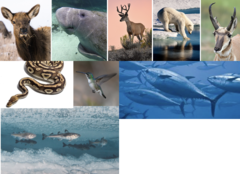
Most Birds and Mammals:
- Deer
- Dog
- Cat
- Brooding Python

Name animals that are a...
Poikilothermic Ectotherm:
Most Amphibians and Reptiles:
- Lizards
- Freshwater fish (goldfish)

Name animals that are a...
Homeothermic Ectotherm:
Most Marine Fish:
- Polar Marine Fish

Explain why Cataglyphic Ants can hunt in the Saharan Desert at the hottest time of the day:
Cataglyphic Ants can hunt in such hot temperatures because they use heat shock proteins. They also have silver hairs which reflect the light from the sun.
Before going to the surface, they go in the tunnel of the nest which is pretty warm (45C) but not as warm as the surface (50C). They wait in the tunnel for 10-15 min to make heat-shock proteins. The heat shock proteins bind onto the denatured proteins and prevent them from refolding incorrectly while the ants experience hot temperatures, such as when they go up to the surface (50C).
Heat shock proteins allow animals to survive a longer period of heat shock.

Draw all the forms of heat loss and gain from this penguin (the ground is hotter than the penguin, the air is cooler)

Define Colligative Antifreezes:
Colligative Antifreeze:
- Uses solutes to decrease the freezing point within cells. It makes the concentration of solutes within the cells higher so that the freezing point is lower.

Define Non-Colligative Antifreezes:
Non-colligative Antifreeze uses proteins to lower the temperature at which ice crystals form.
Specifically, Glycoproteins which bind to ice crystals and lower the temperature in which ice crystals grow.

Are Colligative Antifreezes or Non-Colligative Antifreezes more effective at lowering the freezing point in animals?
Non-Colligative Antifreezes are more effective at lowering the freezing point than Colligative Antifreezes but are more costly.
Non-Colligative Antifreeze: block ice formation
Colligative Antifreeze: increase solutes

List and explain the four areas of research Williams proposed (Vulnerability of Species/Populations):
1. Exposure
2. Sensitivity
3. Resilience
4. Adapt

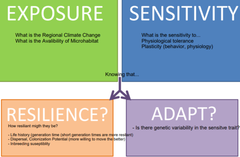
List and explain the four areas of research Williams proposed, to frame how vulnerable populations are to climate change...
1. Exposure
- What is the Regional Climate Change?
- What is the availability of the Microhabitat?
2. Sensitivity
- What is their Physiological Tolerance to climate change?
- How much Placitity do they have?
3. Resilience
- How resilient are they to climate change?
- What is their life history?
- Can they disperse/colonize new places?
- How susceptible are they to inbreeding?
4. Adapt
- Is there genetic variability in the trait they have that is sensitive to climate change?
Summarize the main point of the Lizard/Climate Change Studies:
Draw the graphs that support these studies:
The studies found that there were more Generalists Near the Poles, because there is more variation in temperature there.
The studies found that there are more Specialists near the Equator because they experience more constant temperatures.
The studies found that as latitude increases, the tolerance zone increases (dot graph).
Generalists have more of a broad performance curve (broad range of temperatures)...When temperatures change (graph d) there are not many changes in their fitness
Specialists have a narrow performance curve (narrow range of temperatures)...When temperatures change (graph c), there is a huge change in their fitness. At their optimal temps, they will have the highest fitness.

Of the four areas of research proposed by Williams, which one does the Lizard work fall into?
The Lizard study falls into Sensitivity because it discusses their Physiological Tolerance to Climate Change.
Specifically, how species that live near the equator have a narrow range of temperatures at which they can survive at (they are specialist) and are therefore more physiologically sensitive to climate change.
Whereas species that live near the poles have a wider range of temperatures that they can survive at (generalists) and are therefore less physiologically sensitive to climate change.
