Metabolism
 Call Kai
 Learn
 Practice Test
 Spaced Repetition
 Match
 Flashcards
 Knowt Play
1/46

There's no tags or description
Looks like no tags are added yet.
47 Terms
Define metabolism
All of the chemical reactions in a cell
Distinguish the role of photosynthesis from cellular respiration
Photosynthesis→ store energy as glucose, needs energy
Cellular respiration→breaks down glucose, releases energy
What is the chemical formula for photosynthesis?
6CO2+ 6H2O→C6H12O6 + 6O2
What is the chemical formula for respiration?
C6H12O6 + 6O2→6CO2+ 6H2O
Distinguish between anabolism and catabolism
Anabolism: builds up larger molecules and requires energy e.g. sugars, proteins, DNA
Catabolism (cut): breaks down molecules and releases energy
What is an amphibolic pathway?
It is a pathway that has both anabolic and catabolic elements
Define Kinetic energy, potential energy, and chemical energy
Kinetic: Energy of motion
Potential: stored energy that, if released, could do work
Chemical: energy store in chemical bonds
What does Gibb’s free energy mean?
The amount of energy available to do work (usable energy)
Traingle G < 0 energy is release when reaction occurs
Triangle G > 0 energy is required for reaction to occur
What abbreviation do we use to indicate changes in levels of free energy?
Delta G (triangle G)
What is change in free energy affected by?
Changes in enthalpy (whether it warms or cools)
Changes in entropy (randomness of atoms, whether they are scattered or regularly arranged)
What does spontaneous mean?
Process or reaction that occurs naturally on its own without needing a continuous input of external energy
can occur slowly
Define endergonic reactions
Requires energy
traingle G > 0
usually decreases randomness (entropy)
positive change in free energy
not spontaneous
associated with anabolism
Define exergonic reactions
releases energy
traingle G < 0
usually increases randomness (entropy)
negative change in free energy
spontaneous
associated with catabolism
What do exergonic and endergonic reactions look like?

What is the “hump” in the diagram called?
transition state as it is an unstable state
Define activation energy
Energy required to start a reaction
What is the term for the lowering of activation energy, which allows chemical reactions to proceed? How does it change a free energy diagram?
Catalysis, the height of the hump on the curve would be lower
What is the term of a substance that lower activation energy for a reaction?What is an example?
Catalysts e.g. enzymes
What is the study of thermodynamics?
The study of energy and energy transfer
What is the difference between an open system and closed system? Provide examples
open→allows energy and matter to be transferred from the system to the surroundings
e.g. human body, pot of boiling water, car engine, plants
closed→allows energy but not matter to be transferred from the system to the surroundings
e.g. pot of boiling water with tight lid, sealed gas container or gas cylinder
Summarize the first law of thermodynamics
Energy cannot be created or destroyed, only transferred or changed in form
Summarize the second law of thermodynamics
Every energy transfer increases the universes entropy (randomness)
How do living things maintain order despite entropy?
They take in energy to stay organized increasing disorder in their surroundings
Do enzymes ever change the free energy of the reaction?
No, enzymes never change the free energy (G) of reactant or products; they only decrease
What is the term for direct enzymatic transfer of a phosphate group from an organic compound to ADP?
Substrate-level phosphorylation
Which two areas of ATP have high-energy bonds?

What is the equation for the hydrolysis of ATP? Is it endergonic or exergonic?
ATP + H2O → ADP + Pi
Releases energy → exergonic
Why is ATP only used for short-term, rather than long term energy storage?
ATP is unstable and will hydrolyze prior to when it can be used by the cell
What is the term for cellular pathways that capture energy from
the hydrolysis of ATP and use it to perform a cellular function?
Energy coupling reactions
What is the term for adding a phosphate group to a (usually) organic substance?
Phosphorylation
ATP hydrolysis is generally coupled with which type of reaction?
Endergonic reactions, because they require energy that ATP hydrolysis helps provide e.g. cells use energy from ATP to build proteins from amino acids
What does an enzyme do to the activation energy of reaction?
Lowers it


On this diagram, label the substrate, enzyme substrate-complex, products, and the enzyme’s active site

Do specific enzymes catalyze a wide range of chemical reactions or just one or a few types of reactions?
Specific enzymes catalyze just one or a few types of reactions
Fill in the blank: when changes cause a protein, such as an enzyme, to lose aspects of its secondary, tertiary or quaternary structure, the protein has become ——?
Denatured
What is the effect of increasing temperature on reaction rates for temperature ranges lower than those associated with loss of enyzme shape?
Warming increases the energy of reactants and increases enzyme flexibility, promoting induced fit. Both of these result in faster reaction rates, so long as the temperature doesn’t get too high.
For enzymatic reactions specifically, what happens to reaction rates once
enzymes reach a temperature too hot for them to maintain their shape?
After some point, higher temperatures break bonds or disrupt interactions
among atoms, causing the enzyme’s shape to change – the enzyme denatures. This causes a loss of enzyme function because function depends on shape
Besides, temperature, what other aspect of the cellular environment
can cause an enzyme to denature and become ineffective?
pH
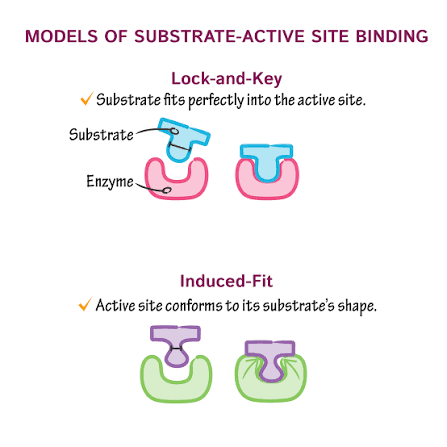
What is the term for the slight change in enzyme structure that occurs when a substrate binds to the enzyme?
Induced fit
State and explain the three different types of inhibitors
competitive inhibitor
binds to the active site
affects only when substrate concentration is low; its effect can be overcome by adding more substrate
(The inhibitor competes with the substrate for the same spot. If you add lots of substrate, the substrate has a better chance of getting into the active site.)
Non-competitive inhibitor
Binds away from active site (allosteric site)
Affects reaction even when substrate concentration is high
(It interferes with how the enzyme works. Adding more substrate cannot fully overcome the inhibition.)
Allosteric inhibitor
binds away from active site (allosteric site)
Affects enzyme activity even at high substrate concentration
(Binding at a different location changes the enzyme's shape or activity, making it work less effectively.)
For which type of inhibitor, competitive or non-competitive, is the inhibitor likely to be similar in shape to the substrate?
Competitive
Mechanistically, how does an allosteric inhibitor cause the enzyme to become
less effective?
It binds to the enzyme and changes its shape in a manner that
reduces its activity.
What are the differences between cofactors and coenzymes?
Cofactors
help an enzyme function properly
can be inorganic, such as metal ions
Coenzymes
organic cofactors
help enzymes transfer electors or chemical groups
e.g. NAD+ and coenzyme A
In feedback inhibition, which enzyme is typically inhibited?
The first enzyme in the metabolic pathway
What acts as the inhibitor in feedback inhibition?
The final product of the metabolic pathway
Why does feedback inhibition occur?
To prevent excess product formation and conserve energy and resources
What happens if a mutation prevents feedback inhibition?
The pathway may keep running, causing too much final product to be made