A1.1.2 - Hydrogen bonds as a consequence of the polar covalent bonds within water molecules
 Call Kai
 Learn
 Practice Test
 Spaced Repetition
 Match
 Flashcards
 Knowt Play
1/4

There's no tags or description
Looks like no tags are added yet.
Name | Mastery | Learn | Test | Matching | Spaced | Call with Kai | Chat |
|---|
No analytics yet
Send a link to your students to track their progress
5 Terms
Electronegativity
An atom's ability to attract electrons in a bond.
Covalent Bonds
Form when atoms share electrons
In a water molecule sharing is unequal because of oxygen being more electronegative than hydrogen.
Structure of a Water Molecule
Polar molecule with two H atoms that have a partial + charge
One O atom that has a partial - charge
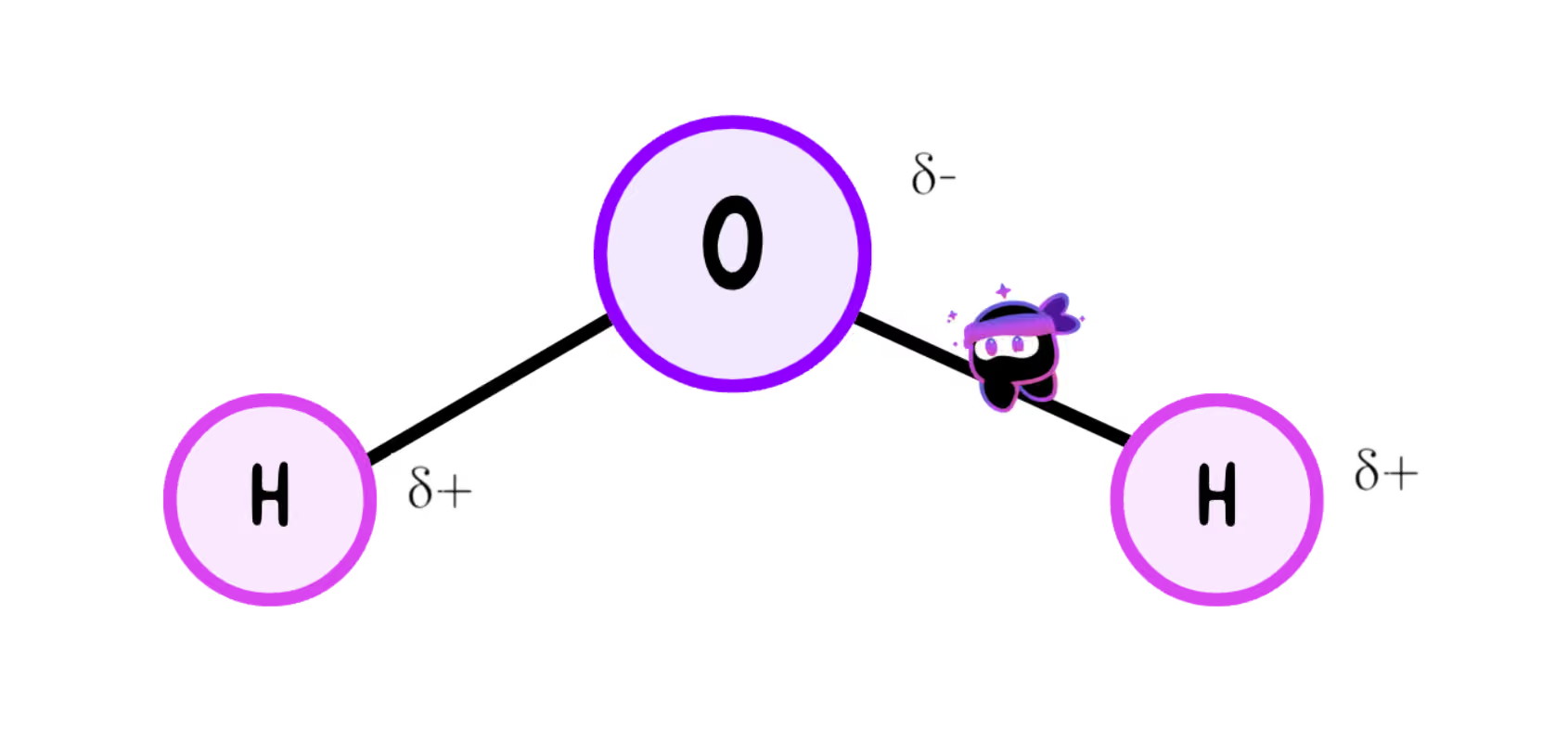
Why Water is Polar
Uneven charge distribution makes water a polar molecule,
Has a positive end (hydrogen side) and a negative end (oxygen side).
Hydrogen Bonds
Polarity is what allows hydrogen bonds to form between water molecules
The δ+ hydrogen of one molecule is electrostatically attracted to the δ− oxygen of neighbouring molecule
Since opposite charges attract, these polar regions create weak intermolecular attractions called hydrogen bonds