real world eco
 Call Kai
 Learn
 Practice Test
 Spaced Repetition
 Match
 Flashcards
 Knowt Play
1/18

There's no tags or description
Looks like no tags are added yet.
19 Terms
EVALUATION
An economy is experiencing low economic growth and rising cyclical unemployment. Evaluate the effectiveness of expansionary monetary policy in reducing cyclical unemployment.
Expansionary monetary policy involves the central bank reducing the cash rate, which generally lowers borrowing costs and encourages household consumption and business investment. This increases aggregate demand (AD), encouraging firms to increase production and employ more workers, thereby reducing cyclical unemployment caused by insufficient demand.
However, the effectiveness of this policy depends on how households and businesses respond to lower interest rates. If consumer confidence is low, households may save rather than spend, while businesses may delay investment because they expect weak sales. Consequently, AD may increase only slightly, limiting the reduction in unemployment. Monetary policy also operates with a time lag.
Overall, expansionary monetary policy is likely to be effective when cyclical unemployment is primarily caused by weak AD and lower interest rates translate into higher spending. However, its effectiveness is limited when confidence is weak, so it may need to be supported by expansionary fiscal policy to stimulate demand more directly.
Consumer confidence
how optimistic people feel about their personal finances and the economy as a whole.
Benefits of expansionary monetary policy
Lower interest rates can encourage household consumption and business investment.
Increases AD, potentially raising real GDP and reducing cyclical unemployment.
Can support households and businesses with variable-rate debt by reducing interest repayments when lending rates fall.
The RBA can adjust the cash rate without requiring the government to pass a new spending or tax measure.
limitations of expansionary monetary policy
Monetary policy operates with time lags.
Households may save rather than spend if consumer confidence is weak.
Businesses may not invest if they expect weak sales, even when borrowing is cheaper.
Lower rates can contribute to excessive borrowing and asset-price growth.
May be ineffective against cost-push inflation if higher production costs are the main cause.
The cash rate does not automatically translate into an equal change in every bank's lending rates.
benefits of expansionary fiscal policy
Increases AD directly through higher government spending or indirectly through tax cuts that encourage consumption.
Can increase real GDP and employment when spare capacity is available.
Infrastructure spending can improve long-run productive capacity as well as short-run demand.
Can have a strong multiplier effect when recipients spend a large proportion of additional income.
limitations of expansionary fiscal policy
Implementation lags: government projects can take time to approve and deliver.
May increase budget deficits and government borrowing.
Can cause demand-pull inflation if the economy is near full productive capacity.
Tax cuts may have a limited effect if households save the additional disposable income.
Increased government borrowing can put upward pressure on interest rates in some circumstances, potentially crowding out private investment.
EVALUATION
The government increases infrastructure spending to stimulate economic growth during a period of weak demand. Evaluate the appropriateness of this policy.
Expansionary fiscal policy through increased government spending directly increases AD because government expenditure is a component of AD. The initial spending also generates a multiplier effect as workers and businesses receive additional income and spend some of it, further increasing consumption and real GDP. This can stimulate production and employment when the economy has spare productive capacity.
However, if the economy is already approaching full productive capacity, increased spending may create excess demand and place upward pressure on the general price level rather than substantially increasing real output. Infrastructure projects may also have implementation delays, meaning their benefits may not occur immediately.
Overall, increasing infrastructure spending is appropriate when weak AD and spare productive capacity are limiting economic growth, as it can increase real GDP and employment. However, it is less appropriate if inflation is already high or projects cannot be implemented promptly. Its suitability therefore depends on the economy's capacity constraints, inflationary pressures and the timing of the spending.
When should expansionary fiscal policy be used
During a recession or economic downturn.
When real GDP growth is weak and cyclical unemployment is rising.
When AD is insufficient and the economy has spare productive capacity.
benefits of contractionary fiscal policy
Reduces AD through lower government spending and/or higher taxes, helping reduce demand-pull inflation.
Can moderate excessive economic growth and relieve pressure on productive resources.
May improve the budget balance, depending on the measures used and their effects on revenue and expenditure.
costs of contractionary fiscal policy
Can reduce real GDP growth and increase cyclical unemployment.
Higher taxes can reduce household disposable income and consumption.
Spending cuts may reduce public services or infrastructure investment.
May worsen a downturn if AD is already weak.
If inflation is primarily cost-push, reducing AD does not directly resolve the original rise in production costs.
when should contractionary fiscal policy be used
When inflationary pressure is high because AD is excessive.
When the economy is operating above or close to productive capacity.
When the government wants to reduce a budget deficit, although this is a separate objective from controlling inflation.
benefits of contractionary monetary policy
Higher interest rates generally reduce consumption and investment, lowering AD.
Reduces demand-pull inflationary pressure and helps move inflation towards the RBA's target.
Can moderate excessive borrowing and spending.
May support price stability over time, helping preserve purchasing power.
costs of contractionary monetary policy
Lower AD can reduce real GDP growth and increase cyclical unemployment.
Higher interest repayments can reduce disposable income for households with variable-rate debt.
Higher borrowing costs can discourage business investment and slow productive capacity growth.
Works with a time lag and cannot directly eliminate supply-side causes of inflation.
Can be particularly costly if economic growth is already weak.
when should contractionary monetary policy be used
When inflation is too high, particularly when excess AD is contributing to demand-pull inflation.
When the economy is operating above productive capacity.
when should expansionary monetary policy be used
When economic growth is weak and cyclical unemployment is rising.
When AD is insufficient.
When inflation is low or falling and there is scope to stimulate spending without creating excessive inflationary pressure.
high, low, and normal cash rate ranges
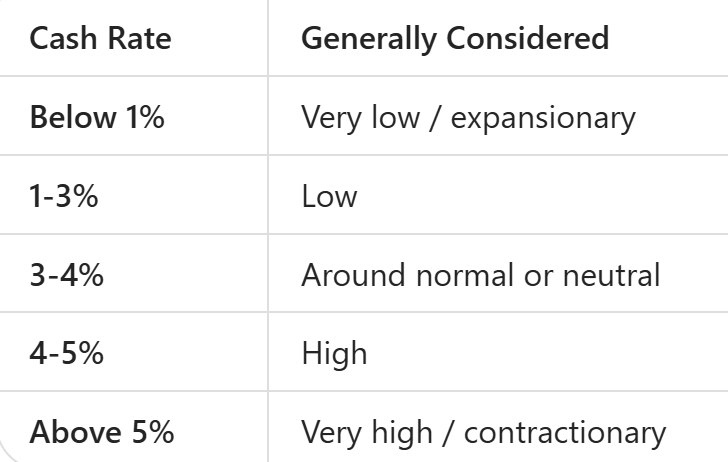
What happens if the RBA cuts the cash rate from 0.25% to 0.1%
If the RBA cut the cash rate from 0.25% to 0.10%, it suggests that the existing highly expansionary stance was not generating enough economic activity to achieve the RBA's goals, so further stimulus was needed.
Possible reasons:
weak consumer confidence
deflationary pressures
rising unemployment
trade surplus vs budget surplus
trade surplus (international trade)
exports > imports
(X-M) in the AD equation but
budget surplus (gov is collecting more revenue mainly through taxes)
gov revenue > gov expenditure
What are reasons for a budget deficit
Government spending exceeding revenue
Lower tax collections
Higher welfare payments
high unemployment