PBL and Workshop MSK (copy)
 Call Kai
 Learn
 Practice Test
 Spaced Repetition
 Match
 Flashcards
 Knowt Play
1/49

Earn XP
Description and Tags
50 Terms
How does osteoarthritis differ from rheumatoid arthritis?
OA: mechanical pain, brief morning stiffness, osteophytes;
RA: inflammatory pain, prolonged stiffness, synovitis.
What are the characteristic radiographic findings of OA?
Joint-space narrowing, osteophytes, subchondral sclerosis, and cysts.
What causes the shopping cart sign in lumbar spinal stenosis?
Spinal flexion enlarges the spinal canal, relieving nerve compression.
How does neurogenic claudication differ from vascular claudication?
Neurogenic improves with sitting/flexion; vascular improves with rest regardless of posture.
How does alendronate work?
Inhibits osteoclast-mediated bone resorption; take fasting with water and remain upright for at least 30 minutes.
Acute gout flare pharmacologic treatment
Colchicine → 1.2 mg stat then 0.6 mg 1 hr later (0.6 mg = 1 tab)
Corticosteroids/Prednisolone → 30-35 mg PO OD x 5 days OR kenacort at day 7,10
Indications for long term ULT
Frequent gout flares ≥2 flares/year, Tophi ≥1 or more, Radiographic damage due to gout, Selected patients with CKD ≥3 or urolithiasis.
How does fibromyalgia typically present?
Chronic widespread pain, fatigue, non-restorative sleep, and cognitive symptoms.
How does myofascial pain syndrome differ from fibromyalgia?
MPS has localized trigger points and taut bands; fibromyalgia causes widespread pain.
What is the typical presentation of CRPS type I?
Disproportionate regional pain, allodynia, edema, temperature/color changes, and sweating after injury without confirmed nerve injury.
What is classified as an open fracture?
Any fracture communicating with the external environment through a wound.
What is the initial management of an open fracture?
Cover wound, IV antibiotics, tetanus prophylaxis, splint, and urgent surgical debridement.
Which antibiotics are commonly used for open fractures?
Cefazolin for type I–II; Type III use gentamycin; plus TB booster/TIG
What is the classic deformity of a Colles fracture?
Distal radius fracture with dorsal displacement, producing a dinner-fork deformity.
What is the initial treatment of a displaced Colles fracture?
Closed reduction followed by immobilization in a suitable splint or cast → use sugar tong cast (prevent supination/pronation while fixing wrist and forearm)
What synovial fluid findings suggest septic arthritis?
Cell >50,000 with >75% Neurotrophil
What is the most common cause of native-joint septic arthritis?
Staphylococcus aureus.
How is septic arthritis managed?
Give vancomycin first → add ceftriaxone if need gram neg coverage → deescalate when culture results are ready
What are the characteristic features of ankylosing spondylitis?
Inflammatory back pain, morning stiffness, improvement with exercise, and possible uveitis.
What radiographic finding supports ankylosing spondylitis?
Bilateral sacroiliitis with erosions, sclerosis, and joint-space changes.
What is the initial treatment for ankylosing spondylitis?
Exercise and physiotherapy; NSAIDs are first-line medication when appropriate.
What are the 6 Ps of acute compartment syndrome?
Pain, pallor, paresthesia, paralysis, pulselessness, and poikilothermia.
What delta pressure indicates possible compartment syndrome?
Diastolic blood pressure minus compartment pressure ≤30 mmHg.
What is the definitive treatment for acute compartment syndrome?
Emergency fasciotomy.
What are the major lower-leg compartments?
Anterior, lateral, superficial posterior, and deep posterior.
What are the classic features of cauda equina syndrome?
Saddle anesthesia, urinary retention, bilateral leg symptoms, and reduced anal tone.
How does conus medullaris syndrome differ from cauda equina syndrome?
Conus: more symmetric deficits and early sphincter dysfunction
Cauda equina: often asymmetric radicular pain and LMN signs.
What are the lesions associated with TUBS
Bankart → Anteroinferior tear of the glenoid labrum
Hill Sach → Posterolateral humeral head compression fracture
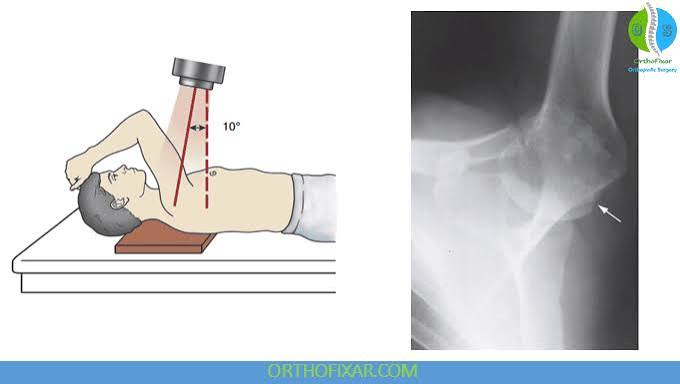
What is this view and what is it used for
Stryker Notch view → used to look at Hill Sachs lesions

What is this view and what is it used for
West Point Axillary view → used for Bankart lesions
What causes subacromial impingement?
Compression of rotator cuff tendons and subacromial bursa beneath the coracoacromial arch.
Which tests suggest subacromial impingement?
Neer and Hawkins-Kennedy tests.
What does the Empty Can test assess?
Supraspinatus strength and pain.
What causes lateral epicondylitis?
Overuse tendinopathy of the common wrist extensor origin, especially ECRB.
What causes medial epicondylitis?
Overuse tendinopathy of the common wrist flexor-pronator origin.
What are common return-to-play criteria?
Pain-free full ROM, near-symmetric strength, functional testing, and sport-specific readiness.
What structures form the unhappy triad of the knee?
ACL, MCL, and medial meniscus.
What mechanism commonly causes the unhappy triad?
Valgus force with external rotation of the tibia on a planted foot.
Which test is most useful for ACL injury?
Lachman test; increased anterior translation with a soft endpoint is positive.
What does valgus stress testing assess?
MCL integrity; laxity at 30° suggests MCL injury.
What does the McMurray test assess?
Meniscal injury; joint-line pain or clicking is positive.
Which part of the meniscus has the best healing potential?
Red-red peripheral zone due to its blood supply.
How do closed kinetic chain and open kinetic chain exercises differ?
CKC: distal segment fixed; OKC: distal segment moves freely.
How can non-contact ACL injuries be prevented?
Neuromuscular training with strength, balance, landing mechanics, and movement-control exercises.
Which exercises are useful for knee OA?
Quadriceps strengthening, stretching, cycling, walking, and aquatic exercise.
Which exercises are useful for hand OA?
Tendon gliding, range-of-motion exercises, and gentle intrinsic muscle strengthening.
Absolute CI for arthrocentesis
Underlying infection/bacteremia/acute fracture/prosthetic knee, bleeding/coag disorder, frequent steroids injection
Why should you REDUCE corticosteroid use in OA patients
Can inhibit osteoblast + increase osteoclast lifespan → taper or else cause adrenal insufficiency from HPA cortisol dysfunction
What is Patellar/Ballotment test
Detect LARGE effusion (10-50mL) → use hand to push fluid toward patella and tap
What is bulge sign
Detect SMALL effusion (4-10mL) → one hand rub medial leg up the other hand rub lateral leg down → should see fluid wave