Cell Membrane Transport: Diffusion, Channels, and Epithelial Movement - Chapter 4
 Call Kai
 Learn
Learn Practice Test
 Spaced Repetition
 Match
Match Flashcards
 Knowt Play
1/26

There's no tags or description
Looks like no tags are added yet.
Name | Mastery | Learn | Test | Matching | Spaced | Call with Kai | Chat |
|---|
No analytics yet
Send a link to your students to track their progress
27 Terms
What is the movement of substances along the concentration gradient?
Movement from areas of high concentration to areas of low concentration; a passive process requiring no ATP.

What is the movement of substances against the concentration gradient?
Movement from areas of low concentration to areas of high concentration; an active process requiring ATP.
What is diffusion?
The passive movement of molecules from one location to another due to random thermal motion, eventually reaching equilibrium.
What limits the rate of diffusion?
Distance; diffusion is slow over long distances.
What role do membranes play in diffusion?
Membranes act as barriers that slow the diffusion of molecules, with the hydrophobic lipid bilayer being a major limiting factor.
What types of molecules diffuse easily through the lipid bilayer?
Nonpolar molecules such as oxygen, carbon dioxide, fatty acids, and steroid hormones.
What are ion channels?
Integral membrane proteins that allow specific ions to diffuse across the membrane.

What determines the selectivity of ion channels?
The channel diameter, the charged and polar surfaces of polypeptide subunits, and the number of water molecules associated with the ion.
What is membrane potential?
The separation of electrical charge across plasma membranes that influences ion movement.
What are the types of gated channels?
Ligand-gated, voltage-gated, and mechanically gated channels.
What is mediated-transport?
The movement of molecules across cell membranes via conformational changes of integral membrane proteins known as transporters.
What is facilitated diffusion?
A type of mediated transport that moves substances from higher to lower concentration using a transporter, without ATP energy.

What is active transport?
The movement of substances against their concentration gradient using energy, often referred to as 'pumps'.

What are primary active-transporters?
Transporters that directly use ATP to move substances against their concentration gradient.
What is secondary active transport?
Transport that uses an electrochemical gradient across a membrane to drive the movement of substances against their concentration gradient.

What is osmosis?
The net diffusion of water across a membrane, facilitated by aquaporins.

What is osmotic pressure?
The ability of a solution to pull water; a concentrated solution has higher osmotic pressure than a diluted solution.
What are isotonic solutions?
Solutions that have the same concentration as normal extracellular fluid (e.g., 0.9% NaCl).
What are hypotonic solutions?
Solutions that have a lower concentration than normal extracellular fluid (e.g., 0.1% NaCl).
What are hypertonic solutions?
Solutions that have a higher concentration than normal extracellular fluid (e.g., 5% NaCl).

What is endocytosis?
The movement of molecules into the cell via vesicles, including pinocytosis, phagocytosis, and receptor-mediated endocytosis.
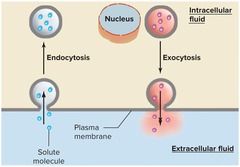
What is exocytosis?
The movement of molecules out of the cell via vesicles, allowing secretion of membrane-impermeable molecules and membrane replacement.
What is the apical membrane in epithelial cells?
The plasma membrane facing a hollow or fluid-filled tube or chamber.
What is the basolateral membrane in epithelial cells?
The plasma membrane adjacent to a network of blood vessels.
What is the transcellular pathway in epithelial transport?
Movement of a substance into an epithelial cell across either the apical or basolateral membrane via diffusion or mediated transport.
What is the paracellular pathway?
Diffusion of a substance between adjacent cells of the epithelium, limited by tight junctions.
What limits paracellular transport?
The presence of tight junctions between adjacent cells, which form a seal and limit diffusion.