Dairy Hygiene
 Call Kai
 Learn
 Practice Test
 Spaced Repetition
 Match
 Flashcards
 Knowt Play
1/23

There's no tags or description
Looks like no tags are added yet.
24 Terms
What are the general things that milk is composed of?
Proteins
Caseins (80%)
Whey proteins
Lactose
Minerals
Fat
WATER MOSTLY (especially when diluted)
Higher concentration of water in a product → better environment for microbial development
= shorter shelf life
** Ratio of fat and protein will vary between species
Remind yourself on how milk is processed and stored…
1) Raw milk is received
2) Filtered
3) Stored
4) Clarifier / separator → raw cream storage OR
5) Pasteurization
Vitamin addition OR
Homogenization
6) Pasteurized storage
7) Filler
8) Cold storage
9) Distribution
At what temperature should milk be stored at all times during the process?
BELOW 5 C
Should be kept refrigerated after pasteurization no matter what
When considering hazards along the process of milk collection and processing, what are the main properties of milk we need to keep in mind?
Milk is a HIGHLY perishable product and requires processing shortly after collection
CANNOT BE STORED FOR MORE THAN A FEW DAYS
A number of hazards can be present in milk (from pre and post-harvest)
Physical
Chemical
Biological
When can the highest amount of potential hazards be found along the milk production line?
In the HOUSING OF DAIRY CATTLE
Animals need to be clean and well kept
Parlor designed to prevent contamination and should be maintained / managed appropriately
Animals not to be allowed in the sites where milk is stored, handled, or cooled
Where are the 4 main areas on a COW that could cause contamination in milk? What are the potential causes of this that may need correction?
1) Dirty legs
Fecal splashing from dirty passageways
2) Dirty tail
Loose feces
Cubicles too small
3) Dirty flanks
Poor beds
4) Udder
Affected by ALL sources

In general, what are the sources of hazards in pre-harvested milk? How could these be prevented?
Hygiene of the animals, environment, and workers
Solved by appropriate health plan
Health of the dairy herd
Quality of the raw milk
Milking and pre-storage conditions
Available storage facilities and technologies
All of these prevented by good farming practices:
Cleanliness of premises
Cleanliness of staff
Cleanliness of the animals
Pest control
Remind yourself how to perform a good, sterile milking routine:
“Strip, dip, dry, and apply”
Strip
Wipe loose dirt from each teat and pre-strip (foremilk)
Dip
Pre-dip and wait 20-30 seconds
Dry
Wipe each teat with a single-use paper towel
Apply
Apply teat cups 60-90 seconds after the first touch of each udder
Why do you strip the teat first before collecting milk?
To eliminate the first milk, which will be contaminated
To check if there’s any indication of mastitis
To trigger suckling reflex of the teat to begin the milking process
When it comes to milking equipment, how do you avoid the buildup of residues? What does cleaning and disinfection include in general?
Needs to be able to prevent the buildup of milk residues: FAT, PROTEIN, and MINERALS
Fat → Alkaline wash
Protein → Alkaline + Cl wash
Mineral → Acid wash
What cleaning and disinfection includes:
Manual cleaning of exterior and parlor
Internal cleaning
Circulation cleaning (“cleaning in-place (CIP))
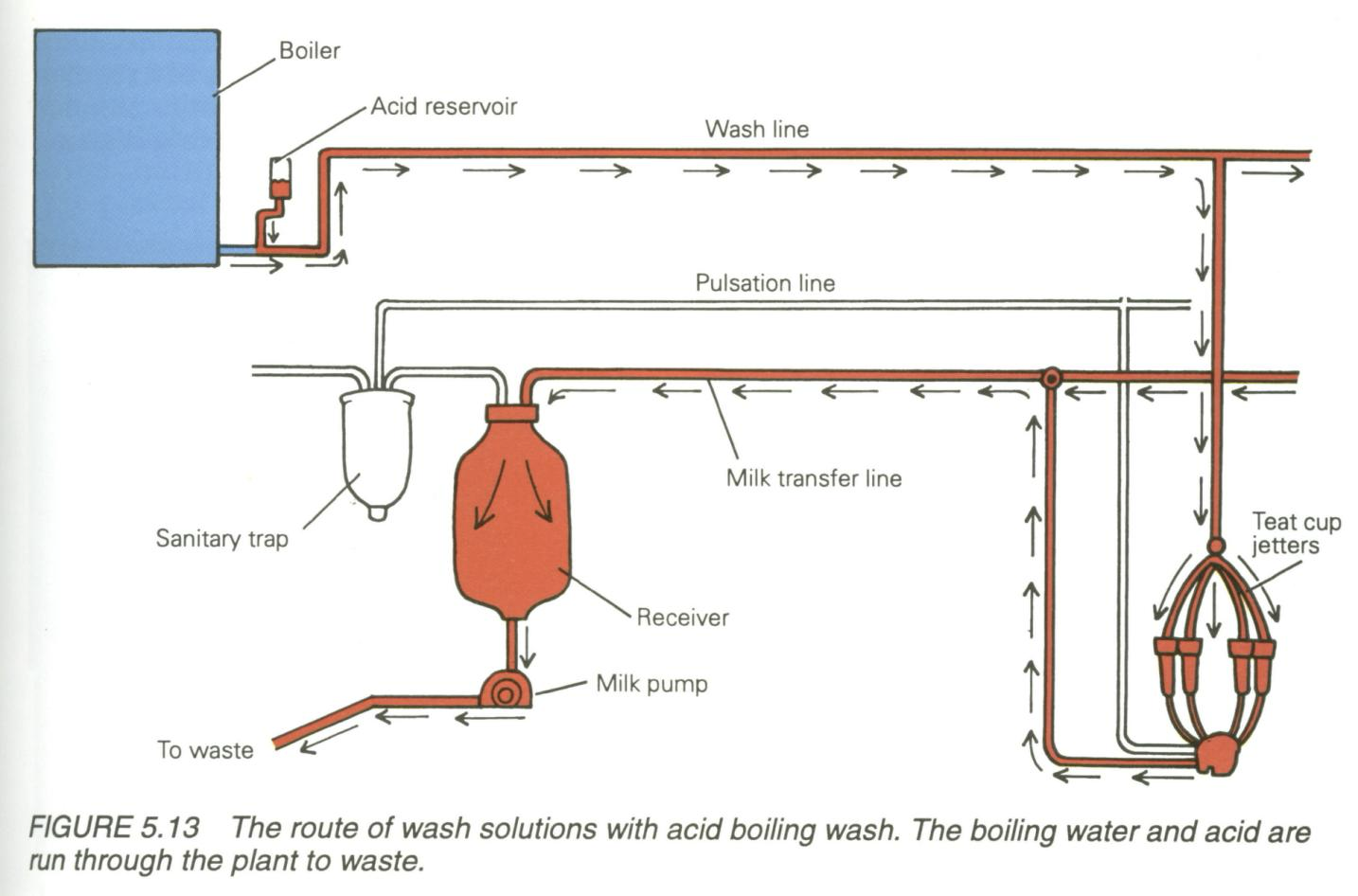
Acid boiling wash (ABW) → single pass
Bulk tank cleansing
Describe the process of circulation cleaning (CIP)…
Cleaner circulates through entire milk collecting pump, over and over again from the milk transfer line (see image)
Same cleaner cycles through; this is why it is called “cleaning in place”
Cleaning process:
Step 1) Rinsing
Done with WARM water at 38-43C
Protein residues in milk… if water too hot, proteins will denature and stick to inner surfaces of the tubing
Will cause a rough surface area, with places to harbor and facilitate bacterial growth
If water is too cold, the FAT content in the residues will harden… will do the same thing
So water needs to be at this warm temp range
Step 2) Wash
Alkaline (+ chlorine) solution; can be done at a higher temp (60-70 C) for 5-8 minutes during circulation
Best for maintenance cleaning

Describe the proces of an acid boiling wash…
Cleaner only circulates through the milk collector once
Cleaner is an acid; corrosive, so don’t want to keep the mechanisms exposed to that for long
NOT DONE DAILY
Single flush
VERY HOT WATER (start at 96C)
MUST STAY ABOVE 77C
Nitric / sulphanilic acid in the first few minutes
Best for big cleanings
What are some potential errors in milk equipment disinfection that could lead to contamination?
Problems may occur due to:
Inadequate temperature
Inadequate volume of cleaner
Inadequate chemicals
Inadequate circulation and physical action (e.g. circulation too long – temperature decreases - deposits accumulate)
Blind ends in milk collector tubing
Failure to manually clean the bulk tank when necessary.
When problems occur – higher number of microorganisms (Bactoscan and/or total bacterial count)
Approach to bactoscan problems…
Keep in mind, if there is a high bacterial load of contamination of RAW milk, the most likely source is gonna be from the pre-milk farm end of things (cleanliness, milking technique, maintenance of machines, etc.)

What are some of the most common microorganisms to contaminate milk?
Streps - specifically S. agalactiae
Coliforms
Psychotrophs
Thermodurics
What are the most common sources of that bacterial contamination?
Udders
Environment
Dirty milking machine / poor wash up equippment
Often the bulk tank
Failure of refrigeration
Match the source of contamination with the bacteria that comes from it…
Streptococcus agalactiea is a bacteria specific to the udder; so if you find it, you know its the udder specifically that is contaminated
Coliforms -
Come from fecal matter; can also be a potential sign of clinical mastitis, but usually that comes with other physical symptoms that would have to be reported.
If you see high numbers of coliforms in a bactoscan, with no other reported findings, its most likely they’re coming from a fecal-contaminated environment
Psycotrophs -
Thrive in colder temperatures; are indicative of a dirty environment (GENERALLY dirty, not fecal dirty); shows that there isn’t much cleaning happening (whether thats through dirty pens/ unchanged bedding) that allows these bacteria that like colder temps to thrive
Can also be caused by failure of refrigeration; chilling is cold but not cold enough to prevent the spread of psycotrophs, who can still thrive at 10 C (milk should be refrigerated below 5C at all times)
Thermodurics -
Can thrive in higher temps (40-50C), so if you’re getting them in your milk after collecting, this means they are surviving through the milk collector cleaning process
Indicates poor cleaning routine, resulting in a still-dirty milking machine
Define what “raw milk” is…
Is defined as milk produced by the secretion of the mammary gland of farmed animals that has not been heated to more than 40C or undergone any treatment that has an equivalent effect
**“Raw milk is milk from any animal that has not been pasteurized to kill harmful bacteria. Raw milk can carry harmful bacteria and other germs that can make you very sick or kill you. While it is possible to get foodborne illnesses from many different foods, raw milk is one of the riskiest of all”. (CDC)
What zoonotic agents MUST be reported if found in an animal product according to List A of Annex I of the Zoonoses Directive EC 99/2003?
Salmonella
Campylobacter
Listeria monocytogenes
Shiga toxin-producing E. coli (STEC)
Mycobacterium bovis
Brucella
Trichinella
Echinococcus
Which microorganism is the biggest zoonotic threat when consuming raw milk?
MYCOBACTERIUM BOVIS
Tuberculosis
Comes directly FROM the milk itself
This and Brucella bovis
In high-income countries, what is the biggest source of contamination in dairy products?
Bacteria from FECAL CONTAMINATION
So even in first world countries, milk is most commonly contaminated by coliforms
Keep in mind that antimicrobial testing is done quickly to determine whether or not milk still has medicinal residues in it…
What is the most common antimicrobial testing done during milk processing?
The Delvotest SP
Principle:
Incubate a milk sample with media containing bacteria sensitive to what ever the cow had been treated with
If the bacteria continue to multiply:
Color change of bacterial growth occurs in media
Metabolic byproducts
If the bacteria does NOT multiply…
No color change = fail = bacterial growth was INHIBITED (means that there ARE antimicrobials in the milk and is not fit for human consumption)
What are the 3 different kinds of heat treatment you can do to milk? Which is the most popular?
1) Pasteurization - most common
Holding Method
62.8 °C to 65.6 °C
30 minutes holding
Immediate cooling to <10 °C
High Temperature Short Time
71.7 °C
15 sec holding
Milk must:
Be cooled immediately after heat treatment
Be phosphatase negative
Be peroxidase positive
Meet microbiological standards
Be packaged as soon as possible
Records must be kept for 3 months
2) Ultra High Temperature (UHT)
135 °C
1 second holding
Milk must:
Be packaged immediately
Sterile containers
Aseptic conditions
Meet microbiological standards
Records must be kept for 3 months
3) Sterilization
Is the ONLY METHOD that actually kills all microbes
Heated to greater than 100°C
Milk must
Comply with turbidity test
Meet microbiological standards
Records must be kept for 3 months