Psychology Exam
 Call Kai
 Learn
 Practice Test
 Spaced Repetition
 Match
 Flashcards
 Knowt Play
1/171

There's no tags or description
Looks like no tags are added yet.
172 Terms
According to the “Who’s in the Expert’s Chair” segment of the “Psychology of Social Class and Money” lecture, who is MOST LIKELY to build the most cognitive capacity over their lifetime?
Harper, who has always attended well-resourced schools.
Jalen’s parents often promise him rewards for completing chores but do not always follow through. When offered a small toy now or a large toy later, Jalen chooses the smaller toy. According to the “Social Class” lecture, what BEST explains Jalen’s decision?
An expectation that the larger reward may not actually be available later
Tyler’s family has substantial wealth and resources, but when asked about his family’s social position, he describes them as middle class. According to the Psychology of Social class and Money lecture, what does Tyler’s response BEST illustrate?
People with high wealth may still identify as middle class.
8-year old Katerina and Serena are studying to compete in their schools spelling bee. Katerina comes from a wealthy background, while Serena’s family struggles financially. According to the “Challenges of Growing Up in Poverty” reading, which of the following BEST predicts how Katerina and Serena may prepare for the spelling bee?
Katerina will continue studying despite struggling to memorize her first few words, while Serena will give up quickly after struggling.
Andre is driving through a busy parking garage when another driver takes a long time to back out of a space. Andre honks and becomes visibly impatient. According to the “Psychology in the News” segment of the “Psychology of Social Class and Money” lecture, which type of vehicle would MOST likely be associated with Andre’s Behavior?
A high-priced luxury car.
According to the “Does Money Make You Mean?” Ted Talk, which person would MOST likely attribute their success to their hard work and talent?
Someone who grew up in a wealthy family.
Clarke is a 90-year-old Republican and Derek is a 21-year old Democrat. According to the “Psychology of Social Class & Money” lecture, if Clarke and Derek were asked how they would design the United States’ distribution of wealth, how would they each respond?
They would both favor a MORE equal distribution of wealth than the US currently has.
According to the lecture, which socioeconomic status do people at every level of the wealth distribution tend to say they are apart of?
Middle class
Does Money Make you Mean?
In an experiment where they put two people against each other in a game of monopoly, where one player began with more money than the other (simulating wealth inequality)
The rich player moved around the board louder, was more likely to display power and celebration, eat more snacks provided to both participants, and began to be ruder and showboat about how well they were doing in the game.
How do rich people regard their privileges in life?
According to a monopoly experiment that simulated wealth inequality, the rich players were less attuned to the differences in their privileges that led to them winning the game.
What’s the relationship between wealth and empathy?
Across studies, we’ve found that as a person’s levels of wealth increase, their feelings of compassion and empathy go down, and their feelings of entitlement and self-interest increase.
What are wealthier individuals more likely to moralize?
Greed being good and that the pursuit of self interest is favorable.
Who’s more likely to offer monetary help to another person?
In a study that gives people the equivalent of 10 dollars, given the option they could give however much money to a stranger that they’d never meet, individuals who made less than 25,000 dollars a year gave 44% more of their money to a stranger than individuals making 150,000 to 200,000 dollars a year.
What kind of economic distribution do people typically prefer across the board?
People prefer a more equal distribution of wealth than they estimate to be the actual case.
When do our preferences for equal distribution of resources emerge?
Early in life, we can see this in nonverbal infants up to kindergarten aged children, where they prefer an equal distribution of resources. We also see this in nonhuman animals.
Revealed Preferences vs. Stated Preferences of Wealth
A lot of people say they want to live in an economy that's equal, but they don’t actually act when given the opportunity in ways that will encourage equality of resources amongst the group or they will act in ways that are ultimately self-interested.
This is the difference between stated preferences, and what’s revealed through behavior.
What is the long-arm of childhood?
The way in which stressors or poverty early in childhood can alter biological function later in life.
How does poverty impact cognitive capacity?
Kids that have more inputs or resources earlier in life escalate faster, develop cognitive capacity at higher rates, and continue to develop capacity later on in life, and they reach a peak of cognitive capacity at much later ages.
The inverse is true for kids with less resources early in life.
How can anti-poverty intervention alter biological age?
Moms given an anti-poverty intervention early in their child’s life, their babies had slower biological aging (cellular measure of how quickly you’re aging) I
n later life, these cellular aging measures predict things like dying earlier, having aging-related disease, and we showed that if you just give poor families money, you can slow that aging even in early life.
Does poverty impact wellbeing universally?
There is a stronger relationship with wealth and wellbeing in some countries than others. The relationship is less strong in countries of high religiosity because virtually all major religions propose that being poor is a virtue, buffering those well-being effects of being poor.
What does the Marshmallow test reveal about childhood poverty and impulsivity?
Poorer children are more likely to wait less time for a second marshmallow because they grow up to go for what is guaranteed now versus what might not come later. It was shown that children in the unreliable group ate their marshmallow faster because they weren't guaranteed those resources would come at a later time
Why is poverty harmful to kids?
Because of the chronic stress they experience as a result. Parts of the brain may change in children who grow up in poverty leading to:
Less efficient control and regulation of cognitive and emotional processes
Heightened emotional responses
Deficits in adult memory, higher levels of aggression and greater psychological distress.
What is the relationship between childhood poverty and task persistence?
Researchers consistently saw less persistence in regards to motivation towards tasks from the disadvantaged. When challenged, they’re much more likely to give up.
When you grow up with a lot of stressors, your environment sets you up for feeling like you don’t have a sense of mastery or self-efficacy.
You just lost $10,000 playing poker in Monte Carlo. To take your mind off the loss, you check your social media accounts. This is an emotional regulation strategy known as:
Distraction
Isabel is gambling in Vegas on her 21st birthday. Based on the “Psychology in the News” segment of the “emotions” lecture, which of the following is most likely to be true?
Isabel will have smoother hand movements when dealt a good hand.
Elena is startled when her friend unexpectedly jumps out behind a door, but her surprise disappears within a few moments. According to the “Emotion” lecture, which dimension BEST describes this characteristic of Elena’s emotion?
Duration
Noelia experiences high emotional fluctuations, while Tony experiences relatively little emotional fluctuation. According to the “Emotion Experience and Well-Being” reading, which statement is most accurate regarding their emotional well-being?
Noelia’s emotional well-being will be lower than Tony’s emotional well-being.
Vivian grew up in Japan. While working on a group project, one of her group members makes a suggestion that she disagrees with. According to the “culture and emotion” reading, how is Vivian MOST LIKELY to respond?
She may be more likely to withhold her disagreement and adjust to the group because of an interdependent model of self.
Jenna thinks people would be more likely to fear cars, while Kylie thinks they would be more likely to fear tigers. From the evolutionary perspective discussed in the “Emotion” lecture, who has the BEST answer and why?
Kylie, because threats from predators caused humans to evolve to be more prepared to develop fears of them
Minji is from South Korea and is choosing an activity to do during her vacation. According to the “Culture and Emotion” reading, which activity would Minji MOST LIKELY prefer based on her IDEAL AFFECT?
Relaxing peacefully by a quiet lake
Lina grew up in a household that discouraged outward emotional expression. Whenever Lina received praise or exciting news, her father would tell her to stay composed and not show her feelings. According to the “Emotion Experience and Well-Being” reading, which of the following is MOST likely true?
Lina has more difficulty forming close friendships than people who outwardly express emotions
What are emotions for evolutionarily?
Think of emotions as a psychological element of getting us to do more of the things that are good for us, less of what is bad for us. In terms of passing on your genes to the next generation.
If you take love, the purpose of love evolutionarily is a mechanism that makes parents care for their children, despite them being annoying or unpleasant.
What are emotions for in terms of long-term behavior?
Emotions also motivate us to do things that are better for us in the long term. If you knew you weren’t going to feel anxious or sad about a bad grade on a test if you didn't study, how likely are you to study for that test?
Emotional Preparedness
We are more prepared to fear some things than others, because our evolution has equipped us to learn some fears more easily than others. Our ability to learn to fear something comes from our brain’s evolution to respond to certain threats
Self-conscious emotions
These types of emotions don’t emerge until later in child development; because they require some sense of self; emotions like pride, embarrassment, shame, and guilt. They require some thought of:
“What do other people want or expect, and how will I live up to those standards?”
Social Emotions
More common in animal species with groups and hierarchies. These animals within hierarchies need to be aware of where they are in it. If a dominant animal wants to express their hierarchy they will display it through body language and facial expression.
How are emotions a form of social signaling?
Emotional displays act as social signals that shape how people interact, coordinate, and navigate group dynamics.
Expressions like a smile, frown or furrowed brow tells others what you plan to do, how you view them, and whether you feel safe or threatened. Observers use emotional displays to interpret a situation, for example anxiety signals a potential threat.
Emotional Dimensions
You can categorize all emotions in terms of three dimensions:
Valence - Is the emotion positive or negative?
Intensity - High stimulation emotions versus calmer, more gentle emotions
Duration - Sadness and love tend to last longer, while surprise tends to be shorter.
Basic Emotional Response
There is a certain number of basic emotions that are universal across humanity, this is how we categorize them based on response:
Subjective Experience - Each emotion has a subjective experience, or more objective feeling among them.
Physiological Signature - Body language of emotions
Antecedents and Consequences
Disgust is typically associated with the presence of some stimuli that’s bad for you (antecedent), and then it’s after the feeling of disgust it’s associated with behaviors that are going to try and remove that object from your vicinity (consequence)
What is true about emotional expressions?
There are universally recognize facial expressions, but cultures differ in display rules, about what emotions are appropriate to show in a given situation.
How is the US different from Asia in culture and emotion?
North Americans are largely individualistic
East Asians are mostly collectivistic
How does Asia and America differ in their dominant model of self?
Americans dominant model of self is independent; being a person means being distinct from others
Asia’s dominant model of self is interdependent: being a person means being fundamentally connected to others and being responsive to situational demands.
How does an interdependent model of self teach people how to express themselves?
In asia, an interdependent model of self teaches people to suppress their own beliefs and desires and adjust to others and fit in with their environment
How does an independent model of self teach people how to express themselves?
In america, an independent model of self teaches people to express themselves and try to influence others.
How does culture influence people’s response to emotional events?
Studies of emotional response tend to focus on three components:
Physiology, subjective experience, and facial expression
Regardless of culture, people tend to respond similarly in terms of bodily expression. However, accompanying facial expressions are more culturally distinctive.
How does emotional suppression impact wellbeing?
People suppress their emotions across cultures but culture influences the consequences of suppression for psychological well-being.
Suppressing emotions has negative consequences for wellbeing in North American contexts. This is because in individualistic societies, the expression of emotion is a fundamental aspect of positive interactions with others.
In collectivistic cultures, emotional suppression is needed to adjust to others, simply a part of normal life and therefore not associated with depression.
Depressed Americans show reduced emotional expression, but depressed asian Americans do not, in fact, they might express more emotion.
Thus muted responses are associated with depression in American contexts but not in Asian contexts.
How does culture influence whether people feel bad during positive events?
Compared with people in North American contexts, people in East Asian contexts are more likely to feel bad and good during positive events.
This may be because East Asians engage in more dialectical thinking than Americans, accepting that positive and negative feelings can occur simultaneously.
Dialectical differences in culture
Whereas North Americans value maximizing positive states and minimizing negative ones, East Asians value a greater balance between the two.
Ideal affect differences in culture
North Americans prefer feeling excited, enthusiastic, energetic, a “high arousal positive” state. While people in East Asia generally prefer feeling calm, peaceful and other “low arousal positive” states.
One’s ideal affect functions as a guide for behavior and a way of evaluating one’s emotional states. People engage in activities consistent with their cultural ideal affect. North Americans tend to prefer thrilling activities like skydiving, East Asians prefer tranquil activities like lounging on the beach.
How are wellbeing and ideal affect related?
People also base their conceptions of well-being on their ideal affect. Among European Americans the less people experience high arousal positive states, the more depressed they are. But the opposite effect is for East Asians, the less they feel tranquility, the more depressed they are.
What are the factors for happiness in America vs. Asia?
Americans and Chinese both base life satisfaction on self esteem and their relationships, but their weighing of each factor was different. For European Americans emphasis was put on self esteem whereas Chinese based their life satisfaction equally on both factors
Self esteem is more correlated with life satisfaction in more individualistic nations compared to collectivistic ones.
What are the three aspects of an emotional experience that affect how a given emotion is linked with wellbeing?
The intensity, the fluctuation, and the context.
What is the link with negative emotional suppression and wellbeing?
People who aim not to feel negative emotions are at risk for worse well-being and adaptive functioning, including lower life satisfaction, social support, worse college grades, and feelings of worse physical health.
Why does the fluctuation of an emotion matter for wellbeing?
Greater fluctuations are associated with worse well-being, fluctuation in negative emotions, in turn, has been linked with increased depressive symptoms. Beyond the overall intensity of positive or negative emotion, the fluctuation of one’s emotions across time is associated with well-being. Strong fluctuations are indicative of emotional instability, relative stability in emotional experience appears to be optimal for well-being.
Why does the intensity of emotion matter for wellbeing?
People who have more positive emotions and less frequent negative emotions have higher well being, but experiencing very high levels of positive emotions may be harmful because it makes individuals more likely to engage in risky behaviors.
Moderation is key to leading a good life.
Why does the context of emotion matter for wellbeing?
There are three contexts that dictate the emotion being expressed and whether it’s good for your wellbeing:
Each emotion has its own function, the external environment in which the emotion is being experienced is important. Although fear is a negative emotion, it is helpful for us to notice and avoid threats to our safety.
The other emotional responses of people around you, and the degree to which responses and emotion travel together (emotional coherence) are important because of social communication and how it impacts your mental health. Experiencing high levels of positive emotion aided wellbeing only if it was accompanied by corresponding positive facial expressions.
Lower coherence was associated with worse wellbeing because it makes you feel less socially connected to others.
The other emotions that someone feels during the experience of emotion has a positive or negative effect on wellbeing. Adults who experience more mixed emotions over a span of 10 years were physically healthier than adults whose experience of mixed emotions did not increase over time.
The research reported in Psychology in the News suggests that disruptions to sleep:
Might be a cause, not just a symptom of depression
Richard is experiencing a loss of pleasure in watching the New England Patriots, his favorite American football team. Richard reports a diminished interest in social and sexual activities as well. According to the “Mood Disorders” reading, which of the following terms BEST explains these phenomena?
Anhedonia
Amber has been diagnosed with a phobia of planes, Whenever she travels, she chooses driving instead of flying, even if it will increase her travel time significantly. According to the “Anxiety and Depression” lecture, which core feature of anxiety is BEST represented by Amber’s behavior?
Avoidance
According to the “Anxiety and Depression” lecture, which of the following individuals was MOST LIKELY diagnosed with depression?
Zia, who has lost interest in her hobbies and has been feeling worthless for the past six weeks.
Eric has always been extremely temperamental and experiences severe, negative mood fluctuations. According to the “Emotional Experience and Well-Being” reading, which of the following is MOST LIKELY to be associated with Eric’s severe negative mood fluctuations?
Eric will be more likely to experience increased depressive symptoms
According to the “Mood Disorders” reading, which of the following MOST LIKELY describes a patient benefitting from SSRIs/SNRIs?
Maya starts taking an SSRI to help improve her mood and is told by her provider that it may take weeks before she notices its full effect.
Ryan, who has been quiet and withdrawn for months, suddenly feels unstoppable. He stays up all night starting new projects, spends his savings on expensive equipment, and tells his friends he’s on the “verge of something huge.” According to the Mood Disorders reading, which of the following BEST describes Ryan’s behavior?
He is showing signs of mania
According to the “Anxiety and Related Disorders” reading, which of the following individuals is MOST likely to be diagnosed with an anxiety disorder?
Iris, who hasn’t been able to take her kids to school for months because leaving the house has felt scary
Taylor is a student in a pre-nursing program. However, she is considering giving up her dream as a nurse because she faints everytime she sees blood. According to the “Anxiety and Related Disorders” reading, which type of phobia is Taylor MOST LIKELY to be diagnosed with?
Blood-injury-injection
What are mood disorders?
Extended periods of depressed, euphoric, or irritable moods that in combination with other symptoms cause the person significant distress and interfere with his or her daily life often resulting in social and occupational difficulties.
What is the diagnostic criteria for a major depressive episode?
Require five or more of the following nine symptoms, including one or both of the first two, for most of the day, nearly every day:
Depressed mood, diminished interest or pleasure in almost all activities, significant weight loss or gain or an increase or decrease in appetite, insomnia or hypersomnia, psychomotor agitation or retardation, fatigue or loss of energy, feeling worthless or exclusive or inappropriate guilt, diminished ability to concentrate or indecisiveness, suicidal ideation or a suicide attempt.
What is the diagnostic criteria for a manic or hypomanic episode?
A distinct period of abnormally and persistently euphoric, expansive, or irritable mood and persistently increased goal-directed activity or energy. The mood disturbance must be present for one week or longer in mania or four days or longer in hypomania. Concurrently, at least three of the following symptoms must be present in the context of euphoric mood:
Inflated self esteem or grandiosity, increased goal-directed activity, reduced need for sleep, racing thoughts or flight of ideas, distractability, increased talkativeness, excessive involvement in risky behaviors
What are Unipolar Mood Disorders?
2 major types are described by the DSM-5:
MDD (Major depressive disorder) (one or two MDE’s, but not history of manic or hypomanic episodes)
PDD (persistant depressive disorder (feeling depressed most of the day for more days than not, for at least two years)
Misattribution of Arousal
A psychological phenomenon where people make a mistake in identifying the true cause of their psychological state, mistakenly labeling bodily reactions to an unrelated stimulus.
Because physical symptoms across different emotions often feel similar, the brain scans the environment to figure out why it’s reacting.
Schacter’s Two Factor Theory of Emotion States
Emotion is the result of two key components: physiological arousal and a cognitive label. The mind evaluates the surrounding context, environment and past experiences to assign a meaning or label to that arousal. (e.g. interpreting a racing heart as fear in a dark alley versus excitement at a concert)
What differentiates a mood vs a mood disorder
Duration - 14 day rule; you need to feel depressive related symptoms consistently for 14 days for it to be considered an illness.
Distress/impairment - Impairment such as not being able to do certain things due to your illness
What are the core features of anxiety?
Avoidance & Catastrophic thoughts
Avoidance - Am i avoiding situations to the detriment of my life? Does my anxiety motivate the avoidance of situations, places, or people?
Catastrophizing: Not just thinking something bad will happen, but thinking a catastrophe will happen
ex: I’m going to fail a test, then fail out of school, then i’ll be disowned by my parents, then i’ll be homeless, etc.
Anxiety Sensitivity
How sensitive people are to the physical sensations of anxiety, having high sensitivity can set you up for that fear being maintained over time.
Depression’s relation to sleep
Depression often causes disruptions in sleep, but also not getting enough sleep can bring an onset of depressive symptoms.
Are women at higher risk for depression?
Only 10% of men and 20% of women will experience a major depressive episode during their lives. Women are at higher risk because of progesterone and women’s menstrual cycle.
What are Bipolar mood disorders? What are the different types?
Cycles of high energy and depression (manic and depressive episodes)
Bipolar I (BD I)
A single or recurrent manic episode
Bipolar II disorder
Characterized by single (or recurrent) hypomanic (shorter) episodes and depressive episodes
Demographics of Depression
Prevalence of MDD among older adults is much lower than it is for younger people.
Women experience 2-3x higher rates of MDD than do men.
White americans had a higher prevalence rate of MDD than did African and Hispanic Americans.
Demographics of Bipolar Disorder
65% of people with BD meet diagnostic criteria for at least one additional psychiatric disorder, most commonly anxiety or substance abuse.
Adolescence is a significant risk period for BD
Common Risk Factors for Depression
Genetic factors, several genetic variants and environmental factors
Stressful life events (divorce, unemployment)
Early adversity (childhood abuse/neglect, poverty)
Attributional styles
Common Risk Factors for BD
Highly heritable
Psychosocial triggers
Environmental stressors, severe stressors
Attainment of a desired goal (unique to BD)
Sleep disruptions
Effective Treatments of Depression
Anti-depressant medications
MAOIs, Tricyclics, SSRIs & SNRIs
Electroconvulsive therapy (ECT)
Transcranial Magnetic Stimulation (TMS)
Deep brain stimulation
Behavior & Cognitive Therapy
Interpersonal therapy
What is ECT?
Electroconvulsive therapy, a viable treatment for depression
Inducing a seizure after a patient takes muscle relaxants and is under general anesthesia.
What is Transcranial Magnetic Stimulation?
A treatment for depression
Brief pulsating magnetic fields are delivered to the cortex, including electrical activity.
Fewer side effects than ECT
Promising treatment for patients with MDD who have shown resistance to other treatments.
What is deep brain stimulation?
Implanting an electrode in the brain connected to an implanted neurostimulator, electrically stimulating a particular brain region to treat depression.
Effective Treatments for Bipolar Disorder
Mood stabilizers such as lithium
Anticonvulsant medications
Interpersonal and social rhythm therapy
According to the lecture, people are more likely to pay attention to things that are:
Complex, novel, and in motion.
James is intently watching a video of a magician juggling 5 yellow bean bags, trying to catch him doing a trick. According to the “Failures of awareness: The Case of Inattentional Blindness” reading, which object is James MOST LIKELY to notice if it flashed across the screen?
A lemon (yellow bean bag-connection)
Eve, a four year old, is in the store with her mother. According to the “Attention” lecture, which of the following is MOST LIKELY to capture her attention?
A colorful car with flashing lights
Ryan is scrolling through Tiktok with his phone on silent while his friend tells him a funny story across the room. Ryan doesn’t even realize that his friend is talking. According to the “Failures of Awareness: The Case of Inattentional Blindness” reading, why did Ryan MOST LIKELY fail to notice his friend speaking?
He experienced inattentional deafness
At a basketball game, Mary focuses on her friend’s story and tunes out other chatter, until she suddenly hears someone say her name, according to the “Attention” reading, this scenario BEST represents:
Selective Attention
Maria, an office worker, has an important report due by the end of the day. According to the “Who’s in the Experts Chair” segment of the “Attention” lecture, which approach is LEAST LIKELY to produce high-quality work?
Working on the report while attending team meetings
According to the “Attention” reading, which of the following scenarios BEST demonstrates the use of Divided Attention?
A student is listening to an Audiobook about birds while solving a calculus equation.
Katerina is listening to two different songs through headphones, one in each ear. She is told to repeat the left-ear song lyrics aloud as she hears them. Afterward, she reports that the singer in her right ear had a deep voice, but she cannot describe what the song was about. According to the “Attention” reading, which model of attention is BEST represented here?
Broadbent’s filter model
Selective Attention
The ability to select certain stimuli in the environment to process, while ignoring distracting information. We seem to be limited in how much we can attend to at one time, which in turn suggests that attention is crucial in selecting what is important.
What is the Dichotic Listening Task?
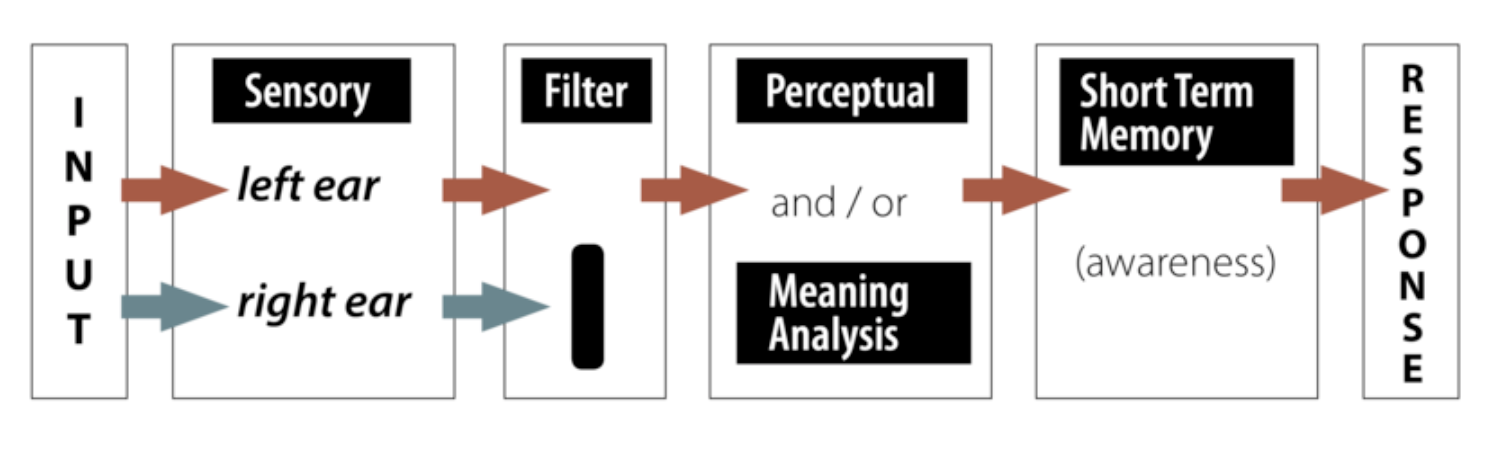
Two messages are presented simultaneously to an individual, with one message in each ear. In order to control which message the person attends to, the individual is asked to repeat back or “shadow” one of the messages as he hears it. People can become pretty good at the shadowing task, and they can easily report the content of the message that they attend to. In the figures below, the message they’re shadowing comes through the left ear and the unattended information is from the right ear.
What happens to the ignored message in a dichotic listening task?
Typically, people can tell you if the ignored message was a man’s or a woman’s voice, or other physical characteristics of the speech, but they cannot tell you what the message was about. Only the basic physical characteristics, such as the pitch of the unattended message, could be reported.
Broadbent’s Filter Model
This found that people select information on the basis of physical features; the sensory channel (or ear) that a message was coming in, the pitch of the voice, etc. but with no additional processing past this point.
People seemed vaguely aware of the physical features of the unattended information, but had no knowledge of the meaning
Broadbent argued that selection occurs very early with no additional processing for unselected information.
Treisman’s Attenuation Model
The fact that you tend to hear meaningful information even when you aren’t paying attention to it, suggests that we do monitor the unattended information to some degree on the basis of its meaning.
Treisman argues that selection begins at the physical or perceptual level but that the unattended information is not blocked completely, it’s just weakened or attenuated.

A late selection or response selection model
Suggests all information in the unattended ear is processed on the basis of meaning, not just the selected or highly pertinent information.
Only the information that is relevant for the task response gets into conscious awareness. This model is consistent with ideas of subliminal perception; that you don’t have to be aware of or attending a message for it to be fully processed for meaning.
