NEURO W1
 Call Kai
 Learn
Learn Practice Test
 Spaced Repetition
 Match
Match Flashcards
 Knowt Play
1/44

Earn XP
Description and Tags
Neurones, neuron physiology, CNS Embryology & Neurological Diagnosis
Name | Mastery | Learn | Test | Matching | Spaced | Call with Kai | Chat |
|---|
No analytics yet
Send a link to your students to track their progress
45 Terms
What are the 4 functional units of a neuron?
Cell body
Dendrite
Axon
Synapse
How signalling in a neuron work?
Cell fires action potential
Signal transmits down the neuron
Leads to release of neurotransmitter at synaptic cleft
What is the function of the myelin sheath?
Increase the speed of neuronal transmission
What sized fibres have a faster speed of conduction and are generally more brain friendly?
Large diameter fibres
What is the charge on the outside of a neuron?
Positive
What is the charge on the inside of a neuron?
Negative
What is responsible for the large amount of negative charge within a neuron?
Protein
What else besides protein maintains the electrical differential in a neuron?
Sodium Potassium pumps
What happens to a neuron if it synthesises less protein?
Will become more positive (closer to 0mV)
What is required for a neuron to produce energy?
Mitochondria
Protein replication
Gene expression
Fuel supply
Oxygen
What will failure to trigger gene expression and protein replication cause in the cell?
Cell will become closer toward 0mV electrical potential, causing it to spontaneously fire
Define Resting Membrane Potential
The sum of all excitatory and inhibitory influences on the neuron at a given moment
What is the standard Resting Membrane Potential (RMP) of a neuron?
-70mV
What does hyperpolarisation mean?
More inhibition/less excitation
What does hypopolarisation mean?
Less inhibition/more excitation
At what RMP will a neuron fire (depolarise)?
-55mV
What is long term potentiation?
The process of neuroplasticity
Building health and functional capacity within a neuron
Involves repeated firing through temporal and spatial summation which causes NMDA receptor activation
DNA transcription and protein synthesis occurs
What happens if long term potentiation doesn’t occur?
Replication process wont happen as much, causing dysfunction in the neuron
What happens if long term potentiation occurs in the “wrong” systems?
OCD. Failing to inhibit systems within the brain
What is the first 4 steps in the embryology of the nervous system?
Notochord, precursor of neural crest, precursor of neural tube formed
Precursor neural tube folds in on itself
Forms neural tube—> Precursor of CNS—> If no join happens=Spina Bifida
Neural crest cells migrate out to form the PNS
What will the Telencephalon become through embryology?
Rhinencephalon, amygdala, hippocampus, neocortex, basal ganglia, lateral ventricles
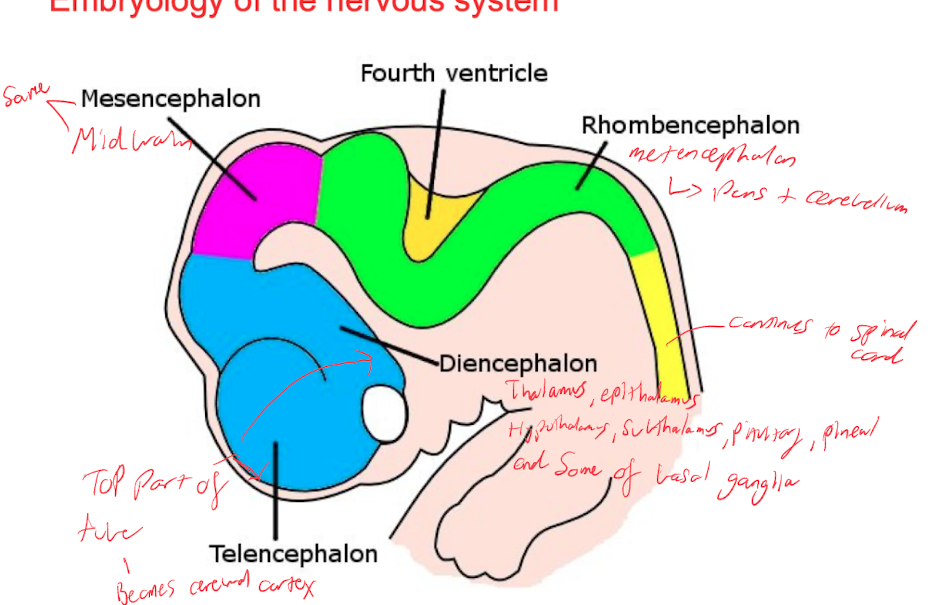
What will the Diencephalon become through embryology?
Epithalamus, thalamus, hypothalamus, subthalamus, pituitary gland, pineal gland, third ventricle
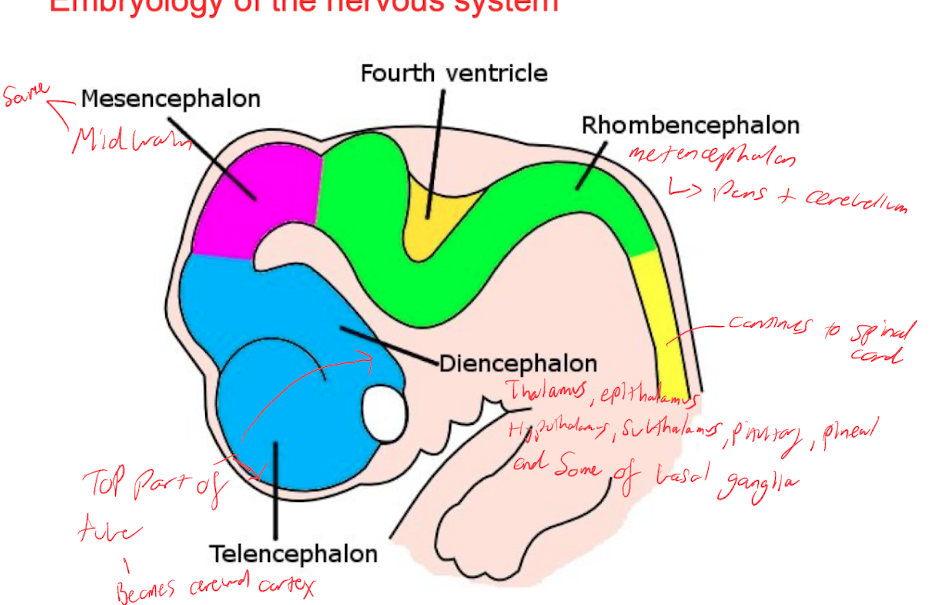
What will the Mesencephalon become through embryology?
Midbrain

What will the Rhombencephalon become through embryology?
Metencephalon→ Pons, cerebellum
Myelencephalon→ Medulla oblongata

What do Rostral and Caudal mean?
Superior and inferior
Depending on orientation, Rostral can mean ANT, Caudal can mean POST
What do Ventral and Dorsal mean?
Anterior and Posterior
What nerve fibre types are there, from fastest conducting to slowest?
Larger diameter:
Type Ia, Ib, II
Alpha motor neurons
A delta
Smaller diameter:
C fibres
What 7 levels of the nervous system are there to consider in the neurological differential diagnosis?
Effector/receptor/neurological junction
Peripheral nerve & nerve roots
Spinal cord
Brainstem
Cerebellum
Thalamus/Basal Ganglia
Cerebral cortex
What should you be thinking about when considering Effector/receptor/neurological junction differential diagnosis?
Receptor/neurological junction→ muscle spindle degeneration w/ age
Effector= gland or muscle→ output of nervous system
What should you be thinking about when considering Peripheral nerve & nerve root differential diagnosis?
Anatomy of the nerves and roots
Peripheral nerve→ thinking pain/temp fibres, changes in LDA fibres
Sensory loss will match dermatome
Motor loss will match myotome
What should you be thinking about when considering spinal cord differential diagnosis?
Sensory loss will not match particular dermatome or myotome
UMN/LMN
Consider distinctive pattern of loss due to involved tract
i.e. corticospinal→ hemiplegic signs, UMN signs ipsilateral to lesion
i.e. ANT spinothalamic tract→ P/T loss contralateral to lesion. POST→ light touch, proprioception, 2 point discrimination, vibration loss is all ipsilateral
What should you be thinking about when considering brainstem differential diagnosis?
Sensory and motor findings from long tract involvement (patterns differ to spinal cord)
Cranial nerve signs as well
IF spasticity one side of body and CN signs, you will not get CN signs from spinal cord lesion
What should you be thinking about when considering cerrebellum differential diagnosis?
Rhythm, coordination and timing changes
Assess through function tests→ Finger to nose, rapid alternating movements, nystagmus test
What should you be thinking about when considering thalamus/basal ganglia differential diagnosis?
Sensory and motor changes (non-dermatomal)
Hyperkinetic disorders (ballistic movements, dystonic posturing, ticks, myoclonic bradykinesia, rigidity, resting tremors)
What should you be thinking about when considering cerebral cortical differential diagnosis?
Consider the 4 lobes
Frontal→ problems with planning, decision making, motivation, speech
Parietal→ complex movements
Temporal→ Hearing, memory, smell, naming things, identifying objects, seizure type activity
Occipital- Vision
When assessing light touch for a patient, what neurological structure is being assessed?
Posterior columns
When assessing sharp touch for a patient, what neurological structure is being assessed?
Corticospinal tracts
Dermatomes- Upper limbs

Dermatomes- Lower limbs

List the upper and lower limb reflexes
C5- Biceps→ Elbow flexion
C6- Brachioradialis→ Elbow flexion
C7- Triceps→ Elbow extension
L4- Patella→ Knee extension
L5- Medial hamstring→ Knee flexion
S1- Achillies- Dorsiflexion
Please state all grades in the Muscle Stretch Reflex results
0= Absent (Possible LMN lesion)
1= Reduced (Possible LMN lesion
2= Normal
3= Increased (Hyper-reflexia)
4= Increased (Hyper-reflexia with clonus)
What does the positive test for clonus look like at the ankle?
Sustained beats (5 or more)
List the myotomes of the upper limb
C3 – neck lateral flexion
C4 – shoulder shrug
C5 - deltoid
C6 – Wrist extension
C7 – Wrist flexion
C8 – Finger abduction
List the myotomes for the lower limb
L2 – hip flexion
L3 – knee extension
L4– ankle dorsiflexion
L5 – big toe extension
S1 – ankle dorsiflexion
Please state all grades in recording muscle strength
0= Total paralysis, no evidence of contraction
1 (Trace)= Palpable/visible contraction (no joint movement)
2 (Poor)= Full ROM with gravity eliminated
3 (Fair)= Full ROM against gravity
4 (Good)= Full ROM against gravity with moderate resistance
5 (Normal)= Full ROM against gravity with full resistance